Mojito Sorbet
Sour lands before sweet, then the mint opens the whole mouth cold, and a faint warmth from the rum is the last thing to leave.
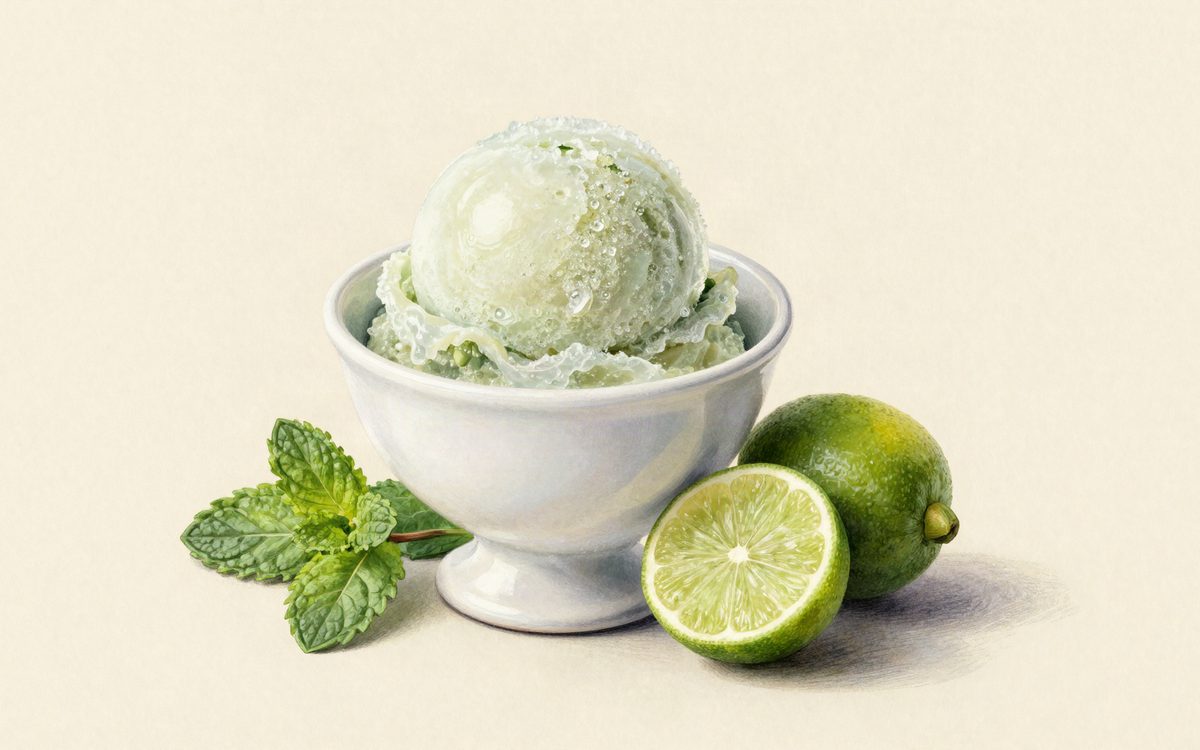
By the time it reaches the spoon it has already begun to soften, and it should: with no fat and no milk solids there is nothing to slow the melt, so the edges go liquid while the centre still holds. Sourness lands before sweetness and lands fast, because acid needs no fat to carry it. Then the mint opens the back of the mouth and keeps everything feeling colder than the freezer ever made it, which is why the herb stops at 30 g; in water, with nothing to mask it, menthol reads loud. What stays last is the rum, a faint warmth under the cold, and 4 g of carob seed flour is the only body on offer.
The usual rule of 350 to 650 g of fruit per kilo does not apply to citrus. Lime and lemon are used between 180 and 280 g/kg because pH 2.2 to 2.4 and the titratable acidity take over the palate long before the fruit takes over the solids. Two hundred grams of Tahitian lime is the classic lime sorbetto dose. Mint sits at 30 g, lower than in a mint gelato, since a water base has no fat to soften menthol and the same amount reads sharper.
Rum at 18 g is the dangerous lever and also the point of the recipe. It carries PAC 296, so those 18 g alone spend around 53 of the 340 points available to a sorbet, and that is exactly why a mojito sorbet never sets hard the way a plain lime sorbet does. The sugars then had to be chosen to pay for it: 135 g of sucrose, 25 g of dextrose and 120 g of glucose powder, the last one running POD 44 against PAC 72, which buys solids and sweetness without pushing the freezing point any further down. Final PAC 323.62.
Ingredients
Makes 1000 g of finished base.
| Ingredient | Grams | Home measure |
|---|---|---|
| Water | 454 | 2 cups |
| Tahitian Lime | 200 | |
| Sugar (Sucrose) | 135 | 2/3 cup |
| Glucose Powder | 120 | 1/2 cup plus 2 tablespoons |
| Mint | 30 | |
| Dextrose (Glucose) | 25 | 2 tablespoons |
| Rum | 18 | |
| Inulin (Vegetable Fiber) | 14 | |
| Carob Seed Flour | 4 |
Loads these exact grams into the free balancer, ready to edit.
Method
Hot syrup, cold pour, two stirs in a metal tray
- 1Whisk every dry ingredient together first: sugars, milk powder, stabiliser and salt. Dry-blending them stops the stabiliser clumping when it meets liquid.
- 2Warm the liquids to 40 C (104 F), then rain the dry mix in while whisking hard.
- 3Heat to 82 C (180 F) and hold for 2 minutes so the stabiliser hydrates.
- 4Chill in an ice bath to under 5 C (41 F) within 2 hours. Slow cooling is where bacteria and coarse crystals both start.
- 5Age 6 to 12 hours in the fridge under 5 C (41 F). This is when the stabiliser and the milk protein take up water.
- 6Freeze in a shallow metal pan 2 to 3 cm deep, breaking the crystals with a fork every 30 to 40 minutes, 4 to 6 times.
- 7Freeze firm, then temper 10 to 15 minutes in the fridge before scooping.
The balance
All six against the professional range for Sorbetto.
PAC 323.62 inside 280 to 340 is the number the whole sheet turns on, and the rum eats a large slice of it before any sugar is weighed. That is why the sugar is split three ways instead of being one sucrose line: glucose powder at POD 44 and PAC 72 adds 120 g of solids and body at a low antifreeze cost, dextrose adds 25 g of freezing point depression where it is wanted, and sucrose carries the rest. POD closes at 207.66, near the bottom of 200 to 270, which is the sweetness needed to hold 200 g of lime in check without the thing tasting like syrup. Solids land at 30.99 percent against 28 to 34, helped by 14 g of inulin that contributes body with no sweetness of its own, and sugars at 27.52 against 25 to 31. Water reads 68.41 against 66 to 72, fat 0.03 against a 1 percent ceiling and protein 0.20 against 1, both of which confirm this is a true sorbet rather than a lightened dairy base.
Estimated nutrition: ~124 kcal · Fat 0 g · Sugars 27.5 g · Protein 0.2 g (per 100 g of mix, from the balanced composition).
The order of addition is not negotiable here. Make the syrup first: water, sugars and carob seed flour taken to 85 C, because carob does not hydrate cold. Cool it down. Only then do the lime juice and the rum go in, both cold. Citrus juice heated with sucrose undergoes acid inversion, which raises PAC by an amount nobody counted and pushes the mix out of band, and it wrecks the fresh terpene aroma at the same time. The mint is infused in the syrup while it is warm rather than boiling, 10 to 15 minutes, and strained out before the juice goes in. Do not raise the rum: past roughly 25 g/kg the sorbet will not firm up at -12 C. An acid sorbet also refuses protein based stabilisers, they precipitate at this pH, which is the other reason the carob is there.
If it goes wrong
The lime juice was heated with the syrup. The terpenes went with the steam and the acid inverted part of the sucrose.
Take the syrup to 85 C on its own, cool it fully, and add the 200 g of lime juice and the 18 g of rum cold at the end.
The rum was poured rather than weighed. At PAC 296 it is the strongest antifreeze on the sheet and 18 g already spends around 53 of the 340 available points.
Weigh the rum to 18 g per kilo. Above roughly 25 g/kg no sugar adjustment on this sheet will make it set.
The carob seed flour was stirred in cold and never hydrated, so it contributed no viscosity to a mix that is 68.41 percent water.
Take the 4 g of carob to 85 C with the water and sugars, before anything acidic or alcoholic goes near it.
Suitable for: Vegan, Vegetarian, Lactose-free, Egg-free
Contains alcohol.
No ingredient in this recipe contains gluten.
- https://www.greatbritishchefs.com/recipes/mojito-sorbet-recipe
- https://www.waitrose.com/ecom/recipe/mint-mojito-sorbet
- https://www.certifiedpastryaficionado.com/mojito-sorbet/
- https://www.innovaitalia.com/en/lemon-sorbet-recipe/
- The science behind it: Alcohol in Gelato
- Ingredient sheet: Tahitian Lime
Want to change an ingredient and watch the numbers move? Open the free balancer