Mocha Gelato
Roast and cocoa arrive together without stacking up, milk rounds the middle, and a coffee bitterness stays on the palate long after the cold has gone.
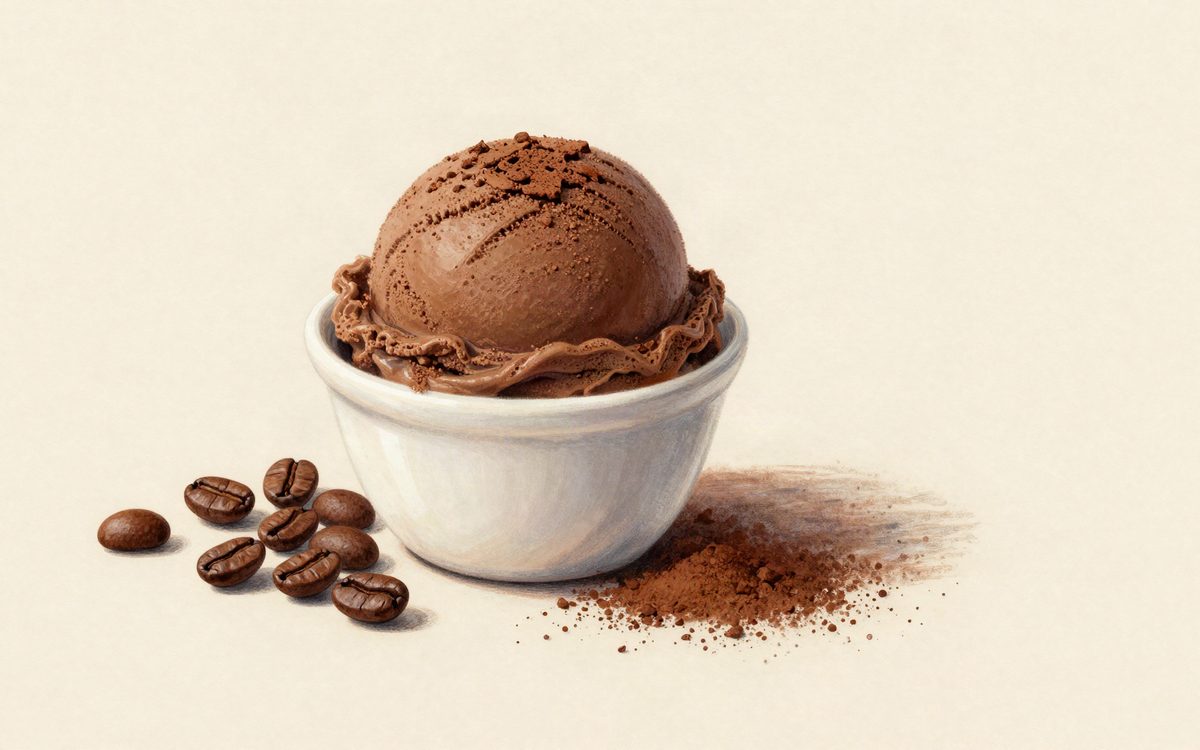
The habit behind this one is Italian: coffee taken seriously as coffee, then carried inside the gelato rather than served beside it. That is why the espresso goes in as espresso, 80 g per kilo with 4 g of instant coffee behind it for depth, instead of an extract standing in for the real thing. The rest of the balance is about keeping two bitter things from adding up. Cocoa sits at 40 g of powder plus 40 g of 70 percent chocolate, below what a straight chocolate gelato carries, because roast and astringency already occupy part of that space, and the cream is held back since cocoa butter turns up with the cocoa anyway.
The structural ingredient is the cocoa powder, not the chocolate. It is roughly 97 percent solids and 20 percent protein, so it draws on the total solids budget and the 5 percent protein ceiling at the same time, and it absorbs water greedily on top of that. Protein closes at 4.33 percent and the skim milk powder line stops at 32 g for exactly that reason. The 70 percent chocolate brings around 30 percent of its own weight as sugar, which is counted before any free sucrose is added.
Cream at 60 g looks thin for a chocolate base and it is meant to. Cocoa butter arrives from both cocoa sources, around 23 percent of the powder and 38 percent of the chocolate, so total fat closes at 6.62 percent, low in the 6 to 12 band. That is the design. A mocha carrying 10 or 11 percent fat coats the palate, and a coated palate reads the coffee as a background note instead of half the flavour.
Ingredients
Makes 1000 g of finished base.
| Ingredient | Grams | Home measure |
|---|---|---|
| Whole Milk | 574 | 2 1/3 cups |
| Sugar (Sucrose) | 120 | 1/2 cup plus 2 tablespoons |
| Espresso (Rich) | 80 | |
| Heavy Cream 35% | 60 | 1/4 cup |
| Dextrose (Glucose) | 45 | 1/4 cup |
| Cocoa Powder 22-24% | 40 | |
| Dark Chocolate 70% | 40 | |
| Skim Milk Powder | 32 | 1/3 cup |
| Instant Coffee | 4 | |
| Carob Seed Flour | 4 | |
| Salt | 1 |
Loads these exact grams into the free balancer, ready to edit.
Method
Twelve hour age, then shallow tray with three stirs
- 1Whisk every dry ingredient together first: sugars, milk powder, stabiliser and salt. Dry-blending them stops the stabiliser clumping when it meets liquid.
- 2Warm the liquids to 40 C (104 F), then rain the dry mix in while whisking hard.
- 3Heat to 82 C (180 F) and hold for 2 minutes so the stabiliser hydrates.
- 4Melt the chocolate to 45 C (113 F) and stir it into the hot base off the heat, then blend 60 seconds until glossy.
- 5Chill in an ice bath to under 5 C (41 F) within 2 hours. Slow cooling is where bacteria and coarse crystals both start.
- 6Age 6 to 12 hours in the fridge under 5 C (41 F). This is when the stabiliser and the milk protein take up water.
- 7Freeze in a shallow metal pan 2 to 3 cm deep, breaking the crystals with a fork every 30 to 40 minutes, 4 to 6 times.
- 8Freeze firm, then temper 10 to 15 minutes in the fridge before scooping.
The balance
All six against the professional range for Milk Gelato.
Fat at 6.62 percent and protein at 4.33 percent are the two numbers that fixed everything else. The fat sits low in the 6 to 12 band on purpose, since cocoa butter comes in from both cocoa sources and any extra cream would mute the coffee, which is why the cream line stops at 60 g against 574 g of whole milk. Protein at 4.33 against a 5 percent ceiling is the harder constraint: with cocoa powder at roughly 20 percent protein, 40 g of it plus 32 g of skim milk powder consumes most of the budget, and the powder line cannot rise without breaching it. Around those, 120 g of sucrose and 45 g of dextrose put PAC at 264.41 inside 220 to 300 and sugars at 17.39 inside 16 to 22, the chocolate contributing part of that sugar itself. POD reads 169.63 against 140 to 200, solids 38.25 against 36 to 42, MSNF 8.54 against 8 to 11.5, water 61.75 against 58 to 64. Lactose is 4.65 percent of the mix and 7.53 percent of the water.
Estimated nutrition: ~186 kcal · Fat 6.6 g · Sugars 17.4 g · Protein 4.3 g (per 100 g of mix, from the balanced composition).
Cocoa powder needs hot hydration to release its colour and aroma. Disperse it dry into the sugar, add that into the milk at about 45 C, then take the mix to 82 to 85 C and hold it there for one to two minutes. Skip this and the base tastes raw and looks dull. The 40 g of 70 percent chocolate should be melted and emulsified with a little of the hot base first, ganache fashion, before it goes back into the full volume, otherwise it grains. Coffee is last and cold. Watch the cumulative bitterness: cocoa tannins and the chlorogenic acids in coffee add up in perception, which is why the 1 g of salt is functional rather than decorative, it selectively suppresses bitter. Age a full 12 hours, because the cocoa keeps taking up water overnight and the viscosity of the mix changes while it sits.
If it goes wrong
The cocoa never reached hydration temperature. Below 82 C the starch in the powder does not swell and the aroma does not develop.
Disperse the 40 g of cocoa dry into the sugar, bring the mix to 82 to 85 C and hold it there for one to two minutes.
The 70 percent chocolate went straight into the full volume and seized instead of emulsifying.
Melt the chocolate, work a small amount of the hot base into it to form a smooth emulsion, then return that to the rest of the mix.
The salt was left out, or the cocoa was raised past 40 g. Cocoa tannins and coffee acids stack in perception.
Keep the 1 g of salt, it suppresses bitter selectively, and do not push the cocoa above the 40 g plus 40 g on this sheet.
Suitable for: Vegetarian, Egg-free
Allergens: milk
- https://www.saveur.com/article/Recipes/David-Lebovitzs-Mocha-Sherbet
- https://www.kingarthurbaking.com/recipes/mocha-madness-ice-cream-recipe
- https://theheritagecook.com/icy-cold-mocha-chocolate-gelato/
- https://foodnouveau.com/dark-chocolate-gelato/
- The science behind it: Gelato Total Solids
- Ingredient sheet: Espresso (Rich)
Want to change an ingredient and watch the numbers move? Open the free balancer