Mocha Chocolate Coffee Gelato
Roast and bitterness lead, cocoa fills in underneath, and the finish keeps the long, faintly acidic tail that properly extracted coffee leaves behind.
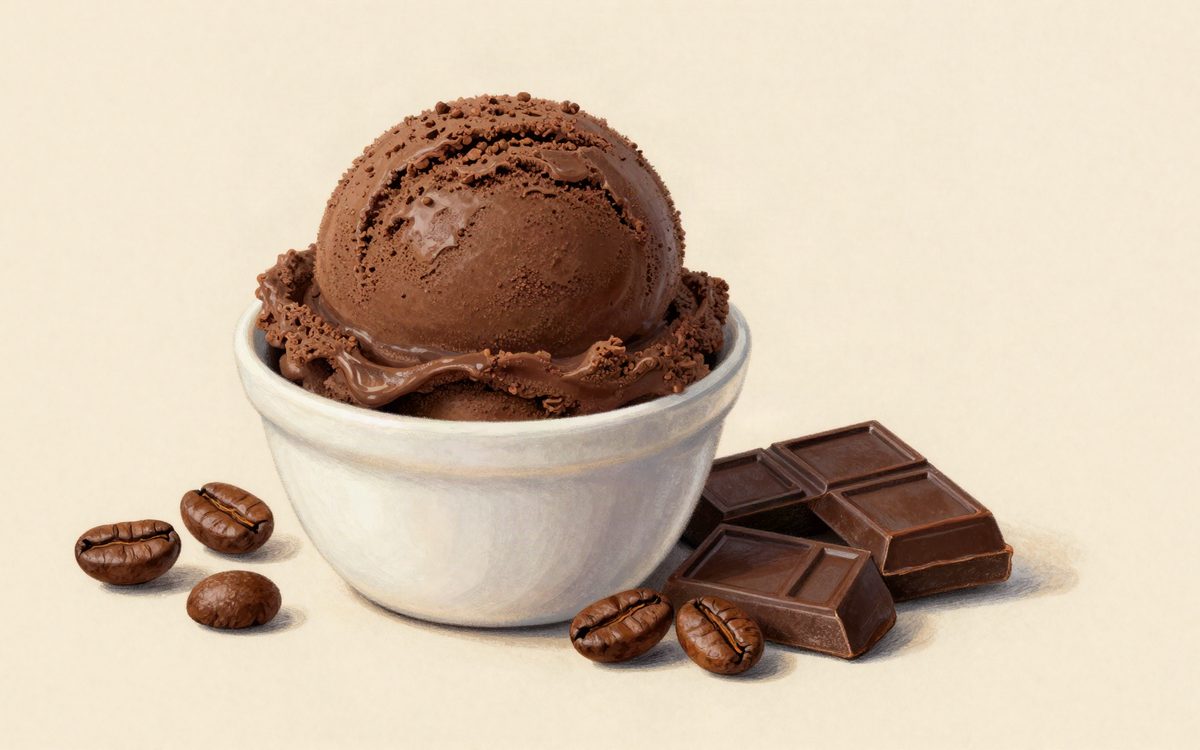
Behind this one there is Italian coffee, taken out of the cup and put inside a milk base, and the move is harder than it sounds: what makes espresso worth drinking is volatile, and pasteurisation strips it. So the coffee goes in twice. Ninety grams of concentrated espresso per kilo, about three shots, bring the aromatics, the acidity and the body of freshly pulled coffee. Five grams of instant bring the roasted weight that survives the pot. Cocoa is deliberately kept low, 45 g of powder and 45 g of chocolate at 70 percent, because more of it would bury the acidity that makes this taste of coffee rather than of chocolate with a hint of it.
The espresso is not free on the water line. Those 90 g carry about 81 g of water with them, and that water has to come out of the milk. It is why the whole milk line reads 577 g rather than the 650 or 700 g a plain chocolate sheet would carry, and it is why water still closes at 61.45 percent, sitting inside the 58 to 64 band instead of above it.
The cocoa was held back on purpose. Forty five grams of 22 to 24 percent powder plus 45 g of 70 percent chocolate is less than a straight chocolate gelato carries, because in a mocha the coffee co signs the flavour rather than decorating it, and too much cocoa flattens the acidity that makes the coffee legible. There is a structural reason as well: cocoa powder runs around 20 percent protein, so 45 g of it alongside 33 g of skim milk powder already brings protein to 4.48 percent against a 5 percent ceiling.
Ingredients
Makes 1000 g of finished base.
| Ingredient | Grams | Home measure |
|---|---|---|
| Whole Milk | 577 | 2 1/3 cups |
| Sugar (Sucrose) | 120 | 1/2 cup plus 2 tablespoons |
| Espresso (Rich) | 90 | |
| Cocoa Powder 22-24% | 45 | |
| Dark Chocolate 70% | 45 | |
| Dextrose (Glucose) | 45 | 1/4 cup |
| Heavy Cream 35% | 35 | 2 1/2 tablespoons |
| Skim Milk Powder | 33 | 1/3 cup |
| Instant Coffee | 5 | |
| Carob Seed Flour | 4 | |
| Salt | 1 |
Loads these exact grams into the free balancer, ready to edit.
Method
Espresso stirred in cold, then shallow tray with four stirs
- 1Whisk every dry ingredient together first: sugars, milk powder, stabiliser and salt. Dry-blending them stops the stabiliser clumping when it meets liquid.
- 2Warm the liquids to 40 C (104 F), then rain the dry mix in while whisking hard.
- 3Heat to 82 C (180 F) and hold for 2 minutes so the stabiliser hydrates.
- 4Melt the chocolate to 45 C (113 F) and stir it into the hot base off the heat, then blend 60 seconds until glossy.
- 5Chill in an ice bath to under 5 C (41 F) within 2 hours. Slow cooling is where bacteria and coarse crystals both start.
- 6Age 6 to 12 hours in the fridge under 5 C (41 F). This is when the stabiliser and the milk protein take up water.
- 7Freeze in a shallow metal pan 2 to 3 cm deep, breaking the crystals with a fork every 30 to 40 minutes, 4 to 6 times.
- 8Freeze firm, then temper 10 to 15 minutes in the fridge before scooping.
The balance
All six against the professional range for Milk Gelato.
Two numbers set the shape of this sheet. Fat reads 6.06 percent, just above the floor of the 6 to 12 band, and the cream line is only 35 g: the 45 g of 70 percent chocolate already brings cocoa butter, and 90 g of espresso occupies volume that would otherwise be dairy. PAC lands at 266.12, mid range in 220 to 300, split 120 g of sucrose against 45 g of dextrose. That split matters more here than in a dairy only base, because cocoa solids contribute no antifreeze at all, so a cocoa heavy mix carried by sucrose alone freezes solid in a domestic freezer. Everything else falls in around those two: solids 38.55 against 36 to 42, sugars 17.56 against 16 to 22, POD 171.29 against 140 to 200, MSNF 8.52 against 8 to 11.5, protein 4.48 against 3 to 5, water 61.45 against 58 to 64. Lactose comes to 4.64 percent of the mix and 7.56 percent of the water, under the level where lactose crystals turn the texture sandy.
Estimated nutrition: ~184 kcal · Fat 6.1 g · Sugars 17.6 g · Protein 4.5 g (per 100 g of mix, from the balanced composition).
What is specific to this flavour is that espresso aromatics are volatile and pasteurisation destroys them. Pasteurise the base with the cocoa and the 5 g of instant coffee inside, since both take heat, and add the espresso once the mix is cold, at the end of ageing. If the espresso boils with the base, only the bitter fraction survives. Acidity is the second issue: espresso sits at pH 4.8 to 5.2 and you are putting 90 g of it into a dairy base, so it goes in cold, in a thin stream, while you stir. Poured all at once into a hot base it can curdle the casein. Third, the water in coffee counts as free water and it freezes, so do not swap the concentrate for ordinary drip coffee without redoing the arithmetic: drip runs about 2 percent solids against 10 percent for the concentrate, and the batch comes out icy and hard. Age 6 to 12 hours at 4 C.
If it goes wrong
The espresso was pasteurised with the base. Its aromatics are volatile and heat drives them off, leaving the bitter fraction behind.
Heat only the cocoa and the 5 g of instant coffee with the mix. Stir the 90 g of espresso in after the base is cold, at the end of ageing.
Espresso at pH 4.8 to 5.2 met a hot dairy base. At 90 g per kilo that is enough acid load to break the casein.
Chill the base to 4 C first, then pour the espresso in as a thin stream while stirring, never in one go.
Drip coffee replaced the concentrated espresso. Drip carries around 2 percent solids against 10 percent, so 90 g brought water and almost no solids.
Use a genuinely concentrated espresso. If you only have drip, rebalance the solids and the water lines before you brew.
Suitable for: Vegetarian, Egg-free
Allergens: milk
- https://www.thehungrybites.com/chocolate-coffee-ice-cream/
- https://www.kingarthurbaking.com/recipes/mocha-madness-ice-cream-recipe
- https://icecreamcalc.com/2021/03/12/chocolate-gelato/
- https://icecreamcalc.com/knowledge-base/balancing/
- The science behind it: Gelato Total Solids
- Ingredient sheet: Espresso (Rich)
Want to change an ingredient and watch the numbers move? Open the free balancer