Mixed Berry Milk Gelato
Acidity lands first and bright, the dairy catches it halfway through, and a red fruit sourness hangs about long after the spoon is empty.
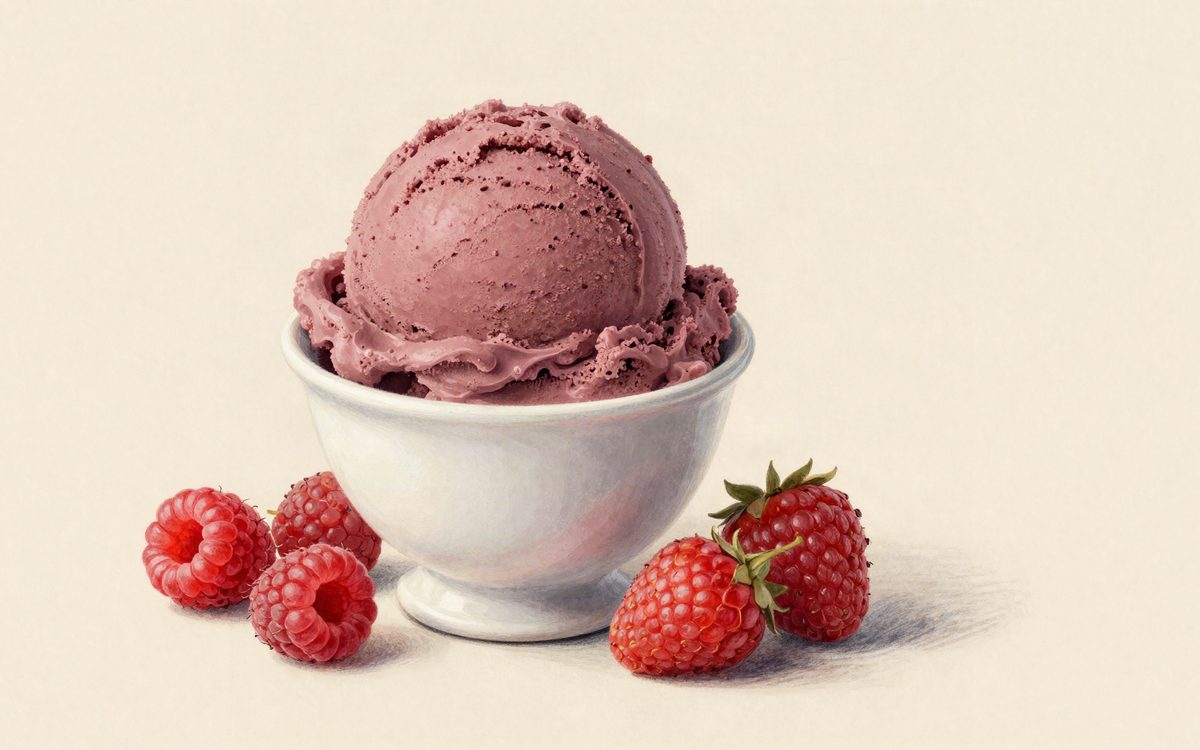
Eat it straight from the machine and the order never changes: acid first, quick and sharp at the tip of the tongue, then a beat later the dairy arrives and takes the edge off, and only at the end does the fruit return as a long, faintly jammy sourness. The body underneath sits between a sorbet and a cream gelato, softer than one and firmer than the other, and that is what the powders buy. Fruit at 270 g per kilo walks in with 237 g of water, and without 60 g of glucose powder and 50 g of milk powder rebuilding the dry matter the same spoon would read icy and thin, all acid with nothing to land on.
So the formula is really an exercise in rebuilding. Non-fat dry milk at 50 g and glucose powder at 60 g put dry matter back, and total solids finish at 36.72% against a 32 floor, with water at 63.28% against a 68 ceiling. Skip that rebuilding and the tub freezes hard with large crystals, because there is simply too much free water for the mix to hold.
The sugar architecture is the decisive lever. The fruit itself contributes only about 30 of PAC, so sucrose at 110 g and dextrose at 15 g have to lift PAC to 261.83 while POD stays at 172.46. Glucose powder is the piece that makes both possible at once: it adds solids with modest sweetening power, so the extract closes without the gelato tasting like syrup.
The 6 g of lemon juice standardise acidity, which in a mixed berry base swings a lot depending on how much strawberry, sweet and low in acid, is in the mix against blackberry or currant.
Ingredients
Makes 1000 g of finished base.
| Ingredient | Grams | Home measure |
|---|---|---|
| Whole Milk | 340 | 1 1/2 cups |
| Mixed Red Berries | 270 | |
| Heavy Cream 35% | 145 | 1/2 cup plus 2 tablespoons |
| Sugar (Sucrose) | 110 | 1/2 cup plus 1 tablespoon |
| Glucose Powder | 60 | 1/4 cup plus 1 tablespoon |
| Non-Fat Dry Milk | 50 | 1/2 cup plus 1 tablespoon |
| Dextrose (Glucose) | 15 | 1 1/2 tablespoons |
| Lemon Juice | 6 | |
| Stabilizer (Neutral) | 3 | |
| Salt | 1 |
Loads these exact grams into the free balancer, ready to edit.
Method
Matured milk base, cold raw berry puree folded in
- 1Whisk every dry ingredient together first: sugars, milk powder, stabiliser and salt. Dry-blending them stops the stabiliser clumping when it meets liquid.
- 2Warm the liquids to 40 C (104 F), then rain the dry mix in while whisking hard.
- 3Heat to 82 C (180 F) and hold for 2 minutes so the stabiliser hydrates.
- 4Chill in an ice bath to under 5 C (41 F) within 2 hours. Slow cooling is where bacteria and coarse crystals both start.
- 5Age 6 to 12 hours in the fridge under 5 C (41 F). This is when the stabiliser and the milk protein take up water.
- 6Fold the fruit in cold, after ageing. Heating it costs you the fresh aroma and nothing is gained.
- 7Freeze in a shallow metal pan 2 to 3 cm deep, breaking the crystals with a fork every 30 to 40 minutes, 4 to 6 times.
- 8Freeze firm, then temper 10 to 15 minutes in the fridge before scooping.
The balance
All six against the professional range for Milk Gelato with Fruit.
PAC 261.83 sits low in the 240 to 310 window for a milk gelato with fruit, and that number is doing more work here than in a plain milk gelato because the mix carries 63.28% water. Total sugars land at 19.7% inside a 17 to 25 range, the range a milk and fruit base runs on, and POD at 172.46 against 150 to 230 keeps the fruit acid readable instead of buried. Fat finishes at 6.32% inside 3.5 to 8, on 145 g of cream, low enough that the berries stay bright. MSNF at 8.66% inside 5 to 9.5 and protein at 3.5% inside 2 to 4.5 both come from the 50 g of milk powder plus 340 g of whole milk. Lactose lands at 7.46% of the water phase, safely under the sandiness threshold.
Estimated nutrition: ~178 kcal · Fat 6.3 g · Sugars 19.7 g · Protein 3.5 g (per 100 g of mix, from the balanced composition).
Standardise your blend before you weigh anything, because the proportion between the berries changes the real balance. A stable working ratio is 40% strawberry, 25% raspberry, 20% blackberry and 15% blueberry, which keeps solids near the 12% the formula assumes. Sieve to remove raspberry and blackberry seeds. If you use a frozen mix, thaw it under refrigeration and include the released liquid, since that liquid carries the sugar and acid the balance counted. The puree goes in raw and cold, into an already matured base. The point of attention that belongs to this flavour is colour: anthocyanins from different berries shift to different tones once they meet milk, and without the lemon acid the mix drifts toward a greyish pink. Do not correct colour by adding more fruit. Correct it with acidity.
If it goes wrong
Anthocyanins losing colour at the pH of the milk base.
Keep the 6 g of lemon juice per kilo and add it with the puree. Adding more fruit makes the water problem worse without fixing the colour.
Total solids fell under the 32 floor, usually because the glucose powder or the milk powder was reduced while the fruit stayed at 270 g.
Keep 60 g of glucose powder and 50 g of non-fat dry milk. They are what holds 36.72% solids against 237 g of incoming fruit water.
The berry proportions drifted, and strawberry and blackberry are very far apart in both sugar and acid.
Fix the blend at 40 / 25 / 20 / 15 strawberry, raspberry, blackberry, blueberry and weigh each one.
Suitable for: Vegetarian, Egg-free
Allergens: milk
- Corvitto, A. - Los secretos del helado: el helado sin secretos, Vilbo, 2004 (reconstrucao de solidos em frutas aguadas)
- Goff, H.D.; Hartel, R.W. - Ice Cream, 7a ed., Springer, 2013 (agua congelavel, tamanho de cristal e extrato seco)
- USDA FoodData Central - composicao de frutas vermelhas (morango, framboesa, amora) (https://fdc.nal.usda.gov)
- Caviezel, L. - Scienza e tecnologia del gelato artigianale, Chiriotti Editori (frutti di bosco em base leite)
- The science behind it: Why Acidic Fruit Curdles Dairy Gelato, and How to Stop It
- Ingredient sheet: Mixed Red Berries
Want to change an ingredient and watch the numbers move? Open the free balancer