Mint Chocolate Chip Gelato
Cooling green lift first, then hard flakes that snap under the teeth and melt down into a bitterness sitting where the mint has just been.
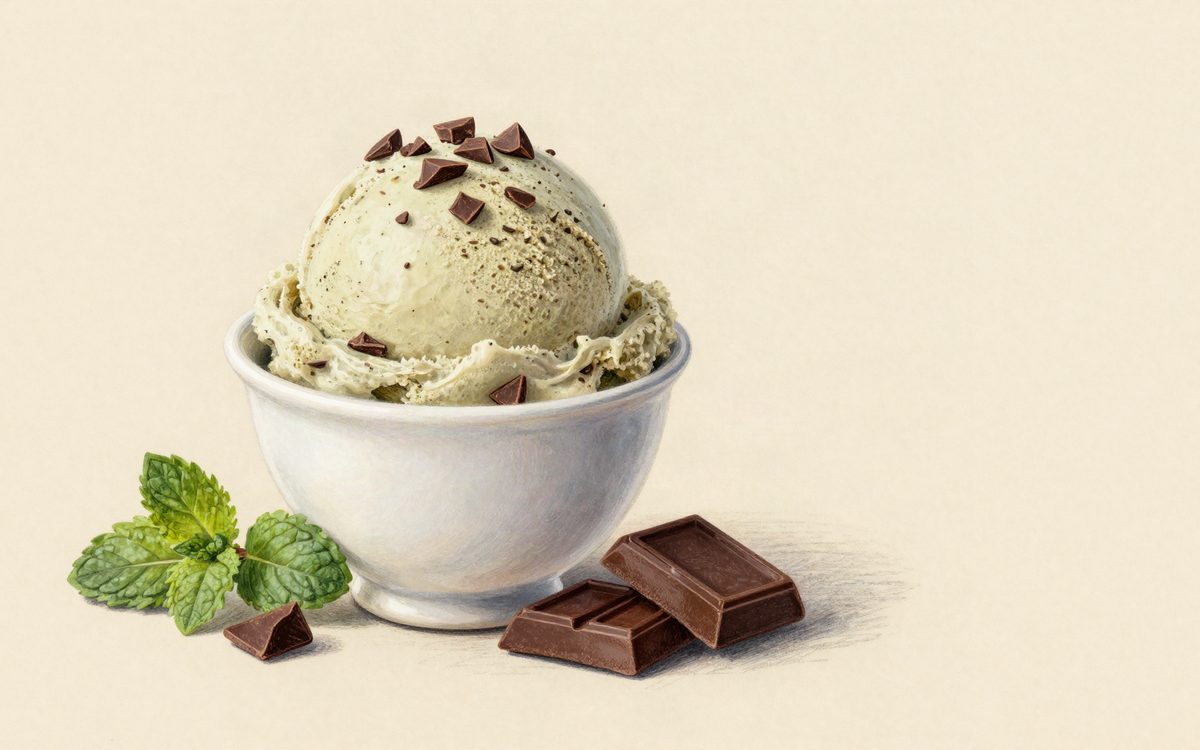
Both halves of this shopping list punish a bad choice, in opposite ways. Fresh leaf is bought for aroma and nothing else: 35 g per kilo steeps in hot milk, gives up its menthol and chlorophyll, then leaves in the strainer, so tired mint simply hands over less and there is no topping it up later. Chocolate is a real ingredient here at 90 g per kilo, and the ingredient list is worth reading before it goes in the basket. A 70% bar with cocoa butter as its only fat sets hard and shatters into fine flakes as it is drizzled into the churn. One cut with other fats stays soft and smears through the mix instead of snapping.
The chocolate is the stracciatella phase, 90 g per kilo of dark 70%, inside the classic 70 to 100 range. It is not neutral in the maths: those 90 g bring 34 g of fat and 27 g of sugar per kilo, and the balance subtracts both from the added levers, which is why cream stops at 80 g and skim milk powder at 30 g.
Because mint competes for nothing, all eight indicators here have slack rather than sitting pressed against a wall. Fat at 8.41% against 6 to 12, MSNF at 8.78% against 8 to 11.5, protein at 4.0% against 3 to 5. The one real trap has nothing to do with the ingredient list: when you strain the leaves you remove mass that the balance already counted, so you have to weigh the strained base and put the difference back.
Ingredients
Makes 1000 g of finished base.
| Ingredient | Grams | Home measure |
|---|---|---|
| Whole Milk | 610 | 2 1/2 cups |
| Sugar (Sucrose) | 105 | 1/2 cup plus 1 tablespoon |
| Dark Chocolate 70% | 90 | |
| Heavy Cream 35% | 80 | 1/3 cup |
| Dextrose (Glucose) | 45 | 1/4 cup |
| Mint | 35 | |
| Skim Milk Powder | 30 | 1/4 cup plus 1 tablespoon |
| Carob Seed Flour | 4 | |
| Salt | 1 |
Loads these exact grams into the free balancer, ready to edit.
Method
Whole leaf infusion off the heat, chocolate drizzled in at the end
- 1Whisk every dry ingredient together first: sugars, milk powder, stabiliser and salt. Dry-blending them stops the stabiliser clumping when it meets liquid.
- 2Warm the liquids to 40 C (104 F), then rain the dry mix in while whisking hard.
- 3Heat to 82 C (180 F) and hold for 2 minutes so the stabiliser hydrates.
- 4Melt the chocolate to 45 C (113 F) and stir it into the hot base off the heat, then blend 60 seconds until glossy.
- 5Chill in an ice bath to under 5 C (41 F) within 2 hours. Slow cooling is where bacteria and coarse crystals both start.
- 6Age 6 to 12 hours in the fridge under 5 C (41 F). This is when the stabiliser and the milk protein take up water.
- 7Freeze in a shallow metal pan 2 to 3 cm deep, breaking the crystals with a fork every 30 to 40 minutes, 4 to 6 times.
- 8Freeze firm, then temper 10 to 15 minutes in the fridge before scooping.
The balance
All six against the professional range for Milk Gelato.
PAC finishes at 263.62 in a 220 to 300 window and POD at 168.52 in a 140 to 200 window, reached with 105 g of sucrose and 45 g of dextrose per kilo. That dextrose share is what keeps the base soft enough to scoop around hard chocolate flakes, which is a texture problem specific to this flavour: a stiff base plus brittle chocolate reads as gritty rather than as stracciatella. Fat at 8.41% is the sum of 80 g of cream and the 34 g the chocolate donates. MSNF sits at 8.78%, just above the 8 floor, on only 30 g of skim milk powder, and lactose ends at 7.74% of the water phase. Total solids 38.21% inside 36 to 42, with 610 g of whole milk carrying the base.
Estimated nutrition: ~195 kcal · Fat 8.4 g · Sugars 17.3 g · Protein 4 g (per 100 g of mix, from the balanced composition).
Two things here are unlike any other gelato. First, the infusion is strained, and straining is a balancing event. Pasteurize at 82 to 85 C, take the pot off the heat, add the leaves whole rather than chopped, cover, wait 30 minutes and strain. Then weigh the strained base and top it back up with whole milk to the weight you started with, otherwise all eight indicators shift. Never let the leaves boil: above 90 C chlorophyll converts to pheophytin and the colour drops from green to olive. Second, the chocolate does not go into the mix. Melt it to 40 to 45 C and drizzle it in a thin stream during the last 2 minutes of churning, where the cold shatters it into flakes. Its 34 g of fat are counted in the total, but because it sits as a separate solid phase it does not depress the freezing point the way the calculation assumes, so the tub comes out about a degree firmer than PAC 263.62 suggests. Serve at minus 12 C.
If it goes wrong
The leaves were boiled or chopped. Above 90 C chlorophyll becomes pheophytin, and cut leaf oxidises.
Infuse whole leaves off the heat, covered, for 30 minutes, then strain.
It was too cool when poured, or it went in too fast and in too thick a stream.
Hold it at 40 to 45 C and pour it in a thin thread over the last 2 minutes of churning.
Mass was lost in the strainer and never replaced, so every indicator drifted from the balanced figures.
Weigh the base after straining and add whole milk back until it matches the pre infusion weight.
Suitable for: Vegetarian, Egg-free
Allergens: milk
- https://www.recipesfromitaly.com/stracciatella-gelato/
- https://www.greatitalianchefs.com/recipes/stracciatella-gelato-recipe
- https://honest-food.net/mint-leaf-ice-cream-recipe/
- https://icecreamcalc.com/knowledge-base/balancing/
- The science behind it: Chocolate Chips Too Hard in Gelato
- Ingredient sheet: Dark Chocolate 70%
Want to change an ingredient and watch the numbers move? Open the free balancer