Milk Chocolate Gelato
Milky sweetness at the front, a toasted cocoa shadow underneath it, and a fat-coated finish that keeps going long after the spoon is empty.
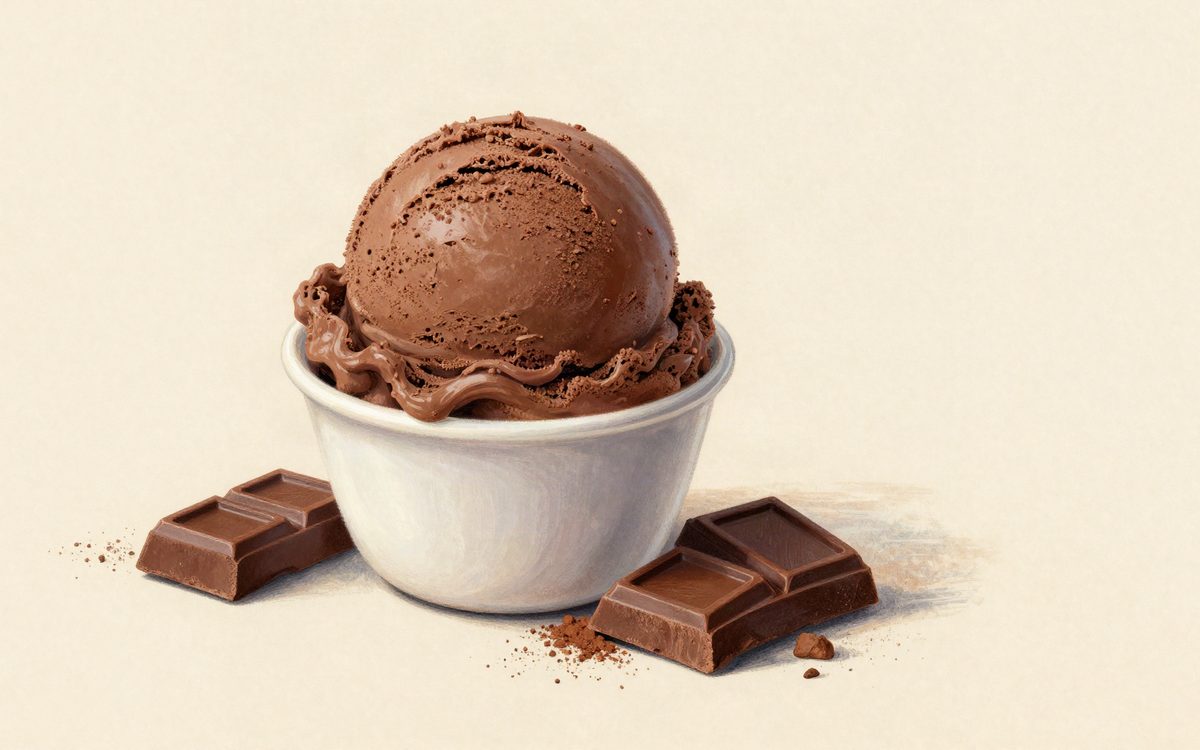
Because only 40% of a milk chocolate bar is cocoa, it has to go in heavy for the flavour to read as chocolate at all, and that makes the wrapper worth reading. A proper couverture lists cocoa butter among its fats and nothing else, while the cheaper bar carries palm or shea fractions; at 180 g/kg you are pouring 180 g of somebody else's recipe into yours, sugar, fat and milk solids included. Check where sugar sits in the list too, because a bar that leads with it will push the mix sweet before you have added a gram. The 10 g of cocoa powder is not there for bitterness, but for colour depth and a roasted floor the milk bar cannot reach alone.
That inverts the usual balancing logic. Added sucrose becomes a small lever, 80 g here, and non-fat dry milk is almost switched off at 8 g, because the chocolate is already supplying both. What is left to steer with is the ratio between whole milk and skim milk, 300 g against 388 g, and that is the dial that lands fat at 8.53% inside a 6 to 12 window.
The 10 g of cocoa powder are not there to make it bitter. They are there for colour depth and for a roasted back note that milk chocolate on its own does not have. MSNF finishes at 10.02% against 8 to 11.5, and lactose reaches 8.8% of the water phase, which is the single number this formula is most constrained by.
Ingredients
Makes 1000 g of finished base.
| Ingredient | Grams | Home measure |
|---|---|---|
| Skim Milk | 388 | 1 2/3 cups |
| Whole Milk | 300 | 1 1/4 cups |
| Milk Chocolate 40% | 180 | |
| Sugar (Sucrose) | 80 | 1/3 cup plus 1 tablespoon |
| Dextrose (Glucose) | 30 | 2 1/2 tablespoons |
| Cocoa Powder 22-24% | 10 | |
| Non-Fat Dry Milk | 8 | 1 1/2 tablespoons |
| Stabilizer (Neutral) | 3 | |
| Salt | 1 |
Loads these exact grams into the free balancer, ready to edit.
Method
Dairy pasteurized alone, chocolate melted in off the heat
- 1Whisk every dry ingredient together first: sugars, milk powder, stabiliser and salt. Dry-blending them stops the stabiliser clumping when it meets liquid.
- 2Warm the liquids to 40 C (104 F), then rain the dry mix in while whisking hard.
- 3Heat to 82 C (180 F) and hold for 2 minutes so the stabiliser hydrates.
- 4Melt the chocolate to 45 C (113 F) and stir it into the hot base off the heat, then blend 60 seconds until glossy.
- 5Chill in an ice bath to under 5 C (41 F) within 2 hours. Slow cooling is where bacteria and coarse crystals both start.
- 6Age 6 to 12 hours in the fridge under 5 C (41 F). This is when the stabiliser and the milk protein take up water.
- 7Freeze in a shallow metal pan 2 to 3 cm deep, breaking the crystals with a fork every 30 to 40 minutes, 4 to 6 times.
- 8Freeze firm, then temper 10 to 15 minutes in the fridge before scooping.
The balance
All six against the professional range for Milk Gelato.
PAC lands at 260.91 in a 220 to 300 window and POD at 176.46 in a 140 to 200 window, and both are reached with only 80 g of sucrose and 30 g of dextrose, because 68 g of sugar arrived free inside the chocolate. Total solids finish at 37.98% against 36 to 42, again mostly donated rather than added. Protein sits at 3.88% in a 3 to 5 range, kept there by leaning on skim milk at 388 g rather than on milk powder. The binding constraint is lactose at 8.8% of the water phase: milk chocolate carries 16 to 17% of its own weight as milk solids, so the added non-fat dry milk has to stop at 8 g per kilo or the lactose crystallises in storage and the spoon starts to feel sandy. That single ceiling explains why this base looks so lightly dosed on paper.
Estimated nutrition: ~195 kcal · Fat 8.5 g · Sugars 17.6 g · Protein 3.9 g (per 100 g of mix, from the balanced composition).
The risk that defines this flavour is sandiness from lactose, not ice crystals. Beyond that, the order of operations decides whether it tastes clean or cooked. Pasteurize only the dairy portion, at 80 to 82 C, then pull it off the heat and melt the 180 g of milk chocolate in at 60 to 65 C. The milk protein already inside the chocolate has been heat treated once at the factory, and taking it to 85 C a second time gives a boiled, caramel-adjacent note that flattens the cocoa. Do not add any acid to this base. Serve at minus 12 C: milk chocolate sets harder than dark at the same temperature because of the milk fat it carries.
If it goes wrong
The chocolate was added to the pot and taken to pasteurizing temperature, denaturing its milk protein a second time.
Pasteurize the dairy alone at 80 to 82 C, take it off the heat, and stir the chocolate in once the mix has fallen to 60 to 65 C.
Lactose crystallising. This mix already runs at 8.8% lactose in the water phase before any extra powder.
Keep non-fat dry milk at 8 g per kilo. Do not top it up to thicken the base, use the 3 g of neutral stabilizer that is already in the formula.
Milk fat from the couverture sets firmer than cocoa butter alone, even at the same PAC 260.91.
Serve at minus 12 C and give the tub a few minutes of tempering before scooping.
Suitable for: Vegetarian, Egg-free
Allergens: milk
- https://icecreamcalc.com/2021/03/12/chocolate-gelato/
- https://www.recipesfromitaly.com/chocolate-gelato-recipe/
- https://www.gavinpublishers.com/article/view/functional-gelato-how-to-reduce-the-excessive-amount-of-added-sugars-while-still-maintaining--the-perfect-taste
- The science behind it: Milk vs Dark Chocolate in Gelato
- Ingredient sheet: Milk Chocolate 40%
Want to change an ingredient and watch the numbers move? Open the free balancer