Mascarpone Gelato
The tang of fresh curd sits under the sugar, the body is thick without turning greasy, and the finish clears the mouth instead of coating it.
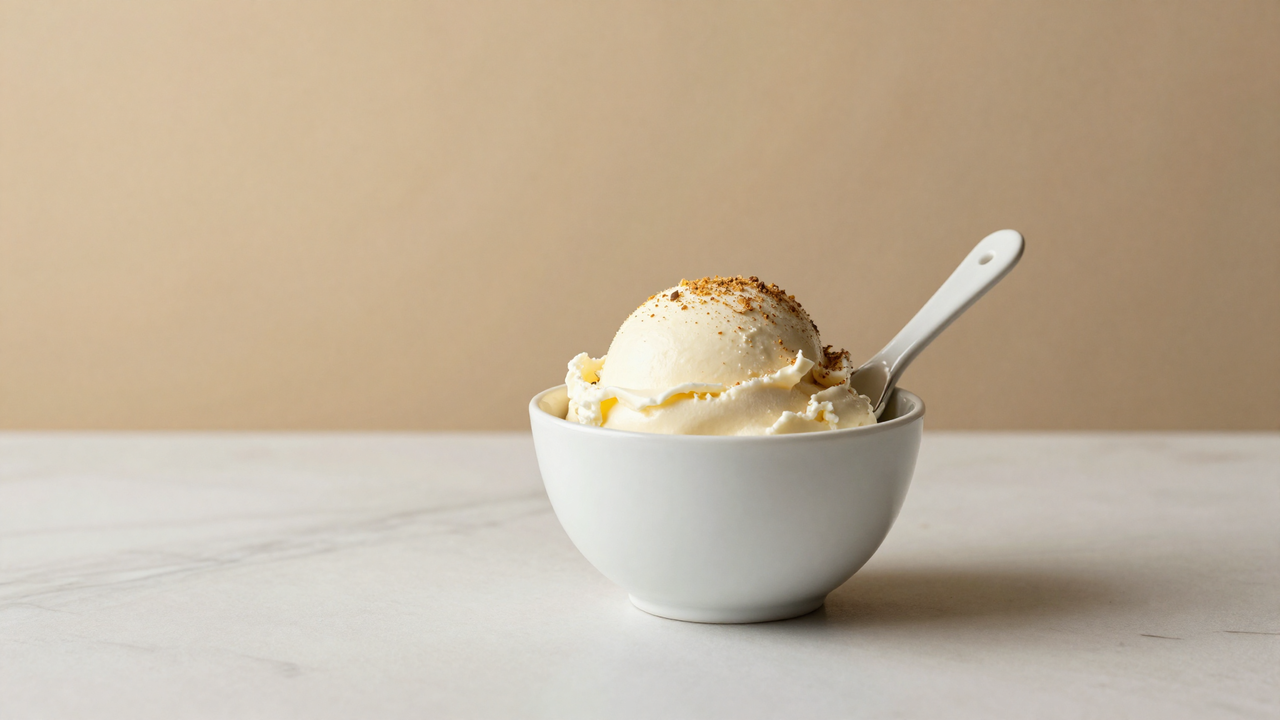
What goes wrong with this one at home is usually generosity. The cheese is 44 percent fat, so the instinct to add another spoonful for more flavour walks the mix past its fat limit, and what comes out coats the palate, melts slowly and tastes of butter instead of fresh curd. The sheet stops at 200 g per kilo, a little under the range Italian shops work in, which puts fat at 10.88 percent against a 12 percent ceiling. Cream is reduced to a marginal adjustment, skimmed milk powder does the structural work, and 3 g of lemon zest keeps the whole thing from reading heavy.
The knock on effect shows up as an absence. Cream is capped at 50 g per kilo on this sheet instead of the 200 g other flavours allow, and in the end it is not in the list at all: here cream would be a fat problem, not a fat lever. The MSNF lever is skim milk powder, 30 g of it, because mascarpone only carries about 9.5 percent MSNF and 4.8 percent protein, which is very little for a 200 g dose. MSNF closes at 10.02 percent and protein at 3.96.
The last three grams matter more than their weight suggests. Lemon zest at 3 g per kilo comes straight from pastry practice with mascarpone: citric acidity cuts the fat sensation on the tongue and keeps the gelato from reading heavy. Vanilla stays low, just to round the edges. Carob seed flour drops to 3 g, because 10.88 percent fat already provides body and too much hydrocolloid in a fat rich base turns the texture gummy. Sugars close at 17.19 percent and PAC at 261.37.
Ingredients
Makes 1000 g of finished base.
| Ingredient | Grams | Home measure |
|---|---|---|
| Whole Milk | 585 | 2 1/2 cups |
| Mascarpone | 200 | |
| Sugar (Sucrose) | 135 | 2/3 cup |
| Dextrose (Glucose) | 40 | 3 1/2 tablespoons |
| Skim Milk Powder | 30 | 1/4 cup plus 1 tablespoon |
| Lemon Zest | 3 | |
| Vanilla Extract | 3 | |
| Carob Seed Flour | 3 | |
| Salt | 1 |
Loads these exact grams into the free balancer, ready to edit.
Method
Blend the cheese in at 40 C, then chilled tray, worked fast
- 1Whisk every dry ingredient together first: sugars, milk powder, stabiliser and salt. Dry-blending them stops the stabiliser clumping when it meets liquid.
- 2Warm the liquids to 40 C (104 F), then rain the dry mix in while whisking hard.
- 3Heat to 82 C (180 F) and hold for 2 minutes so the stabiliser hydrates.
- 4Chill in an ice bath to under 5 C (41 F) within 2 hours. Slow cooling is where bacteria and coarse crystals both start.
- 5Age 6 to 12 hours in the fridge under 5 C (41 F). This is when the stabiliser and the milk protein take up water.
- 6Fold the fruit in cold, after ageing. Heating it costs you the fresh aroma and nothing is gained.
- 7Freeze in a shallow metal pan 2 to 3 cm deep, breaking the crystals with a fork every 30 to 40 minutes, 4 to 6 times.
- 8Freeze firm, then temper 10 to 15 minutes in the fridge before scooping.
The balance
All six against the professional range for Milk Gelato.
Fat at 10.88 percent against a 12 percent ceiling is the number that governs the whole sheet. It is why the mascarpone stops at 200 g rather than the 205 to 230 g of professional practice, and it is why there is no cream on the ingredient list at all. The second governing number is MSNF at 10.02 percent: mascarpone is a poor source of it, so 30 g of skim milk powder had to do the work, and that in turn puts protein at 3.96 percent inside a 3 to 5 range. Around those two, the rest was allowed to sit comfortably: solids 38.56 percent in 36 to 42, sugars 17.19 percent in 16 to 22, POD 168.24 against a 200 ceiling, water 61.44 percent in 58 to 64. Lactose reads 5.46 percent of the mix and 8.88 percent of the water, and it clears the sandiness check.
Estimated nutrition: ~209 kcal · Fat 10.9 g · Sugars 17.2 g · Protein 4 g (per 100 g of mix, from the balanced composition).
Mascarpone is cream coagulated with acid while hot, and reheating it separates the fat. It does not go into the pasteuriser. Pasteurise milk, sugars and milk powder at 85 C, cool to around 40 C, and blend the mascarpone in at that temperature with a gentle hand: at 40 C it is plastic and disperses without effort, while at 4 C it is stiff and forms lumps that only an aggressive blender will break, and that blender then wrecks the emulsion and frees fat. Finish chilling to 4 C and age 6 to 12 hours. At 10.88 percent fat the mix is in the over churning zone: long working butters it, meaning the fat globules coalesce and you get free fat, a greasy mouthfeel and a butter flavour. Work it fast and stop the moment it holds. Aim for overrun between 30 and 35 percent, because a fat rich base takes air easily and goes past the point without warning.
If it goes wrong
Over working. At 10.88 percent fat, near the 12 percent ceiling, the globules coalesce quickly and free fat appears.
Stop as soon as the mixture holds its shape. Fewer, shorter passes with the fork and no extended blending once it starts to set.
The mascarpone was blended into a base that was already cold. At 4 C it is stiff and will not disperse.
Cool the pasteurised base to about 40 C and blend the 200 g in at that temperature, then finish the chill to 4 C.
Either the acid was skipped or the stabiliser was pushed up. With 10.88 percent fat, the 3 g of lemon zest is doing real work and 3 g of carob is already enough.
Keep the zest at 3 g and do not raise the carob seed flour above 3 g. In a fat rich base more hydrocolloid reads as gum, not as body.
Suitable for: Vegetarian, Egg-free
Allergens: milk
No ingredient in this recipe contains gluten.
- https://www.jopistacchio.it/gelato-mascarpone/
- http://cucineditalia.com/gelato-al-mascarpone/
- https://www.fragolosi.it/gelateria/gelato-al-mascarpone/
- The science behind it: Mascarpone in Gelato
- Ingredient sheet: Mascarpone
- The story of this recipe: Mascarpone Gelato Recipe
Want to change an ingredient and watch the numbers move? Open the free balancer