Marzipan Gelato
Denser and plainly sweeter than most milk gelati, with almond through the body and a bitter-almond lift on top that stops it from reading as syrup.
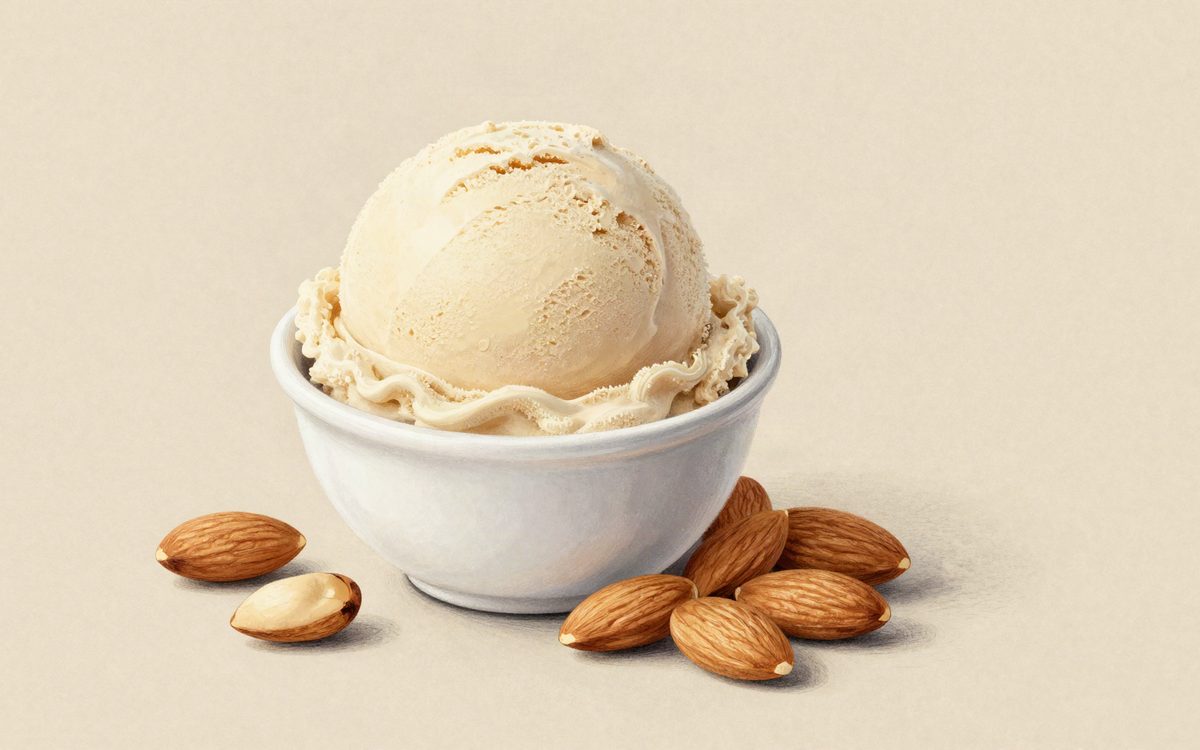
Sicily and Toledo each keep a version of the same confection, almond worked with sugar into a paste that carries a royal name in both places. No jar of it exists in the ingredient database, which turns out to help: bought ready made, it would smuggle an unknown quantity of sugar into the mix and the sweetness budget would stop being controllable. Rebuilt from its parts, 80 g of pure almond paste per kilo with the sucrose floor lifted to 120 g, the sugar becomes a lever again and the balance can lean sweet on purpose. Amaretto at 12 g puts the bitter almond note back on top of it.
That freedom was used immediately. The sucrose floor was raised to 120 g on this sheet, against 60 to 80 g on most of the others, to push sugars up inside the 16 to 22 percent band, because sweetness is what makes marzipan read as marzipan. Sugars close at 17.78 percent and POD at 168.33 against a 200 ceiling, so the sheet gets its sweetness without running out of room.
The almond side is capped by protein rather than by flavour. 80 g per kilo sits at the top of the 60 to 100 g nut range, and almond is about 21 percent protein, so those 80 g alone carry 16.8 g of protein. Add the dairy protein that the 8 percent MSNF floor forces in and the mix closes at 4.75 percent against a 5 percent ceiling, with MSNF at 8.3 percent barely over its floor. There is no room to add more almond.
The 12 g of Amaretto is aroma, not drink. Traditional marzipan carries bitter almond, and the benzaldehyde in the liqueur reproduces that note without the amygdalin risk of raw bitter almond. Those 12 g contribute 31 points of PAC, half of what a 25 g dose would inject, which is precisely what leaves room for sucrose at 120 g. PAC closes at 261.71 in a 220 to 300 band.
Ingredients
Makes 1000 g of finished base.
| Ingredient | Grams | Home measure |
|---|---|---|
| Whole Milk | 640 | 2 2/3 cups |
| Sugar (Sucrose) | 120 | 1/2 cup plus 2 tablespoons |
| Almond Paste (Pure) | 80 | |
| Heavy Cream 35% | 60 | 1/4 cup |
| Glucose Syrup DE42 | 40 | 2 tablespoons |
| Non-Fat Dry Milk | 23 | 1/4 cup |
| Amaretto Liqueur | 12 | |
| Dextrose (Glucose) | 10 | 2 1/2 teaspoons |
| Inverted Sugar | 10 | 1 1/2 teaspoons |
| Stabilizer (Neutral) | 4 | |
| Salt | 1 |
Loads these exact grams into the free balancer, ready to edit.
Method
Warm paste base, then chilled tray with a fork
- 1Whisk every dry ingredient together first: sugars, milk powder, stabiliser and salt. Dry-blending them stops the stabiliser clumping when it meets liquid.
- 2Warm the liquids to 40 C (104 F), then rain the dry mix in while whisking hard.
- 3Heat to 82 C (180 F) and hold for 2 minutes so the stabiliser hydrates.
- 4Off the heat, whisk in the paste, then blend 60 seconds so the fat emulsifies instead of separating.
- 5Chill in an ice bath to under 5 C (41 F) within 2 hours. Slow cooling is where bacteria and coarse crystals both start.
- 6Age 6 to 12 hours in the fridge under 5 C (41 F). This is when the stabiliser and the milk protein take up water.
- 7Freeze in a shallow metal pan 2 to 3 cm deep, breaking the crystals with a fork every 30 to 40 minutes, 4 to 6 times.
- 8Freeze firm, then temper 10 to 15 minutes in the fridge before scooping.
The balance
All six against the professional range for Milk Gelato.
Protein at 4.75 percent against a 5 percent ceiling is the number that sets the almond dose at 80 g, since nut protein and dairy protein draw on the same allowance. MSNF at 8.3 percent sits just over its 8 percent floor for the same reason: more milk powder would have bought MSNF with protein this sheet does not have. The third deliberate number is sugars at 17.78 percent, inside 16 to 22 with the sucrose floor raised to 120 g on purpose, and POD still reads 168.33 under its 200 ceiling. Fat at 8.44 percent sits mid range in 6 to 12, solids at 38.35 in 36 to 42, water at 61.65 in 58 to 64. Lactose is 4.52 percent of the mix and 7.34 percent of the water, so it is not a sandiness risk here.
Estimated nutrition: ~196 kcal · Fat 8.4 g · Sugars 17.8 g · Protein 4.8 g (per 100 g of mix, from the balanced composition).
Unlike a plain almond gelato, this one actually wants heat on the paste. Holding the almond paste at 60 to 70 C in the base for 5 to 10 minutes develops the cooked marzipan note people recognise; raw paste gives you almond gelato instead. That is the opposite of the pistachio rule, where heat destroys the green note. Do not go past 75 C with the paste in, though: above that the almond fat separates and the protein sets into grains. Sequence: pasteurise milk, cream, milk powder, sugars and stabiliser at 82 to 85 C, cool to 70 C, blend the paste in and hold 5 to 10 minutes at 65 to 70 C, then chill fast to 4 C. The Amaretto goes in cold, at the end of ageing, because benzaldehyde is volatile and ethanol boils at 78 C. Age 12 hours at 4 C. Watch the perceived sweetness: with 120 g of sucrose and 80 g of almond, a spoonful tastes right but the palate tires quickly. The 1 g of salt is the corrector, and it should not be increased. Never reach for raw bitter almond to reinforce the note, and if your almond paste is already sweetened the whole sheet has to be rebalanced, because the sugar stops being a free lever.
If it goes wrong
The paste went in cold or was never held warm. The cooked marzipan note only develops with a hold at 60 to 70 C.
After pasteurising, drop the base to 70 C, blend the 80 g of paste in and hold 5 to 10 minutes at 65 to 70 C before chilling.
The paste was taken past 75 C. Almond fat separates and the almond protein coagulates into grains.
Keep a thermometer in the pot during the hold. Blend for 60 seconds after the paste goes in so the fat emulsifies instead of sitting on top.
The liqueur was added while the base was still warm. Ethanol boils at 78 C and benzaldehyde leaves with it.
Add the 12 g cold, at the end of the 12 hour ageing, and stir it in rather than blending.
Suitable for: Vegetarian, Egg-free
Contains alcohol.
Allergens: milk, tree nuts
- Ice Cream Nation — Marzipan ice cream (abordagem de base estilo gelato, alta proporcao de leite e acucar e pouco ou nenhum creme, com a pasta de amendoa dissolvida na base): https://www.icecreamnation.org/2014/01/marzipan-ice-cream/
- Francisco Migoya, Frozen Desserts (The Culinary Institute of America) — Marzipan Ice Cream: https://app.ckbk.com/recipe/froz18665c08s001ss003r013/marzipan-ice-cream
- Eis-Perfecto — Marzipaneis Rezept (proporcao pasta de amendoa/acucar em sorvete de marzipan alemao): https://www.eis-perfecto.de/en/rezepte/marzipaneis-rezept/
- Luca Caviezel, Scienza e Tecnologia del Gelato Artigianale — capitulo de paste di frutta secca (dosagens e comportamento da pasta de amendoa no mix)
- The science behind it: Almond Paste in Gelato
- Ingredient sheet: Almond Paste (Pure)
Want to change an ingredient and watch the numbers move? Open the free balancer