Mango Sorbet
Smooth rather than icy under the spoon, heavy with ripe fruit up front, and a sweetness that pulls up well short of cloying as the lemon closes it.
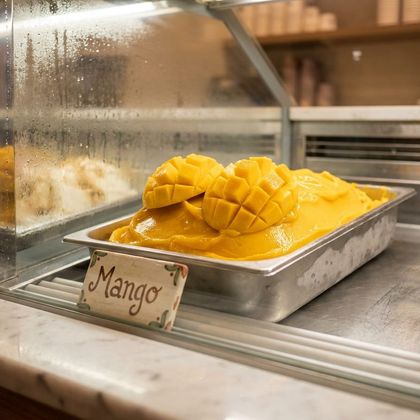
Both of the classic mistakes here happen before the machine is switched on. Sweeten this like any other fruit sorbetto and it comes out syrupy, because ripe mango has already spent close to a third of the sweetness budget by itself, roughly 14 per cent sugar and a POD near 16 per 100 g. Cut the sugar back to fix that and you strip out the dry matter that keeps water from crystallising, so it sets like a slab. This sheet takes the third road: added sucrose stops at 70 g per kilo, near the floor of the band, while glucose powder and maltodextrin buy the missing solids without buying any more sweetness with them.
What carries the volume instead is dry matter that does not taste of anything. 60 g of glucose powder and 45 g of maltodextrin buy solids without buying POD, which is how the sheet reaches 31.06 percent solids inside 28 to 34 while sugars sit at 29.23 percent and POD at 214.72, comfortably under its 270 ceiling. 45 percent fruit is the classic sorbetto dose for a fruit of this intensity.
Protein closes at 0.46 percent, mid band in 0 to 1. PAC lands at 325.76, high in 280 to 340, and 291 g of water is what balances the whole thing back to a kilo.
Ingredients
Makes 1000 g of finished base.
| Ingredient | Grams | Home measure |
|---|---|---|
| Mango | 450 | |
| Water | 291 | 1 1/4 cups |
| Sugar (Sucrose) | 70 | 1/3 cup |
| Dextrose (Glucose) | 65 | 1/3 cup |
| Glucose Powder | 60 | 1/4 cup plus 1 tablespoon |
| Maltodextrin | 45 | |
| Lemon Juice (Squeezed) | 15 | |
| Stabilizer (Neutral) | 4 |
Loads these exact grams into the free balancer, ready to edit.
Method
Cold puree straight to the tray, forked every 30 minutes
- 1Whisk every dry ingredient together first: sugars, milk powder, stabiliser and salt. Dry-blending them stops the stabiliser clumping when it meets liquid.
- 2Warm the liquids to 40 C (104 F), then rain the dry mix in while whisking hard.
- 3Heat to 82 C (180 F) and hold for 2 minutes so the stabiliser hydrates.
- 4Chill in an ice bath to under 5 C (41 F) within 2 hours. Slow cooling is where bacteria and coarse crystals both start.
- 5Age 6 to 12 hours in the fridge under 5 C (41 F). This is when the stabiliser and the milk protein take up water.
- 6Fold the fruit in cold, after ageing. Heating it costs you the fresh aroma and nothing is gained.
- 7Freeze in a shallow metal pan 2 to 3 cm deep, breaking the crystals with a fork every 30 to 40 minutes, 4 to 6 times.
- 8Freeze firm, then temper 10 to 15 minutes in the fridge before scooping.
The balance
All six against the professional range for Sorbetto.
Sugars at 29.23 percent and POD at 214.72 explain almost every line here. Both are already partly spent before a single gram of sucrose is added, because the mango itself is mostly sugar, so the balance had to buy its remaining solids from ingredients with little sweetening power: 60 g of glucose powder and 45 g of maltodextrin. That is why solids close at 31.06 percent, comfortably inside 28 to 34, without sugars going over the 31 percent ceiling. Water at 68.94 percent sits mid range in 66 to 72, and fat is zero, as a sorbetto should be.
Estimated nutrition: ~124 kcal · Fat 0 g · Sugars 29.2 g · Protein 0.5 g (per 100 g of mix, from the balanced composition).
The Brix of mango runs anywhere from 12 to 22 depending on cultivar and ripeness, and that variation is by far the largest source of error in this recipe. Measure the puree with a refractometer. If it is far from 17 Brix, correct on the sucrose, never on the fruit. Nothing here is heated: above about 70 C mango develops a heavy cooked note that no amount of acid will lift. A fibrous cultivar has to be sieved before you weigh it, and the 15 g of squeezed lemon juice goes in with the puree, not at the end.
If it goes wrong
The mango came in above 17 Brix and the 70 g of sucrose was added anyway. Sugars were designed to close at 29.23 percent against a 31 percent ceiling, so there is not much room for a sweeter fruit.
Refractometer first. For a high Brix puree cut the sucrose, not the glucose powder or the maltodextrin, because those two are carrying the solids.
A watery mango dropped total solids below the 28 percent floor. The sheet is designed to sit at 31.06 percent, mid band in 28 to 34.
Add sucrose to bring the solids back, in small steps, and check that sugars stay under 31 percent.
The puree was warmed, either to dissolve the sugars or to hydrate the stabiliser.
Dissolve the sugars and the 4 g of stabiliser in the 291 g of water separately, chill that syrup, then blend the raw puree in cold.
Suitable for: Vegan, Vegetarian, Lactose-free, Egg-free
- https://pastryartsmag.com/sponsored/simple-sorbet-science/
- https://www.iceicedaddy.com/en/sugar_expert.php
- https://www.alcremista.com/en/diary/tips-tricks/158-how-to-create-your-own-gelato-recipe.html
- The science behind it: How to Balance a Sorbetto Recipe
- Ingredient sheet: Mango
- The story of this recipe: Mango Sorbet Recipe
Want to change an ingredient and watch the numbers move? Open the free balancer