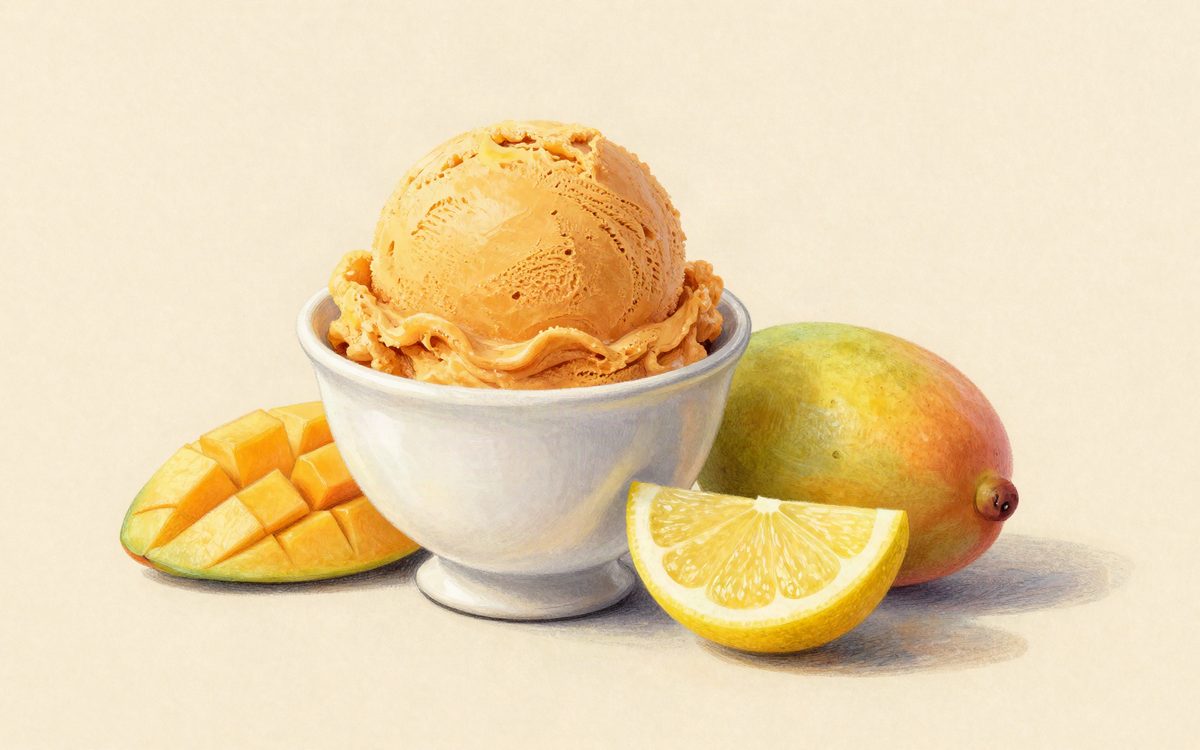
Mango Milk Gelato
Ripe tropical fruit arrives first, then the dairy rounds it out and lemon cuts the finish, closer to a very cold custard than to a sorbet in the mouth.
If the pulp comes sweetened, the sheet is broken before the first weighing. Mango runs around 17 percent solids with roughly 14 of those points already sugar, so at 280 g per kilo the fruit walks in carrying about 47.6 g of sugar of its own, and the 90 g of added sucrose here assumes plain fruit and nothing more. Ripeness is worth checking in both directions: underripe costs aroma and hands back acidity nobody asked for, while properly ripe mango runs flat, pH 4.5 to 5.5, too high to feel fresh in a dairy base. That is the job of the 8 g of lemon juice, and it is also why the fat comes from cream and not from egg yolk, which would bury the fruit.
The fruit brings water as well as flavour. This sheet reads 35.66 percent solids against 64.34 percent water, with water mid range in 60 to 68. That is exactly why 60 g of glucose powder is on the list: it buys dry extract to hold the fruit water without adding sweetness and without pushing POD past its 230 ceiling, which lands at 175.19.
Fat comes from 140 g of cream and from nothing else. No yolk, and that is a choice rather than an omission: egg fat and egg flavour both sit on top of the terpene aroma that makes mango smell like mango. Fat closes at 6.21 percent, mid range in 3.5 to 8, and PAC at 259.36 in a 240 to 310 band, which is what hands you a scoop instead of a block once it has rested briefly in the fridge.
Ingredients
Makes 1000 g of finished base.
| Ingredient | Grams | Home measure |
|---|---|---|
| Whole Milk | 360 | 1 1/2 cups |
| Mango | 280 | |
| Heavy Cream 35% | 140 | 1/2 cup plus 2 tablespoons |
| Sugar (Sucrose) | 90 | 1/3 cup plus 2 tablespoons |
| Glucose Powder | 60 | 1/4 cup plus 1 tablespoon |
| Non-Fat Dry Milk | 48 | 1/2 cup |
| Dextrose (Glucose) | 10 | 2 1/2 teaspoons |
| Lemon Juice | 8 | |
| Stabilizer (Neutral) | 3 | |
| Salt | 1 |
Loads these exact grams into the free balancer, ready to edit.
Method
Chilled tray, forked, mango folded in cold
- 1Whisk every dry ingredient together first: sugars, milk powder, stabiliser and salt. Dry-blending them stops the stabiliser clumping when it meets liquid.
- 2Warm the liquids to 40 C (104 F), then rain the dry mix in while whisking hard.
- 3Heat to 82 C (180 F) and hold for 2 minutes so the stabiliser hydrates.
- 4Chill in an ice bath to under 5 C (41 F) within 2 hours. Slow cooling is where bacteria and coarse crystals both start.
- 5Age 6 to 12 hours in the fridge under 5 C (41 F). This is when the stabiliser and the milk protein take up water.
- 6Fold the fruit in cold, after ageing. Heating it costs you the fresh aroma and nothing is gained.
- 7Freeze in a shallow metal pan 2 to 3 cm deep, breaking the crystals with a fork every 30 to 40 minutes, 4 to 6 times.
- 8Freeze firm, then temper 10 to 15 minutes in the fridge before scooping.
The balance
All six against the professional range for Milk Gelato with Fruit.
Two numbers carry this sheet. Sugars at 19.55 percent sit low in 17 to 25, with about 47.6 g of that sugar put into the kilo by the mango itself. Solids at 35.66 percent sit mid band in 32 to 40 for the opposite reason: 280 g of fruit is 280 g of mostly water, and glucose powder plus 48 g of milk powder are what pull the number back up. Everything else has slack on purpose. POD 175.19 against a 230 ceiling leaves room for a sweeter mango; fat 6.21 percent sits mid band in 3.5 to 8; protein reads 3.49 in a 2 to 4.5 range. Lactose comes to 4.7 percent of the mix and 7.3 percent of the water, so crystallised lactose is not what will make this one grainy.
Estimated nutrition: ~174 kcal · Fat 6.2 g · Sugars 19.6 g · Protein 3.5 g (per 100 g of mix, from the balanced composition).
Pick a cultivar that is low in fibre, Palmer or Tommy, and push the pulp through a fine sieve before you weigh the 280 g. Mango fibre is not broken by freezing or by a domestic blender and it turns up as threads on the spoon. The puree goes in raw, into the cold base, after ageing. Do not pasteurise the mango with the dairy: above 70 C the aroma profile turns into jam. One risk is specific to this fruit. Green or barely ripe mango carries an active protease that attacks casein and leaves a bitter edge that grows during storage, so use fully ripe fruit or pulp that has been blanched beforehand. Draw at -8 C and hold at -14 C.
If it goes wrong
The puree was heated with the base. Above 70 C the fresh terpene aroma cooks off and what is left reads like compote.
Pasteurise the dairy on its own, chill it, age it, then fold the 280 g of raw puree in cold at the end.
Underripe mango. Its protease keeps attacking the casein from the 360 g of milk and the 48 g of milk powder for as long as the tub sits there.
Use only fully ripe fruit, or blanch the pulp before weighing. Once the bitterness has developed there is no fix.
A stringy cultivar went in unsieved.
Sieve the pulp first, then weigh 280 g of the sieved puree, not 280 g of whole fruit.
Suitable for: Vegetarian, Egg-free
Allergens: milk
- Corvitto, A. - Los secretos del helado: el helado sin secretos, Vilbo, 2004 (percentual de fruta e correcao de acidez em gelato alla frutta)
- USDA FoodData Central - composicao da manga crua (https://fdc.nal.usda.gov)
- Goff, H.D.; Hartel, R.W. - Ice Cream, 7a ed., Springer, 2013 (funcao dos solidos totais no controle da agua congelavel)
- Caviezel, L. - Scienza e tecnologia del gelato artigianale, Chiriotti Editori (bilanciamento de bases leite-fruta)
- The science behind it: Fruit Purée Selection for Sorbetto
- Ingredient sheet: Mango
Want to change an ingredient and watch the numbers move? Open the free balancer