Macadamia Gelato
Softer out of the freezer than most nut gelati, buttery rather than greasy, with a delicate aroma that survives the cold instead of vanishing in it.
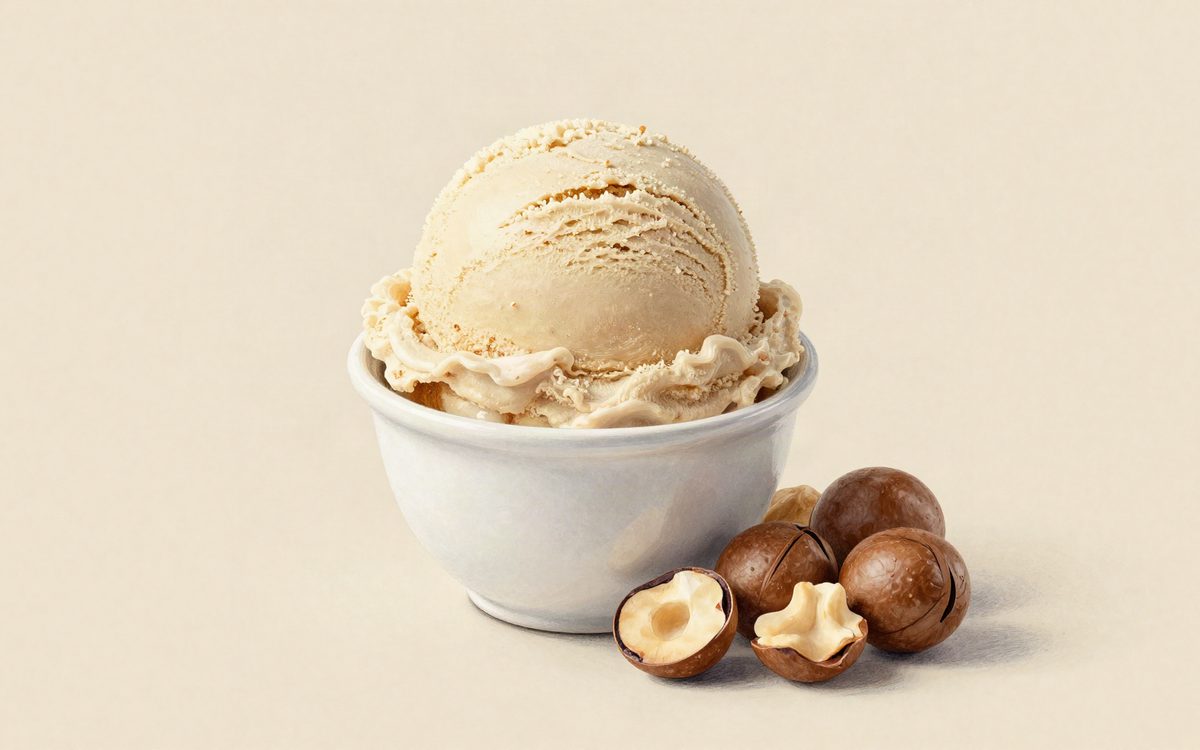
Where this goes wrong at home is the dose. More paste feels like more flavour, so a home batch climbs to 90 or 100 g per kilo the way it would with pistachio, and what comes out is greasy at the front, hard at the back, and quieter rather than louder. This is the fattiest nut there is, around 76 percent lipids, so every extra gram is mostly fat, and fat that high sets stiff and smothers the delicate half of the aroma. Holding the paste at 65 g keeps it leading while the dairy still has somewhere to sit, and 25 g of dextrose does the softening, so the tub stays scoopable without tasting any sweeter.
So 65 g/kg. It delivers 4.9% vegetable fat, it is still a leading flavor dose, and it leaves space for the dairy fat a milk base needs. Total fat finishes at 8.58%, mid band inside 6 to 12. The same pressure shows in the cream line: heavy cream was capped at 140 g/kg for this recipe and the balance used only 35 g, with 682 g of whole milk doing the rest.
The nut's low protein is an advantage here. At 7.9% protein, macadamia does not push the protein indicator against its 5% ceiling the way pistachio does, so protein lands at 4.23% and there is room for 38 g of non fat dry milk, which is what brings MSNF to 9.98% inside 8 to 11.5.
Sucrose runs at 150 g/kg, higher than in most nut gelatos, because macadamia brings only 4.6% sugar of its own. Total sugars finish at 17.57%, in the lower part of 16 to 22.
Ingredients
Makes 1000 g of finished base.
| Ingredient | Grams | Home measure |
|---|---|---|
| Whole Milk | 682 | 2 3/4 cups |
| Sugar (Sucrose) | 150 | 3/4 cup |
| Macadamia Paste | 65 | |
| Non-Fat Dry Milk | 38 | 1/3 cup plus 1 tablespoon |
| Heavy Cream 35% | 35 | 2 1/2 tablespoons |
| Dextrose (Glucose) | 25 | 2 tablespoons |
| Carob Seed Flour | 4 | |
| Salt | 1 |
Loads these exact grams into the free balancer, ready to edit.
Method
Loaf pan freeze, three blender passes
- 1Whisk every dry ingredient together first: sugars, milk powder, stabiliser and salt. Dry-blending them stops the stabiliser clumping when it meets liquid.
- 2Warm the liquids to 40 C (104 F), then rain the dry mix in while whisking hard.
- 3Heat to 82 C (180 F) and hold for 2 minutes so the stabiliser hydrates.
- 4Off the heat, whisk in the paste, then blend 60 seconds so the fat emulsifies instead of separating.
- 5Chill in an ice bath to under 5 C (41 F) within 2 hours. Slow cooling is where bacteria and coarse crystals both start.
- 6Age 6 to 12 hours in the fridge under 5 C (41 F). This is when the stabiliser and the milk protein take up water.
- 7Freeze in a shallow metal pan 2 to 3 cm deep, breaking the crystals with a fork every 30 to 40 minutes, 4 to 6 times.
- 8Freeze firm, then temper 10 to 15 minutes in the fridge before scooping.
The balance
All six against the professional range for Milk Gelato.
Fat at 8.58% explains the texture and the short counter life at the same time. Roughly 60% of macadamia oil is oleic and palmitoleic acid, monounsaturated fats with a low melting point, so this base melts faster on the counter than a hazelnut one at the same fat level, which is why the display window is shorter. POD at 177.52 sits in the upper half of 140 to 200, which is what 150 g/kg of sucrose against a nut contributing 4.6% sugar produces, and PAC at 256.35 lands mid band in 220 to 300, which puts the cabinet at about -12.8 C, where it holds a scoop. Lactose at 8.74% of the water phase clears the sandiness check with margin, which is what allows 38 g of non fat dry milk in a base already carrying 682 g of whole milk.
Estimated nutrition: ~194 kcal · Fat 8.6 g · Sugars 17.6 g · Protein 4.2 g (per 100 g of mix, from the balanced composition).
Four things are specific to this nut. First, the paste separates oil in the jar more readily than most, so homogenize the whole jar before weighing: a 65 g dose taken off the top can be mostly oil and the recipe leaves its fat range. Second, add the paste at 60 to 65 C on the way down, with a stick blender, not at 85 C. Macadamia heated to pasteurization temperature loses the buttery aroma that is the entire reason for the flavor. Pasteurize only the dairy portion, 85 C for 30 seconds. Third, roast light or not at all: dark roasted macadamia turns into generic nut flavor, so if you roast, stop at 140 C for 10 to 12 minutes. Fourth, there is no acid and no tannin anywhere in this formula, so unlike a fruit base or a pistachio base there is no curdling risk and no astringency to manage. Mature 8 hours at 4 C.
If it goes wrong
The paste was weighed off the top of an unstirred jar, so the 65 g was largely separated oil and fat went past the 8.58% the formula was built for.
Stir the jar to full homogeneity before weighing, every single time.
Either the paste went in at 85 C, or the nuts were dark roasted.
Add the paste at 60 to 65 C on the cooling curve, and if you roast, stop at 140 C for 10 to 12 minutes.
Not a defect. Macadamia oil is around 60% monounsaturated with a low melting point, so this base behaves softer than a hazelnut base at the same 8.58% fat.
Keep it in the cabinet at about -12.8 C, where its PAC puts it, plan a shorter counter window, and do not compensate by adding milk powder.
Suitable for: Vegetarian, Egg-free
Allergens: milk, tree nuts
No ingredient in this recipe contains gluten.
- https://fdc.nal.usda.gov/
- https://tools.myfooddata.com/nutrition-facts/170178/wt2
- https://www.sciencedirect.com/topics/agricultural-and-biological-sciences/macadamia-nuts
- https://www.gelq.it/en/7-nuts-ice-cream-pastes
- The science behind it: Starch vs Fat Nut Pastes
- Ingredient sheet: Macadamia Paste
Want to change an ingredient and watch the numbers move? Open the free balancer