Lychee Sorbet
More scent than taste at first, then a cool and yielding body that never turns icy, and a citrus snap at the end that stops the finish going syrupy.
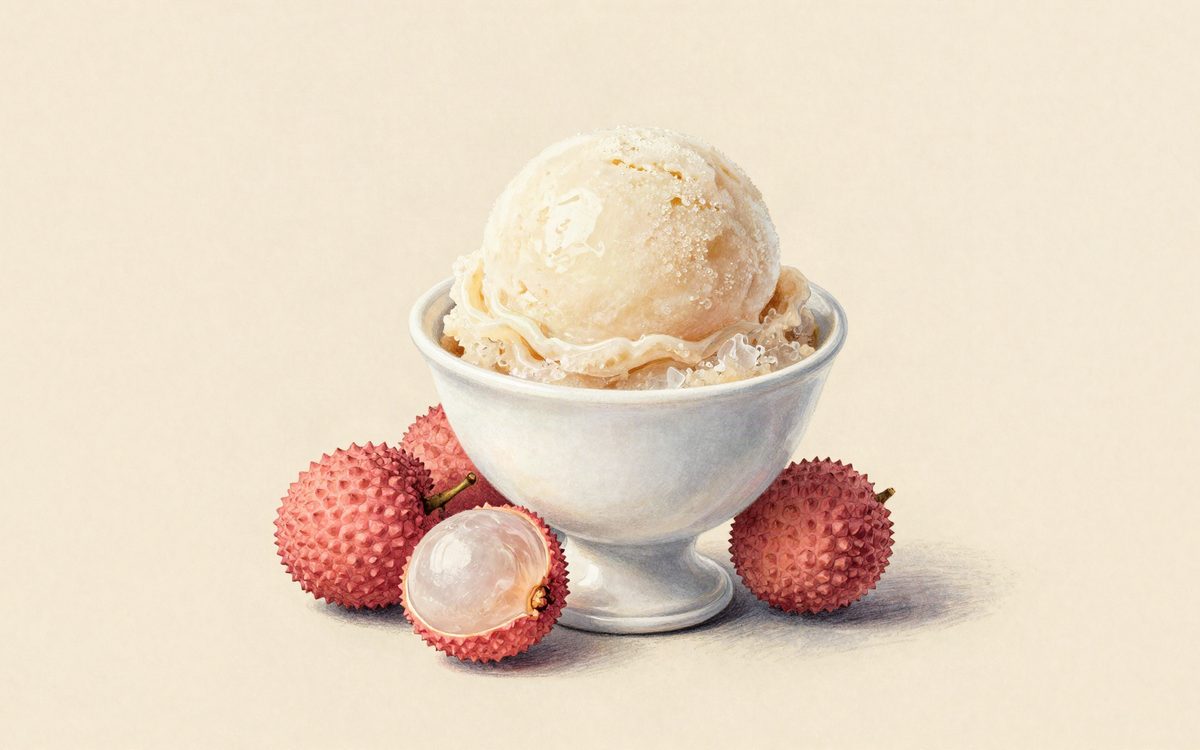
Half of this is smelled rather than tasted, and it lands before the cold has properly registered. The body follows soft, never brittle, because 440 g of fruit per kilo brings a good share of the sugar with it, while maltodextrin and glucose powder build the rest of the dry matter without pushing sweetness any higher. Then the close decides everything. Lemon juice at 18 g per kilo, more than the other sorbets here carry, tightens what would otherwise be a slack, over-perfumed ending and pushes the floral volatiles forward, so the fruit still reads as itself on the way out.
That forces the added sugars to retreat. Sucrose comes down to 75 g/kg and glucose powder to 15 g/kg, while maltodextrin climbs to 90 g/kg, the highest in this group, because it builds solids and body at very low sweetening power. Without that retreat the sorbet is cloying and slack at the same time. As balanced, POD lands at 209.49, just above the floor of its 200 to 270 band.
Protein is the surprising figure. It finishes at 0.47%, mid band in 0 to 1, which is unusual for a sorbet, where protein is usually an afterthought. It is a direct consequence of using 44% fruit by weight.
Lemon juice at 18 g/kg is a heavier acid correction than the other fruit sorbets here get, and it has to be. Lychee runs pH 4.7 to 5.1, so it is notably low in acid, and high sugar without a counterweight makes a sorbet that reads flat and over perfumed. The acidity also lifts linalool and geraniol, the volatiles that make lychee recognizable as lychee.
Ingredients
Makes 1000 g of finished base.
| Ingredient | Grams | Home measure |
|---|---|---|
| Lychee | 440 | |
| Water | 303 | 1 1/4 cups |
| Maltodextrin | 90 | |
| Sugar (Sucrose) | 75 | 1/3 cup plus 1 tablespoon |
| Dextrose (Glucose) | 55 | 1/4 cup plus 1 tablespoon |
| Lemon Juice | 18 | |
| Glucose Powder | 15 | 1 1/2 tablespoons |
| Carob Seed Flour | 3 | |
| Guar Gum | 1 |
Loads these exact grams into the free balancer, ready to edit.
Method
Same day tray freeze, two blitzes
- 1Whisk every dry ingredient together first: sugars, milk powder, stabiliser and salt. Dry-blending them stops the stabiliser clumping when it meets liquid.
- 2Warm the liquids to 40 C (104 F), then rain the dry mix in while whisking hard.
- 3Heat to 82 C (180 F) and hold for 2 minutes so the stabiliser hydrates.
- 4Chill in an ice bath to under 5 C (41 F) within 2 hours. Slow cooling is where bacteria and coarse crystals both start.
- 5Age 6 to 12 hours in the fridge under 5 C (41 F). This is when the stabiliser and the milk protein take up water.
- 6Fold the fruit in cold, after ageing. Heating it costs you the fresh aroma and nothing is gained.
- 7Freeze in a shallow metal pan 2 to 3 cm deep, breaking the crystals with a fork every 30 to 40 minutes, 4 to 6 times.
- 8Freeze firm, then temper 10 to 15 minutes in the fridge before scooping.
The balance
All six against the professional range for Sorbetto.
Read the sugar line against the sucrose line and the formula explains itself. Total sugars finish at 29.34%, high in the 25 to 31 band, but added sucrose is only 75 g/kg because the fruit already supplied 6.8 points of it. PAC lands at 328.24, the highest in this group and in the upper part of 280 to 340, again largely because the fruit brought 128 PAC of its own, so this is a soft sorbet by construction that holds best in a cabinet at -13.1 C. Solids at 31.33% inside 28 to 34 are carried by the 90 g of maltodextrin, doing the job glucose powder does in the citrus sorbets.
Estimated nutrition: ~126 kcal · Fat 0.2 g · Sugars 29.3 g · Protein 0.5 g (per 100 g of mix, from the balanced composition).
The pit carries bitter compounds. Stone the fruit without crushing and discard the pit whole. The pulp oxidizes fast and browns to a dirty beige pink within minutes of air exposure, so work cold, keep blender aeration to a minimum, and put part of the 18 g of lemon juice in with the pulp while you process it. Do not pasteurize the lychee: heat only the syrup, to 85 C, and add the pulp after it has come back down to 4 C, because lychee aroma is almost entirely volatile terpenes that leave with the steam. Keep maturation short, 4 to 6 hours, and churn straight after. A lychee sorbet loses perfume day by day, so it is made to be eaten, not stocked.
If it goes wrong
The pulp oxidized in the blender or was heated along with the syrup.
Work cold with minimal aeration, blend part of the lemon juice into the pulp, and add the pulp only once the syrup is at 4 C.
The pits were crushed during processing.
Stone the fruit by hand and discard the pits whole before anything goes near a blade.
The lemon juice was cut or skipped. Lychee sits at pH 4.7 to 5.1 and cannot supply its own acid balance.
Keep the 18 g/kg of lemon juice. It is higher than in the other fruit sorbets here for exactly this reason.
Suitable for: Vegan, Vegetarian, Lactose-free, Egg-free
No ingredient in this recipe contains gluten.
- So Good Magazine, Fruit sorbets from a syrup base (https://www.sogoodmagazine.com/pastry-blog/pastry-chef-articles/fruit-sorbets-from-a-syrup-base-a-practical-resource/)
- USDA FoodData Central, Litchis, raw (acucares totais cerca de 15,2 g/100 g, proteina 0,83 g/100 g)
- Bread and Basil, How to Make Sorbet: Master Ratio and Guide (https://www.breadandbasil.nyc/recipes/sorbet-guide)
- H. D. Goff e R. W. Hartel, Ice Cream, 7a edicao (Springer), capitulo sobre sorbets, congelamento e depressao do ponto de congelamento
- The science behind it: How to Balance a Sorbetto Recipe
- Ingredient sheet: Lychee
Want to change an ingredient and watch the numbers move? Open the free balancer