Licorice Gelato
Sweetness lands first and briefly, then a dark salty resin builds up behind it and takes over, holding on long after the cold has faded.
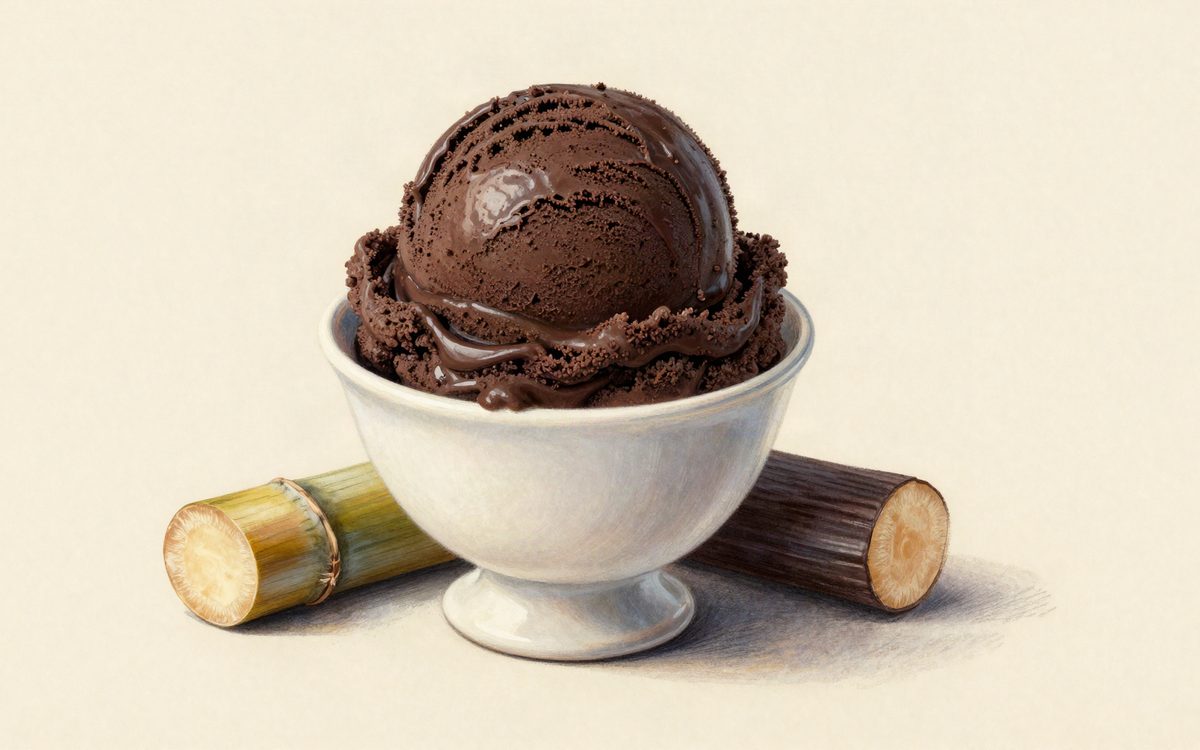
Buy the raw material, not the confectionery. What belongs in a frozen base is root powder or the pure hard extract sold as liquirizia, with nothing added; sweets sold under the name carry too little of the real thing and too much sugar of their own to be useful. Professional practice works at 15 to 25 g of root powder per kilo, or 50 to 60 g of hard extract per litre, and always pulls the sugar back to match, because glycyrrhizin sweetens 30 to 50 times harder than sucrose and turns up with the flavour. The white base is drawn for that: sucrose held at 95 g, glucose powder carrying the solids, POD left short at 158, and 15 g of cane molasses for the dark floor underneath.
The dose to work with comes from professional practice, 15 to 25 g/kg of powdered root, or 50 to 60 g per liter of mix when using pure hard liquirizia, always with a matching cut in sugar. That cut is already built in. POD sits at 157.64, in the lower half of the 140 to 200 band rather than near the 168 you would aim for in a plain milk base, and sucrose is capped at 95 g/kg. Glycyrrhizin is 30 to 50 times sweeter than sucrose, so the licorice brings sweetness of its own and lands the finished gelato where a normal base would already have been.
One catalog ingredient genuinely belongs to this flavor: sugarcane molasses at 15 g/kg. It is in the candy itself and it holds the dark, bitter caramel floor underneath. It is not a substitute for licorice and it is not doing the sweetening.
No egg yolk, and that is a choice rather than an omission. The Italian original is licorice over fior di latte, and the black on white contrast is part of the product. Fat lands at 7.71% in the lower half of 6 to 12, MSNF at 10.46% inside 8 to 11.5, and lactose at 9.16% of the water phase, which clears the sandiness check.
Ingredients
Makes 1000 g of finished base.
| Ingredient | Grams | Home measure |
|---|---|---|
| Whole Milk | 590 | 2 1/2 cups |
| Heavy Cream 35% | 160 | 2/3 cup |
| Sugar (Sucrose) | 95 | 1/3 cup plus 2 tablespoons |
| Glucose Powder | 70 | 1/3 cup plus 1 tablespoon |
| Skim Milk Powder | 45 | 1/3 cup plus 2 tablespoons |
| Dextrose (Glucose) | 20 | 1 1/2 tablespoons |
| Sugarcane Molasses | 15 | |
| Carob Seed Flour | 4 | |
| Salt | 1 |
Loads these exact grams into the free balancer, ready to edit.
Method
Frozen loaf pan, whisk every 40 minutes
- 1Whisk every dry ingredient together first: sugars, milk powder, stabiliser and salt. Dry-blending them stops the stabiliser clumping when it meets liquid.
- 2Warm the liquids to 40 C (104 F), then rain the dry mix in while whisking hard.
- 3Heat to 82 C (180 F) and hold for 2 minutes so the stabiliser hydrates.
- 4Chill in an ice bath to under 5 C (41 F) within 2 hours. Slow cooling is where bacteria and coarse crystals both start.
- 5Age 6 to 12 hours in the fridge under 5 C (41 F). This is when the stabiliser and the milk protein take up water.
- 6Freeze in a shallow metal pan 2 to 3 cm deep, breaking the crystals with a fork every 30 to 40 minutes, 4 to 6 times.
- 7Freeze firm, then temper 10 to 15 minutes in the fridge before scooping.
The balance
All six against the professional range for Milk Gelato.
The whole formula is organized around one fact: the flavoring sweetens. POD at 157.64 is the visible result, held there by capping sucrose at 95 g/kg and letting 70 g of glucose powder carry solids instead, since glucose powder contributes dry matter and freezing point depression at low sweetening power. PAC finishes at 255.55, mid band in 220 to 300, so the block stays workable in a cabinet at -11 to -14 C without going slack. Solids at 37.72% inside 36 to 42 come mostly from dairy: 590 g of whole milk, 160 g of cream and 45 g of skim milk powder, which is what puts MSNF at 10.46% and gives the base enough body to carry a bitter, aggressive flavoring without tasting thin.
Estimated nutrition: ~189 kcal · Fat 7.7 g · Sugars 18.9 g · Protein 3.9 g (per 100 g of mix, from the balanced composition).
Hard licorice extract does not dissolve cold. Melt it into part of the milk at 60 to 70 C before pasteurizing, or you are left with hard black specks that the churn will not break down and that show up on the spoon. Salt stays at 1 g/kg and does not go up: glycyrrhizin already gives a saline echo, and more salt takes the gelato straight to soap and ammonia. The margin between intense and inedible is narrow, so taste the mix cold and matured, never hot, because licorice bitterness opens up in the cold. Licorice stains, and it marks the batch freezer and the spatulas, so run it last in the day. There is also a real pharmacological limit and not only a sensory one: too much glycyrrhizin affects blood pressure and potassium, which is the other reason professional recipes fix a dose ceiling.
If it goes wrong
The hard extract went in cold. It does not dissolve at low temperature.
Melt it into a portion of the 590 g of milk at 60 to 70 C before pasteurizing the rest of the base.
Salt above the 1 g/kg this formula fixes, stacked on the saline echo glycyrrhizin already gives.
Keep salt at 1 g/kg. If the flavor feels flat, add licorice, not salt.
The base was balanced to a normal milk gelato POD instead of the 157.64 used here, so the glycyrrhizin stacked on top of it.
Hold sucrose at 95 g/kg and stay inside 15 to 25 g/kg of root powder.
Suitable for: Vegetarian, Egg-free
Allergens: milk
No ingredient in this recipe contains gluten.
- https://www.jopistacchio.it/gelato-liquirizia/
- https://www.valrhona-selection.it/blog/ricetta-gelato-liquirizia
- https://www.cucina.li/gelato-alla-liquirizia-wally/
- The science behind it: Why Cold Gelato Tastes Less Sweet Than the Numbers Say
Want to change an ingredient and watch the numbers move? Open the free balancer