Kiwi Sorbet
It stays scoopable straight from the cabinet at -11 to -14 C and melts clean, grassy and sharp, without the shards of ice a home sorbet usually leaves on the spoon.
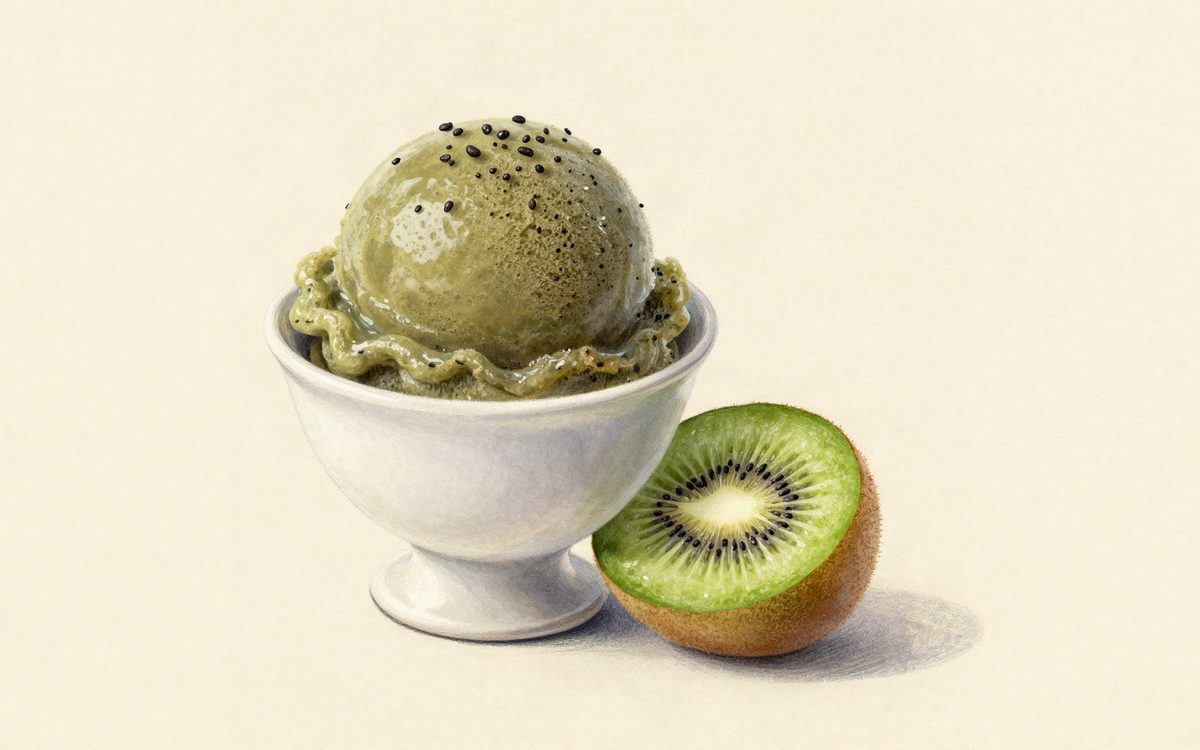
Home sorbet usually goes wrong after the machine, not inside it. Left in the tub, an underbuilt mix keeps freezing, and by the second day the spoon meets a block. This one is built against that: PAC closes at 325.27, so part of the water stays unfrozen at serving temperature, and the sugars are spread across 90 g of sucrose, 65 g of dextrose, 55 g of glucose powder and 32 g of maltodextrin, which brings solids to 31 percent without the mix tasting of syrup. Nothing is heated, and no lemon goes in, because the fruit already sits at pH 3.1 to 3.4 and more acid would push it to harsh.
No lemon juice goes in, which is unusual for a sorbetto. Kiwi already sits at pH 3.1 to 3.4 on its own, and adding acid to that takes it from bright to abrasive.
Kiwi has a useful oddity in its composition: roughly 16.5% solids for only 9% sugar. That is a high proportion of non-sugar solids for a sorbetto fruit, and it means the fruit helps reach the 28% solids floor without spending sweetness to get there. Total solids finish at 31.0%, mid band in 28 to 34, with sugars at 27.23% and POD at 208.34.
The 90 g/kg of sucrose, 65 of dextrose and 55 of glucose powder are not interchangeable. Dextrose is where the formula buys freezing point depression cheaply per gram, glucose powder adds solids and chew, and 32 g/kg of maltodextrin adds structure with almost no sweetness at all. PAC finishes at 325.27, in the upper part of the 280 to 340 sorbetto window.
Ingredients
Makes 1000 g of finished base.
| Ingredient | Grams | Home measure |
|---|---|---|
| Kiwi | 450 | |
| Water | 304 | 1 1/4 cups |
| Sugar (Sucrose) | 90 | 1/3 cup plus 2 tablespoons |
| Dextrose (Glucose) | 65 | 1/3 cup |
| Glucose Powder | 55 | 1/4 cup plus 1 tablespoon |
| Maltodextrin | 32 | |
| Stabilizer (Neutral) | 4 |
Loads these exact grams into the free balancer, ready to edit.
Method
Pulsed purée, cold mix, tray with fork passes
- 1Whisk every dry ingredient together first: sugars, milk powder, stabiliser and salt. Dry-blending them stops the stabiliser clumping when it meets liquid.
- 2Warm the liquids to 40 C (104 F), then rain the dry mix in while whisking hard.
- 3Heat to 82 C (180 F) and hold for 2 minutes so the stabiliser hydrates.
- 4Chill in an ice bath to under 5 C (41 F) within 2 hours. Slow cooling is where bacteria and coarse crystals both start.
- 5Age 6 to 12 hours in the fridge under 5 C (41 F). This is when the stabiliser and the milk protein take up water.
- 6Fold the fruit in cold, after ageing. Heating it costs you the fresh aroma and nothing is gained.
- 7Freeze in a shallow metal pan 2 to 3 cm deep, breaking the crystals with a fork every 30 to 40 minutes, 4 to 6 times.
- 8Freeze firm, then temper 10 to 15 minutes in the fridge before scooping.
The balance
All six against the professional range for Sorbetto.
The fruit sits at 450 g/kg, with protein at 0.45%. Because kiwi runs about 16.5% solids for only 9% sugar, those 450 g arrive with plenty of non-sugar solid, so total solids reach 31.0% without leaning on the sugar line, and sugars can sit at 27.23%, mid band in the 25 to 31 window, instead of being pushed to the top just to fill volume. PAC lands at 325.27, in the upper part of 280 to 340, which for a water-based mix is the difference between a scoop and a shattering block. Fat at 0.22% and MSNF at zero are why a sorbetto has to be balanced this tightly in the first place: there is no fat and no milk solid to cover a mistake, only sugar, water and 4 g/kg of stabilizer.
Estimated nutrition: ~125 kcal · Fat 0.2 g · Sugars 27.2 g · Protein 0.5 g (per 100 g of mix, from the balanced composition).
Kiwi brings two problems that belong only to kiwi. The first is actinidin, its protease, which denatures somewhere around 60 C. A warm hold would deal with the enzyme, but heating kiwi turns the flavor metallic and kills the green, so the right answer is to process everything cold and accept a short shelf life instead. The second is the seeds. Breaking them up releases a bitter, tannic note, so pulse the fruit rather than processing it, and keep it out of a high-speed blender entirely. Hydrate the 4 g/kg of stabilizer in the water and sugar syrup hot, on its own, chill that to 4 C, and only then fold in the pulsed fruit cold.
If it goes wrong
The black seeds were broken up. Kiwi seeds release bitterness when blitzed.
Pulse the fruit in short bursts, never in a high-speed blender, and stop while you can still see whole seeds.
The kiwi was heated. It cannot go through the syrup stage.
Heat the syrup alone to hydrate the stabilizer, chill it to 4 C, then combine with the raw fruit cold.
PAC drifted below where it should be, usually because the sugar split was changed or the fruit was watered down.
Weigh the sugars as written, 90 g sucrose, 65 g dextrose and 55 g glucose powder per kilo. That split is what puts PAC at 325.27, and dextrose is the cheapest PAC in the recipe.
Suitable for: Vegan, Vegetarian, Lactose-free, Egg-free
- https://actazin.com/kiwifruit-protein-digesting-enzyme/
- https://pastryartsmag.com/sponsored/simple-sorbet-science/
- https://www.iceicedaddy.com/en/sugar_expert.php
- The science behind it: How to Balance a Sorbetto Recipe
- Ingredient sheet: Kiwi
Want to change an ingredient and watch the numbers move? Open the free balancer