Keto Strawberry Gelato
Scoops soft and eats light, with fruit acidity out in front and only a faint cooling trace where a long sugary finish would normally sit.
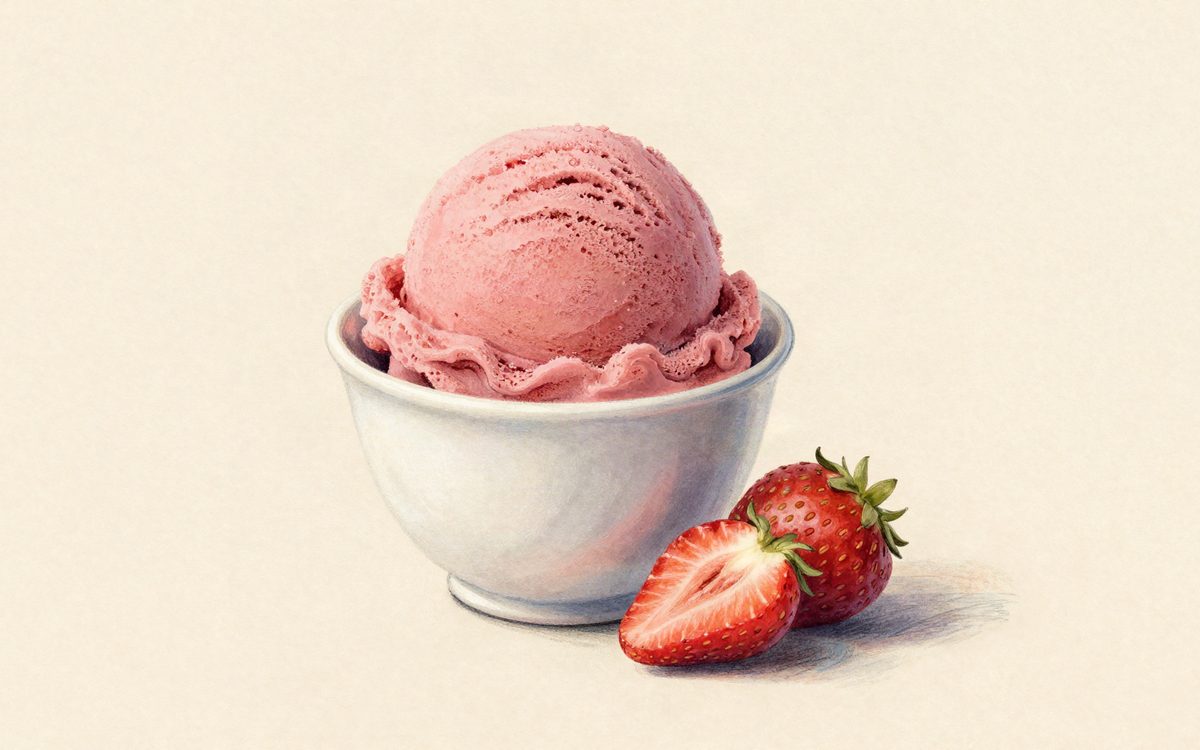
Sucrose does two jobs in the version you already know: it sweetens, and it draws the finish out long and round. The sweeteners here cover the first and only part of the second, so the trade runs in both directions. Fruit comes through louder, with no wall of sugar standing in front of it and the fat kept low, near 6.3 per cent, where it lets volatile aroma through instead of coating it away. What you give up is that long close: maltitol carries most of the body, the erythritol leaves a cooling trace at the back of the tongue, and the sweetness clears earlier than you expect. Three hundred grams of raw fruit per kilo and a little lemon juice keep it tasting of fruit rather than of sweetener.
The fruit dose is 300 g/kg, mid range for gelato alla frutta with milk, which usually runs 250 to 350. Those 300 g bring roughly 273 g of water and a lot of acid into the mix. Fat finishes at 6.27%, mid band in the 3.5 to 8 window, and MSNF at 7.96%, in the upper half of its band. Neither was pushed up.
For a sugar-free build the fruit choice turns out to be generous. Strawberry is only about 5% sugars, so 300 g/kg contribute just 15 g of sugar per kilo and almost the entire sweet load can be designed from scratch. Maltitol at 154 g/kg is the body, erythritol at 8 g/kg and isomalt at 18 g/kg are the trim. Total sugars come out at 19.46% and POD at 169.71, low in the 150 to 230 range.
There is a structural bonus in the lower MSNF band: less milk powder means less lactose. This mix lands at 4.34% lactose by mass and 6.93% of the water phase, noticeably lighter than the same flavor built on a plain milk base. Lemon juice at 8 g/kg drops the pH and lifts the fruit, which matters more here than in a sugared version, because sugar is part of how ripe fruit reads on the tongue.
Ingredients
Makes 1000 g of finished base.
| Ingredient | Grams | Home measure |
|---|---|---|
| Strawberry | 300 | |
| Whole Milk | 292 | 1 1/4 cups |
| Maltitol | 154 | |
| Heavy Cream 35% | 145 | 1/2 cup plus 2 tablespoons |
| Non-Fat Dry Milk | 42 | 1/3 cup plus 2 tablespoons |
| Inulin (Vegetable Fiber) | 23 | |
| Isomalt | 18 | |
| Lemon Juice | 8 | |
| Erythritol | 8 | |
| Whey Protein 80% | 6 | |
| Stabilizer (Neutral) | 4 |
Loads these exact grams into the free balancer, ready to edit.
Method
Cold purée folded in after ageing, tray and blender
- 1Whisk every dry ingredient together first: sugars, milk powder, stabiliser and salt. Dry-blending them stops the stabiliser clumping when it meets liquid.
- 2Warm the liquids to 40 C (104 F), then rain the dry mix in while whisking hard.
- 3Heat to 82 C (180 F) and hold for 2 minutes so the stabiliser hydrates.
- 4Chill in an ice bath to under 5 C (41 F) within 2 hours. Slow cooling is where bacteria and coarse crystals both start.
- 5Age 6 to 12 hours in the fridge under 5 C (41 F). This is when the stabiliser and the milk protein take up water.
- 6Fold the fruit in cold, after ageing. Heating it costs you the fresh aroma and nothing is gained.
- 7Freeze in a shallow metal pan 2 to 3 cm deep, breaking the crystals with a fork every 30 to 40 minutes, 4 to 6 times.
- 8Freeze firm, then temper 10 to 15 minutes in the fridge before scooping.
The balance
All six against the professional range for Milk Gelato with Fruit.
Two numbers carry the design. Fat at 6.27% is deliberately mid band rather than pushed toward the 8 ceiling, because strawberry lives mostly in volatile esters and milk fat holds them back from the nose: there was room to go higher and it would have cost aroma. The second is PAC at 259.51, comfortably inside the 240 to 310 range, which is what lets a fruit-heavy sugar-free mix scoop properly instead of setting like a brick. Maltitol does that work. At PAC 99 it is nearly sucrose, so 154 g/kg fill the sweetness with almost no distortion of the freezing curve, while erythritol at 8 g/kg is kept tiny on purpose because its PAC of 280 would blow the curve open in bulk. Isomalt at 18 g/kg is the quiet one: it adds solids toward the 37.43% total without adding much sweetness or PAC, which is exactly what a fruit base needs when 273 g of fruit water are already in the tank.
Estimated nutrition: ~181 kcal · Fat 6.3 g · Sugars 19.5 g · Protein 3.5 g (per 100 g of mix, from the balanced composition).
Do not pasteurize the strawberry with the base. Pasteurize the white base alone at 85 C for 30 seconds, chill it to 4 C, then fold the raw purée in at ageing. Heated strawberry tastes like jam and turns brick red instead of pink. The purée sits near pH 3.5, so add it cold, slowly, with the base moving: poured in fast it flocculates the casein on contact and the base goes grainy in seconds. The lemon juice goes in with the purée, never in the hot phase. Age 6 to 12 hours at 4 C and churn the same day, because without sucrose there is less protection for the color and it dulls faster than a sugared version.
If it goes wrong
Acid shock. The purée is around pH 3.5 and the casein flocculates if it meets the base too fast or while the base is still warm.
Chill the base to 4 C first, then pour the cold purée in slowly against a running whisk or stick blender.
The fruit went through pasteurization with the base.
Pasteurize the dairy alone at 85 C for 30 seconds, chill it, and fold the 300 g/kg of purée in raw at ageing.
Fat is too high for this band. Milk fat holds back the volatile esters that carry strawberry aroma.
Stay at the 6.27% this formula calculates. If you scaled the cream up, bring it back and let inulin or isomalt carry the solids instead.
Suitable for: Vegetarian, Egg-free, No added sugar
Allergens: milk
- Goff & Hartel, Ice Cream, 7th ed., Springer 2013, cap. 3, gelato de fruta e ajuste de acidez: https://link.springer.com/book/10.1007/978-1-4614-6096-1
- University of Guelph, Ice Cream Structure (estabilidade de emulsao em pH baixo e floculacao de caseina): https://www.uoguelph.ca/foodscience/book-page/ice-cream-structure
- USDA FoodData Central, composicao de morango cru (acucares, solidos, acidez): https://fdc.nal.usda.gov/
- The science behind it: Keto Gelato
- Ingredient sheet: Strawberry
Want to change an ingredient and watch the numbers move? Open the free balancer