Keto Salted Caramel Gelato
Closer to butterscotch than to clean caramel, soft on the spoon and quietly savoury, with a sweetness that arrives after the salt and stays well past the cold.
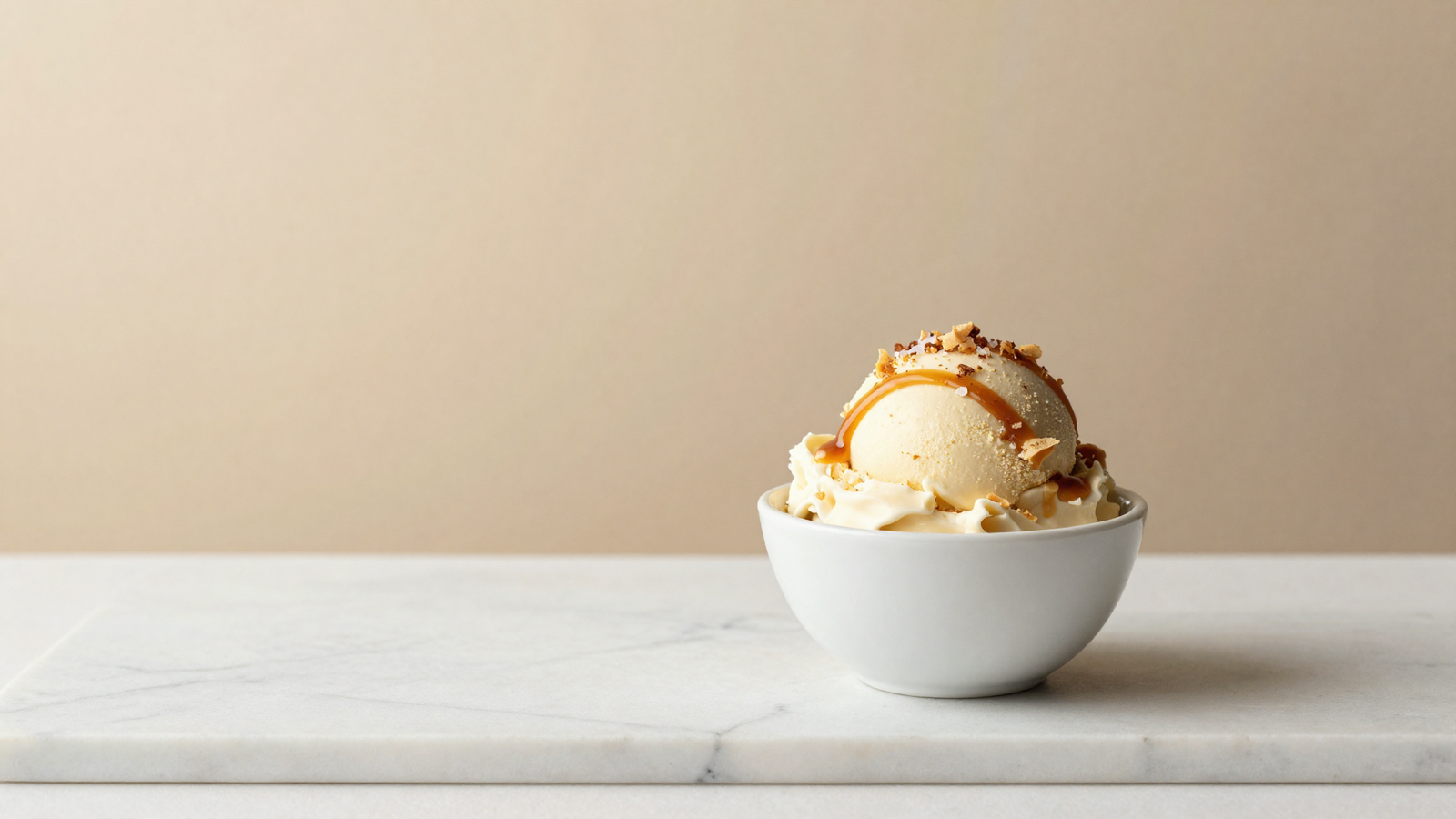
Give it a few seconds on the tongue and it changes twice. Salt registers at the front, quick and sharp; behind it the caramel opens out into burnt sugar; and last comes a buttery weight that hangs on well after the cold has gone. That order is built into the sheet. Salt at 3 g per kilo is enough to lead, butter at 20 g gives the tail its heft, and the browning itself comes from 60 g of allulose, the only sweetener here that takes real colour in the pan instead of melting pale and setting again. Maltitol carries the rest of the sweetness, which is why the body stays soft on the spoon.
The sweetening is handled separately, by 112 g/kg of maltitol that never goes near the pan. Maltitol carries a PAC of 99 against sucrose at 100, so it can take over the sugar load almost one for one without dragging the freezing curve anywhere. Total sugars finish at 17.27%, in the lower half of the 16 to 22 window, and POD lands at 144.35, close to the 140 floor. This reads as caramel and salt rather than as sweetness, which is the point.
Then there is the line that looks harmless. Salt at 3 g/kg is a seasoning quantity, but salt has a PAC of 585, nearly six times sucrose per gram, so those 3 g are worth 17.6 PAC points, roughly what 18 g of sucrose would buy. Stack that on allulose at PAC 190 and the mix finishes at PAC 287.62 against a ceiling of 300. This formula is tight, and it is tight at the top, not the bottom.
Butter at 20 g/kg is doing flavor work, not structure. It is what turns caramel into butterscotch, which is the note most people actually mean by salted caramel. Fat totals 8.45%, mid band in the 6 to 12 range, and 12 g/kg of whey protein with 20 g/kg of skim milk powder bring protein to 4.0% while lactose stays at 5.02% of the mix.
Ingredients
Makes 1000 g of finished base.
| Ingredient | Grams | Home measure |
|---|---|---|
| Whole Milk | 615 | 2 1/2 cups |
| Heavy Cream 35% | 130 | 1/2 cup plus 1 tablespoon |
| Maltitol | 112 | |
| Allulose | 60 | |
| Inulin (Vegetable Fiber) | 24 | |
| Butter | 20 | |
| Non-Fat Dry Milk | 20 | 3 1/2 tablespoons |
| Whey Protein 80% | 12 | |
| Stabilizer (Neutral) | 4 | |
| Salt | 3 |
Loads these exact grams into the free balancer, ready to edit.
Method
Shallow tray, five fork passes
- 1Whisk every dry ingredient together first: sugars, milk powder, stabiliser and salt. Dry-blending them stops the stabiliser clumping when it meets liquid.
- 2Warm the liquids to 40 C (104 F), then rain the dry mix in while whisking hard.
- 3Heat to 82 C (180 F) and hold for 2 minutes so the stabiliser hydrates.
- 4Chill in an ice bath to under 5 C (41 F) within 2 hours. Slow cooling is where bacteria and coarse crystals both start.
- 5Age 6 to 12 hours in the fridge under 5 C (41 F). This is when the stabiliser and the milk protein take up water.
- 6Freeze in a shallow metal pan 2 to 3 cm deep, breaking the crystals with a fork every 30 to 40 minutes, 4 to 6 times.
- 7Freeze firm, then temper 10 to 15 minutes in the fridge before scooping.
The balance
All six against the professional range for Milk Gelato.
Two numbers set every choice here. PAC at 287.62 sits near the top of the 220 to 300 band, which means a large share of the water is still liquid at freezer temperature: this base cuts cleanly once it has rested briefly in the fridge, and it also means there is no headroom left. The salt and the allulose already spent it, 17.6 points from 3 g of salt and the rest from allulose at PAC 190, so maltitol was the only sweetener that could carry the remaining 112 g/kg without adding more, at PAC 99. The second number is POD at 144.35, barely above the 140 floor. A caramel that tasted as sweet as candy would be wrong, and the low POD is what leaves room for the salt and the browned notes to be the thing you notice. Inulin at 24 g/kg is what makes both numbers possible: it adds 24 g of solids toward the 37.9% total without adding sweetness or PAC.
Estimated nutrition: ~194 kcal · Fat 8.5 g · Sugars 17.3 g · Protein 4 g (per 100 g of mix, from the balanced composition).
Allulose browns faster than sucrose and goes from amber to burnt in seconds. Work it dry between 150 and 165 C and pull the pan off the heat while the color is still lighter than you want, because residual heat keeps the reaction running. Deglaze with the dairy hot, never cold, or the caramel spits and sets into a lump you will not dissolve. Butter goes in off the heat. Do not increase the salt and do not swap maltitol for erythritol: erythritol runs at PAC 280 against maltitol at 99, and with the mix already at 287.62 that substitution alone takes it past 300 and the base never firms. Pasteurize at 85 C for 30 seconds once the caramel is dissolved, then mature 12 hours at 4 C.
If it goes wrong
Allulose browns at a lower temperature than sucrose, so the pan went past medium amber, usually in the seconds after it came off the heat.
Work between 150 and 165 C, pull the pan while the caramel is still paler than you want, and have the hot dairy ready to go in immediately.
PAC was pushed over the 300 ceiling. This mix is already at 287.62, so extra salt at PAC 585 or an erythritol swap at PAC 280 is enough on its own.
Hold salt at 3 g/kg and maltitol at 112 g/kg. If the batch is already made, refreeze it in a shallower layer and accept a longer hardening.
Cold dairy hit hot caramel and shocked it into a solid.
Deglaze with the milk and cream hot. If the lump has already formed, hold the base at 85 C and keep stirring until it goes back into solution.
Suitable for: Vegetarian, Egg-free, No added sugar
Allergens: milk
- Goff & Hartel, Ice Cream, 7th ed., Springer 2013, cap. 3, PAC e contribuicao de sais e acucares raros: https://link.springer.com/book/10.1007/978-1-4614-6096-1
- FDA, orientacao sobre declaracao de alulose em rotulagem nutricional e sua distincao dos acucares adicionados: https://www.fda.gov/regulatory-information/search-fda-guidance-documents
- University of Guelph, Ice Cream Structure (efeito de solutos ionicos sobre o ponto de congelamento): https://www.uoguelph.ca/foodscience/book-page/ice-cream-structure
- The science behind it: Keto Gelato
- Ingredient sheet: Salt
Want to change an ingredient and watch the numbers move? Open the free balancer