Keto Peanut Butter Gelato
Roast and salt land first, the sweetness a step behind them with a faint cooling edge, and a body that reads firm rather than soft on the spoon.
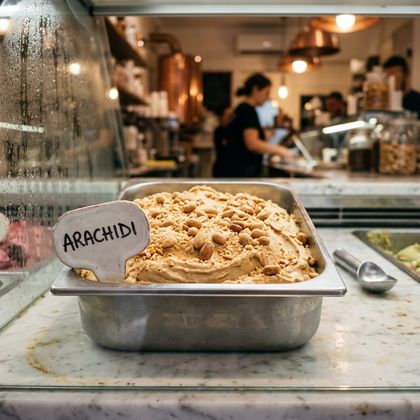
If you already know the sugared version of this, the differences arrive in order. Peanut first, and louder: the paste here is 100% nut, with no factory sugar or salt folded into it, so 70 g per kilo tastes of more peanut than the same weight of a supermarket spread would. Sweetness second, and thinner, since maltitol and erythritol carry a faint cooling edge that sucrose never has. Body third, and firmer on the spoon. What it cannot do is go nuttier: the paste is roughly a quarter protein, and the version at 90 g per kilo failed on the 5% protein ceiling, so 70 g is where it stops.
At 70 g the flavour still dominates, because the paste is pure. No factory sugar, no added oil, no salt, which makes it considerably more intense than a commercial peanut butter at the same weight. The salt line is 2 g per kilo, double what the rest of this keto batch uses, and it is there to rebuild the salted peanut butter profile that people actually expect from the flavour.
Cream was given a floor of zero on purpose, because the paste is around 49.7 percent fat and 70 g of it already puts roughly 3.5 percent fat into the mix before any dairy is counted. The solver settled at 65 g of cream, total fat 8.01 percent inside 6 to 12, with 20 g of plain water as the final adjustment.
Ingredients
Makes 1000 g of finished base.
| Ingredient | Grams | Home measure |
|---|---|---|
| Whole Milk | 639 | 2 2/3 cups |
| Maltitol | 163 | |
| Peanut Paste 100% | 70 | |
| Heavy Cream 35% | 65 | 1/4 cup |
| Non-Fat Dry Milk | 23 | 1/4 cup |
| Water | 20 | 1 1/2 tablespoons |
| Erythritol | 14 | |
| Stabilizer (Neutral) | 4 | |
| Salt | 2 |
Loads these exact grams into the free balancer, ready to edit.
Method
Paste emulsified at 60 to 65 C, 12 hour age, shallow tray
- 1Whisk every dry ingredient together first: sugars, milk powder, stabiliser and salt. Dry-blending them stops the stabiliser clumping when it meets liquid.
- 2Warm the liquids to 40 C (104 F), then rain the dry mix in while whisking hard.
- 3Heat to 82 C (180 F) and hold for 2 minutes so the stabiliser hydrates.
- 4Off the heat, whisk in the paste, then blend 60 seconds so the fat emulsifies instead of separating.
- 5Chill in an ice bath to under 5 C (41 F) within 2 hours. Slow cooling is where bacteria and coarse crystals both start.
- 6Age 6 to 12 hours in the fridge under 5 C (41 F). This is when the stabiliser and the milk protein take up water.
- 7Freeze in a shallow metal pan 2 to 3 cm deep, breaking the crystals with a fork every 30 to 40 minutes, 4 to 6 times.
- 8Freeze firm, then temper 10 to 15 minutes in the fridge before scooping.
The balance
All six against the professional range for Milk Gelato.
Protein at 4.78 percent against a 5 percent ceiling is the binding constraint of this sheet, and every other quantity bends around it. It is why the paste stopped at 70 g, why the milk powder is only 23 g, the lowest of this keto batch, and why MSNF sits at 8.32 percent, barely above its 8 floor: there was no protein budget left to spend on dairy solids. The second anchor is fat at 8.01 percent, which the paste supplies about 3.5 points of on its own, so cream stops at 65 g. Everything else: solids 38.02 percent against 36 to 42, sugars 18.04 against 16 to 22, POD 158.93 against 140 to 200, PAC 260.86 against 220 to 300, water 61.98 against 58 to 64. Lactose is 4.53 percent of the mix and 7.31 percent of the water, a direct consequence of that small milk powder line.
Estimated nutrition: ~192 kcal · Fat 8 g · Sugars 18 g · Protein 4.8 g (per 100 g of mix, from the balanced composition).
A 100 percent paste separates oil in the jar, so stir the whole jar back together before weighing, otherwise the 70 g you weigh is not the composition the balance assumed. Emulsify the paste with part of the base at 60 to 65 C at high shear before it joins the rest, and never drop it straight into the pot. Peanut fat is mostly unsaturated and crystallises poorly, which softens the gelato and lowers its melt resistance, so compensate with a long age, 12 hours at 4 C, to give the dairy fat time to crystallise and build a network. And with no sucrose in the sheet there is no low water activity protection against oxidation: store it away from light and eat it within three weeks so it does not go rancid.
If it goes wrong
The paste was added without being emulsified, so its 49.7 percent fat never entered the emulsion properly.
Blend the 70 g of paste with part of the base at 60 to 65 C at high shear, then combine. Also homogenise the jar before weighing.
Peanut fat is mostly unsaturated and crystallises badly, so the fat network never formed.
Age the full 12 hours at 4 C so the dairy fat crystallises and does the structural work the peanut fat cannot.
Oxidation of the unsaturated peanut fat, with no sucrose in the mix to lower water activity and slow it down.
Keep it covered and away from light, and plan on finishing it within three weeks rather than treating it as a long keeper.
Suitable for: Vegetarian, Egg-free, No added sugar
Allergens: milk, peanuts
- Goff & Hartel, Ice Cream, 7th ed., Springer 2013, cap. 4, contribuicao de pastas de oleaginosas para gordura e proteina: https://link.springer.com/book/10.1007/978-1-4614-6096-1
- University of Guelph, Dairy Science and Technology, Ice Cream Manufacture (equilibrio gordura/MSNF e defeitos de corpo): https://www.uoguelph.ca/foodscience/book-page/ice-cream-manufacture
- USDA FoodData Central, composicao de pasta de amendoim integral sem aditivos: https://fdc.nal.usda.gov/
- The science behind it: Keto Gelato
- Ingredient sheet: Peanut Paste 100%
Want to change an ingredient and watch the numbers move? Open the free balancer