Keto Mint Chocolate Chip Gelato
A leafy chill lands alongside the cold one, sweet without sucrose doing any of the work, and the chocolate turns up as brittle flakes that snap instead of chew.
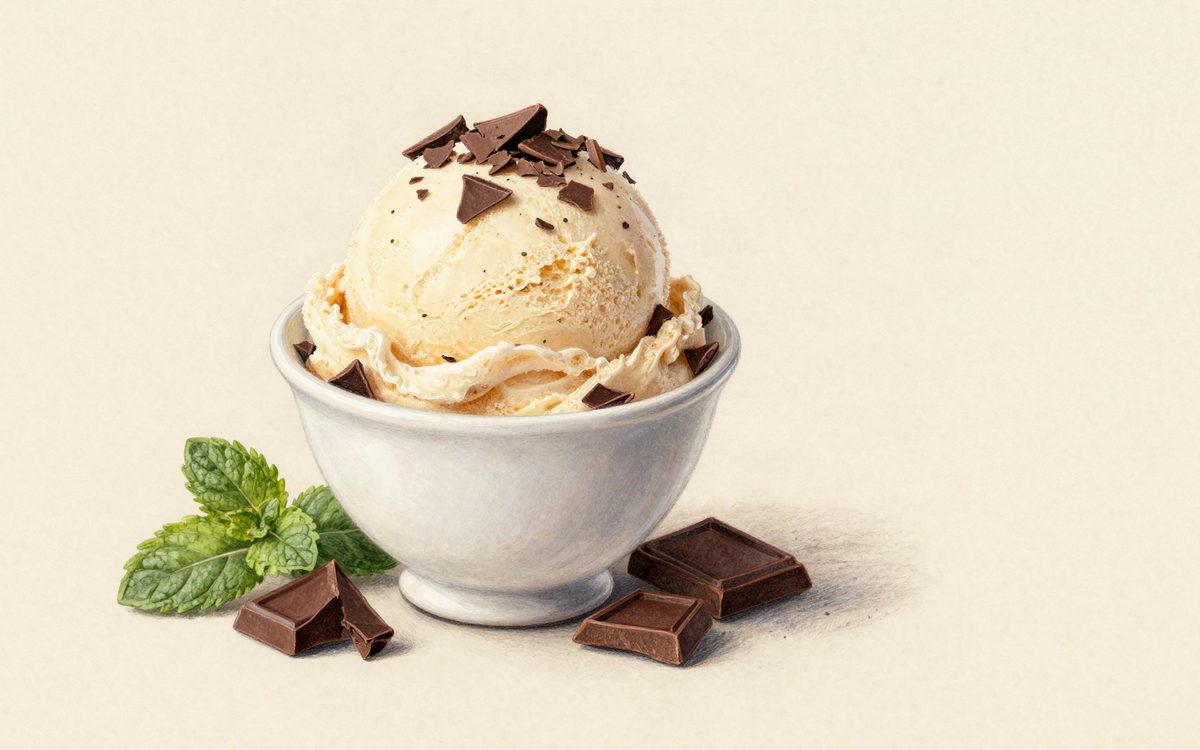
Green arrives before sweetness does, grassy and light, and it clears the front of the mouth almost as fast as it came, which is what an infusion does and an extract never does: extract parks at the back of the throat and refuses to leave. Weight follows, though not the ordinary kind of sweetness, with maltitol carrying the load and a small dose of erythritol keeping the base from setting hard. Last on the spoon comes the chocolate, 60 g of 90 per cent drizzled into the running machine so it lands as a flake that shatters rather than a block you have to work through.
The chip is 60 g of 90 percent chocolate, which on a sucrose free sheet is the only viable bar: about 7 percent sugars against 30 percent in a 70 percent bar. It goes in melted and drizzled in a thin stream at the end of the freezing, which is what turns it into a fine flake rather than a hard block. That is the stracciatella format, and on this recipe it is also a texture decision, because a 90 percent bar sets very hard and a thick chip would be unpleasant.
On the sweeteners, maltitol at 160 g carries the sweetness and 16 g of erythritol does something specific here: with PAC 280 it is the strongest freezing point depressant per gram in the sheet, and a base with no sucrose sets firmer than usual. PAC finishes at 260.08 inside 220 to 300, with sugars at 18.03 percent and fat at 8.36 percent from 617 g of milk and 85 g of cream.
Ingredients
Makes 1000 g of finished base.
| Ingredient | Grams | Home measure |
|---|---|---|
| Whole Milk | 617 | 2 1/2 cups |
| Maltitol | 160 | |
| Heavy Cream 35% | 85 | 1/3 cup |
| Dark Chocolate 90% | 60 | |
| Mint | 30 | |
| Non-Fat Dry Milk | 27 | 1/4 cup plus 1 tablespoon |
| Erythritol | 16 | |
| Stabilizer (Neutral) | 4 | |
| Salt | 1 |
Loads these exact grams into the free balancer, ready to edit.
Method
20 minute mint infusion, strained, chocolate drizzled at the end
- 1Whisk every dry ingredient together first: sugars, milk powder, stabiliser and salt. Dry-blending them stops the stabiliser clumping when it meets liquid.
- 2Warm the liquids to 40 C (104 F), then rain the dry mix in while whisking hard.
- 3Heat to 82 C (180 F) and hold for 2 minutes so the stabiliser hydrates.
- 4Melt the chocolate to 45 C (113 F) and stir it into the hot base off the heat, then blend 60 seconds until glossy.
- 5Chill in an ice bath to under 5 C (41 F) within 2 hours. Slow cooling is where bacteria and coarse crystals both start.
- 6Age 6 to 12 hours in the fridge under 5 C (41 F). This is when the stabiliser and the milk protein take up water.
- 7Freeze in a shallow metal pan 2 to 3 cm deep, breaking the crystals with a fork every 30 to 40 minutes, 4 to 6 times.
- 8Freeze firm, then temper 10 to 15 minutes in the fridge before scooping.
The balance
All six against the professional range for Milk Gelato.
MSNF at 8.61 percent is the number that shaped this list. The mint infusion contributes water and almost no solids, so the sheet had to carry 617 g of whole milk plus 27 g of milk powder just to keep MSNF above its 8 floor, and that in turn puts protein at 4.07 percent under a 5 ceiling. The second anchor is PAC at 260.08, mid band in 220 to 300, which is why 16 g of erythritol at PAC 280 is in the list beside the 160 g of maltitol: a base without sucrose freezes harder, and PAC is the counterweight. The rest: solids 38.25 percent against 36 to 42, sugars 18.03 against 16 to 22, fat 8.36 against 6 to 12, POD 158.86 against 140 to 200, water 61.75 against 58 to 64. Lactose sits at 4.69 percent of the mix and 7.6 percent of the water.
Estimated nutrition: ~195 kcal · Fat 8.4 g · Sugars 18 g · Protein 4.1 g (per 100 g of mix, from the balanced composition).
Infuse the mint at 80 to 85 C for a maximum of 20 minutes, then strain. Go longer and you extract chlorophyll and tannins, which makes the gelato bitter, gives it a hay note and turns it olive green. Do not blend or chop the leaf, just bruise it lightly. For the chocolate, hold it between 30 and 35 C and pour it in a thin stream over gelato that is already around minus 6 C at the end of churning: warmer and it dissolves into the mix, colder and it lands as a hard lump that fights the spoon. Because there is no sucrose, the base sets a little firmer than usual, so pull it with slightly more overrun than you normally would.
If it goes wrong
The infusion ran too long or too hot, pulling chlorophyll and tannins out of the leaf.
Cap it at 20 minutes between 80 and 85 C, then strain immediately. Bruise the leaves, never blend them.
The chocolate was too warm when it went in, or it went into the mix rather than into the freezing gelato.
Hold it at 30 to 35 C and drizzle it in a thin stream over gelato already at about minus 6 C, at the last stir of the freezing.
The chocolate was too cold and fell in lumps. A 90 percent bar sets very hard.
Bring it back to 30 to 35 C and pour thinner and slower, keeping the gelato moving as it falls.
Suitable for: Vegetarian, Egg-free
Allergens: milk
- Goff & Hartel, Ice Cream, 7th ed., Springer 2013, cap. 3, infusoes e incorporacao de particulados: https://link.springer.com/book/10.1007/978-1-4614-6096-1
- University of Guelph, Dairy Science and Technology, Ice Cream Manufacture (adicao de inclusoes e ponto de extracao da batedeira): https://www.uoguelph.ca/foodscience/book-page/ice-cream-manufacture
- EFSA Journal, poliois e depressao do ponto de congelamento: https://www.efsa.europa.eu/en/efsajournal/pub/2076
- The science behind it: Keto Gelato
- Ingredient sheet: Dark Chocolate 90%
Want to change an ingredient and watch the numbers move? Open the free balancer