Keto Coffee Gelato
Bitter and properly cold, it opens on espresso aroma and closes on roast, fuller in the mouth than most no added sugar versions manage without going dry.
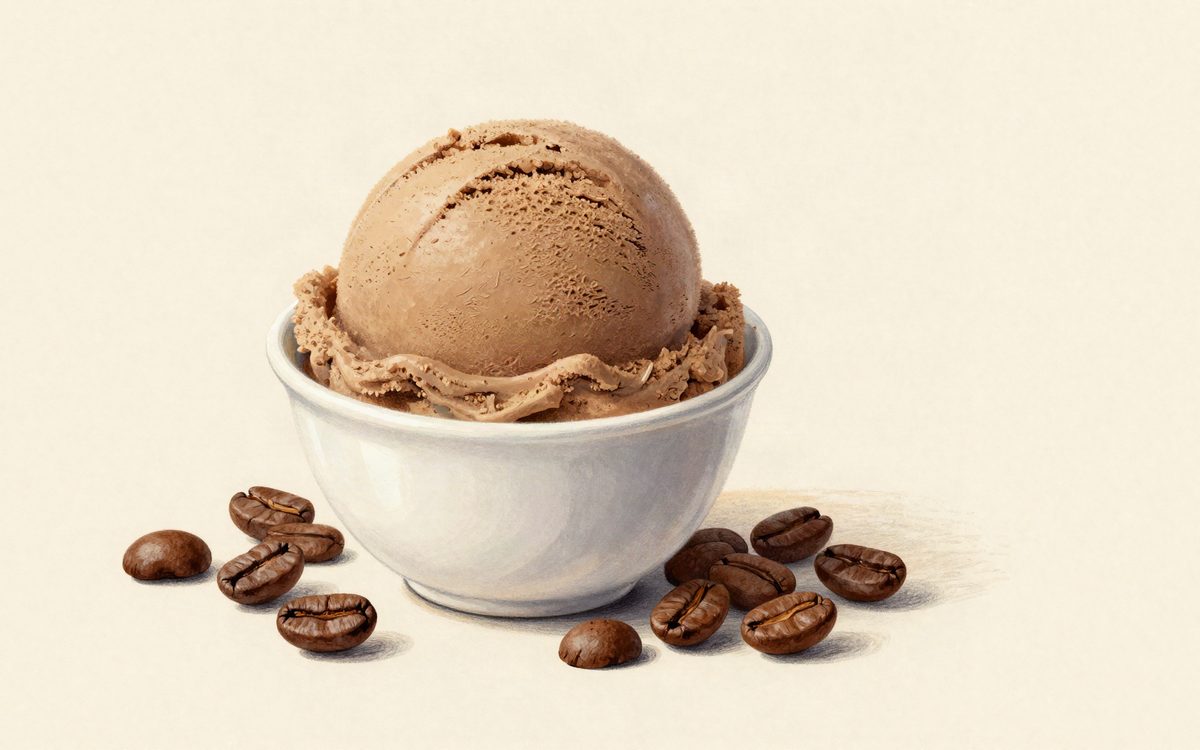
Anyone who has eaten a normal coffee gelato will notice the trade immediately. Sucrose there sweetens, softens and quietly masks bitterness; take it out and the roast stands exposed, which is why maltitol carries the load at 85 percent of the sweetening power of sucrose while erythritol sits at 70. What you lose is the rounded sweetness and a little cushion on the palate. What you gain is coffee you can actually taste. Two coffees do that job: 90 g of concentrated espresso for the volatiles and the acidity, 6 g of instant for roasted body and colour at no cost in water. The 180 g of cream is there to cover the dryness polyols leave behind.
The cream line is the other decision worth explaining. At 180 g it is the highest of this keto batch, and it is not there to hit the fat target, since fat closes at 8.13 percent inside a 6 to 12 band and could have been reached with much less. It is there because polyols leave a dry, slightly astringent finish on the palate, and fat is what covers it and carries the coffee aroma.
Maltitol carries the sweetness at 167 g because it holds about 85 percent of the sweetening power of sucrose, against 70 percent for erythritol and allulose and 47.5 percent for isomalt. In a coffee sheet that matters more than usual, because with no sucrose in the mix the bitterness of the coffee is fully exposed. Sugars close at 17.96 percent, PAC at 259.47.
Ingredients
Makes 1000 g of finished base.
| Ingredient | Grams | Home measure |
|---|---|---|
| Whole Milk | 492 | 2 cups |
| Heavy Cream 35% | 180 | 3/4 cup |
| Maltitol | 167 | |
| Espresso (Rich) | 90 | |
| Non-Fat Dry Milk | 45 | 1/3 cup plus 2 tablespoons |
| Erythritol | 12 | |
| Instant Coffee | 6 | |
| Stabilizer (Neutral) | 4 | |
| Whey Protein 80% | 3 | |
| Salt | 1 |
Loads these exact grams into the free balancer, ready to edit.
Method
Instant in the hot phase, espresso in below 40 C, 8 to 12 hour age
- 1Whisk every dry ingredient together first: sugars, milk powder, stabiliser and salt. Dry-blending them stops the stabiliser clumping when it meets liquid.
- 2Warm the liquids to 40 C (104 F), then rain the dry mix in while whisking hard.
- 3Heat to 82 C (180 F) and hold for 2 minutes so the stabiliser hydrates.
- 4Chill in an ice bath to under 5 C (41 F) within 2 hours. Slow cooling is where bacteria and coarse crystals both start.
- 5Age 6 to 12 hours in the fridge under 5 C (41 F). This is when the stabiliser and the milk protein take up water.
- 6Freeze in a shallow metal pan 2 to 3 cm deep, breaking the crystals with a fork every 30 to 40 minutes, 4 to 6 times.
- 7Freeze firm, then temper 10 to 15 minutes in the fridge before scooping.
The balance
All six against the professional range for Milk Gelato.
Look at the milk powder and the whey. MSNF has to sit inside 8 to 11.5 and lands at 9.99 percent, but the lactose that comes with milk powder is already at 5.44 percent of the mix and 8.77 percent of the water, so the solver stopped the milk powder at 45 g and used 3 g of whey protein 80 percent as a rounding lever to reach protein 3.98 percent against a 5 percent ceiling. That is why a 3 g line exists in the ingredient list at all. The rest reads: solids 37.97 percent against 36 to 42, sugars 17.96 against 16 to 22, fat 8.13 against 6 to 12, POD 159.61 against 140 to 200, PAC 259.47 against 220 to 300, water 62.03 against 58 to 64.
Estimated nutrition: ~193 kcal · Fat 8.1 g · Sugars 18 g · Protein 4 g (per 100 g of mix, from the balanced composition).
Order of addition decides the result on this one. The instant coffee goes into the hot phase alongside the polyols, because it needs to hydrate and extract. The espresso goes in after pasteurisation, during cooling, below 40 C: espresso volatiles evaporate at 85 C and what survives is only bitterness. Second point, the espresso drops the base to pH 5.0 to 5.2, and added hot it curdles the milk protein, so it goes in cold and under agitation. Age 8 to 12 hours at 4 C. Last, if the finished body feels thin, do not raise the milk powder to fix it, because lactose is already at 5.44 percent of the mix and 8.77 percent of the water. Add inulin instead.
If it goes wrong
The 90 g of espresso went in during the hot phase and its volatiles evaporated at 85 C.
Pasteurise the base with the 6 g of instant only, then stir the espresso in during cooling, below 40 C.
Hot espresso. It drops the base to pH 5.0 to 5.2 and at high temperature that curdles the milk protein.
Cool below 40 C first and pour the espresso in slowly with the whisk running.
Lactose crystallising. This sheet already carries 5.44 percent lactose in the mix and 8.77 percent in the water, and 45 g of milk powder is where that comes from.
Do not push the milk powder past the 45 g in the sheet to correct body. Use inulin for body instead, and keep the base sealed so it does not lose water in the freezer.
Suitable for: Vegetarian, Egg-free, No added sugar
Allergens: milk
- Goff & Hartel, Ice Cream, 7th ed., Springer 2013, cap. 3, aromatizacao e perdas de volateis na pasteurizacao: https://link.springer.com/book/10.1007/978-1-4614-6096-1
- University of Guelph, Ice Cream Structure (papel da gordura na liberacao de aroma e na percepcao de cremosidade): https://www.uoguelph.ca/foodscience/book-page/ice-cream-structure
- EFSA Journal, poliois: poder edulcorante relativo e efeitos sensoriais: https://www.efsa.europa.eu/en/efsajournal/pub/2076
- The science behind it: Keto Gelato
- Ingredient sheet: Espresso (Rich)
Want to change an ingredient and watch the numbers move? Open the free balancer