Keto Coconut Gelato, Dairy Free
Coats the tongue like a cream base with no sugar bite anywhere, warm aroma at the front, and dry flecks that carry it past the swallow.
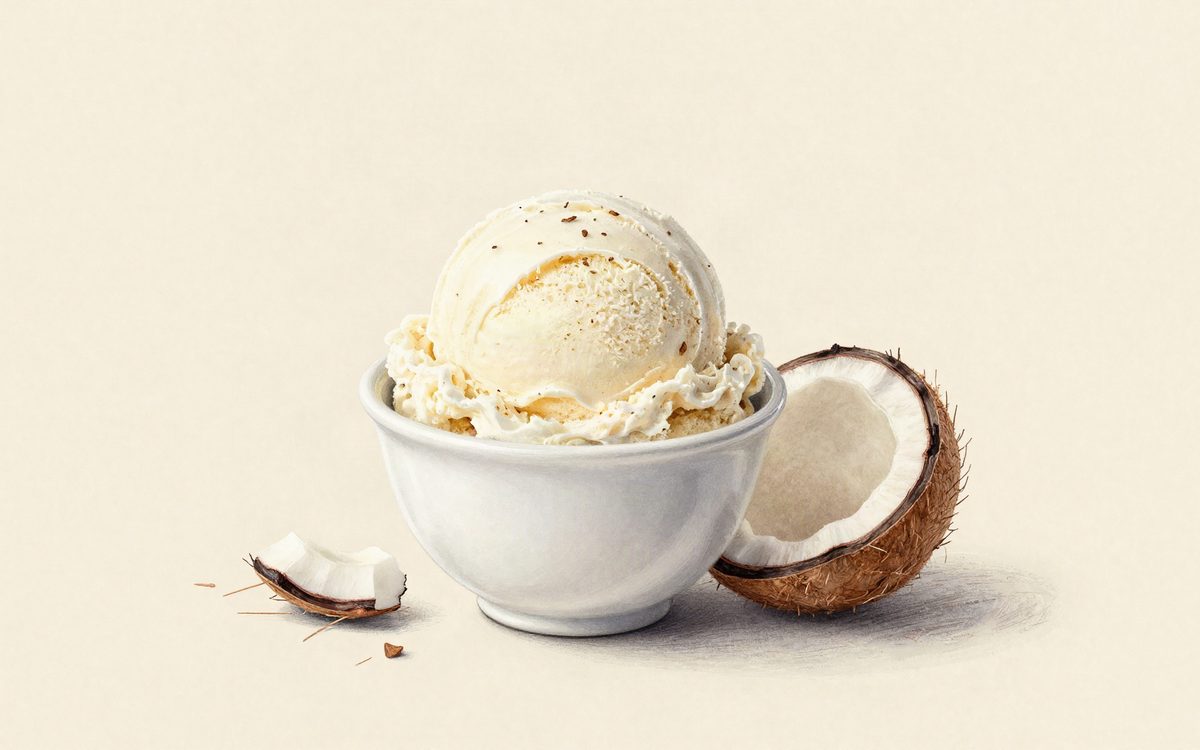
In the tropics the fat that builds a frozen dessert never had to come from a cow. It is pressed out of the palm as milk, and it does the same work: it coats the tongue, it carries aroma, and it keeps the texture from turning icy. That is the whole logic here. Coconut milk at 400 g per kilo takes the place cream would hold elsewhere, the powder at 30 g and 15 g of dried shredded coconut concentrate the aroma without bringing free water with them, and soy milk is the outsider on the list, present only because coconut cannot lift protein on its own. With sucrose gone entirely, the fruit fat is what you are left tasting.
Protein is where coconut runs out. The vegan band asks for 1 to 3.5 percent, and coconut milk is only about 2 percent protein, so all 445 g of coconut products together deliver roughly 1.1 percent, just above the floor. A vegetable protein carrier lifts that figure, and unsweetened soy milk is the neutral one: 260 g takes protein to 2.02 percent without adding sugar or fat. MSNF reads 0.0, which is what a dairy free sheet should read.
The sweetener block is five ingredients because no single one does the job. The IMO 900 with thaumatin bulk at 132 g has POD 80 with PAC 80, a ratio of 1, which is what lets the sheet reach the PAC floor without running at the 310 ceiling. Allulose at 20 g, PAC 190, and erythritol at 22 g, PAC 280, are the antifreeze fine tuning, isomalt at 24 g is low PAC ballast, and 17 g of inulin HP adds solids and body at almost no PAC cost. Final reading: sugars 20.95 percent inside 17 to 24, PAC 254.48 inside 220 to 310.
Ingredients
Makes 1000 g of finished base.
| Ingredient | Grams | Home measure |
|---|---|---|
| Coconut Milk | 400 | 1 2/3 cups |
| Soy Milk (Unsweetened) | 260 | |
| IMO 900 + Thaumatin (Moonsugar) | 132 | |
| Water | 75 | 1/4 cup plus 1 tablespoon |
| Coconut Milk Powder | 30 | |
| Isomalt | 24 | |
| Erythritol | 22 | |
| Allulose | 20 | |
| Inulin HP | 17 | |
| Dried Shredded Coconut | 15 | |
| Stabilizer (Neutral) | 4 | |
| Salt | 1 |
Loads these exact grams into the free balancer, ready to edit.
Method
Hot homogenise at 65 to 70 C, never boiled, 6 to 12 hour age
- 1Whisk every dry ingredient together first: sugars, milk powder, stabiliser and salt. Dry-blending them stops the stabiliser clumping when it meets liquid.
- 2Warm the liquids to 40 C (104 F), then rain the dry mix in while whisking hard.
- 3Heat to 82 C (180 F) and hold for 2 minutes so the stabiliser hydrates.
- 4Chill in an ice bath to under 5 C (41 F) within 2 hours. Slow cooling is where bacteria and coarse crystals both start.
- 5Age 6 to 12 hours in the fridge under 5 C (41 F). This is when the stabiliser and the milk protein take up water.
- 6Freeze in a shallow metal pan 2 to 3 cm deep, breaking the crystals with a fork every 30 to 40 minutes, 4 to 6 times.
- 7Freeze firm, then temper 10 to 15 minutes in the fridge before scooping.
The balance
All six against the professional range for Vegan Creamy Base.
Fat at 11.65 percent and protein at 2.02 percent are the two numbers that decided the ingredient list, and they pull in opposite directions. Coconut is generous with fat and poor in protein, so the fat figure sits in the upper half of 7 to 13 from the coconut alone, while protein needed 260 g of a second milk to reach 2.02 percent. Everything else follows: solids 38.4 percent against 35 to 42, sugars 20.95 against 17 to 24, POD 161.61 against 130 to 195, PAC 254.48 against 220 to 310, water 61.6 against 58 to 65, MSNF 0.0 against a 0 to 1 band. Lactose is 0.0, so sandiness from lactose crystals is simply not a failure mode on this one.
Estimated nutrition: ~212 kcal · Fat 11.7 g · Sugars 21 g · Protein 2 g (per 100 g of mix, from the balanced composition).
Coconut fat is around 90 percent saturated and crystallises at a higher temperature than dairy fat, so the 6 to 12 hour rest at 4 C is what produces partial coalescence. Skip it and the gelato is waxy and falls apart. Homogenise while hot, 65 to 70 C, or the fat phase separates. Pasteurise at 65 C for 30 minutes or fast at 82 to 85 C, but do not boil: the coconut protein and lipid emulsion breaks and the result is oily in the mouth. Hydrate the coconut milk powder and the fibre in cold liquid before heating, otherwise they lump. Erythritol is strongly endothermic and poorly soluble, so dissolve it hot and keep it under 3 percent of the mass, which the 22 g respects, because above that the palate reads it as menthol. One honest note for the label: the total polyol load is around 20 percent of the mass, which in the EU requires the laxative effect statement, and IMO is sold as a keto sweetener but is partially digested, so the correct claim is no added sugar, not zero net carbs.
If it goes wrong
Ageing was cut short. Coconut fat is about 90 percent saturated and needs time at 4 C to crystallise before churning.
Hold the mix 6 to 12 hours at 4 C. On a coconut base this is the structure step, not a formality.
The mix was boiled, or homogenised cold. Either one breaks the coconut protein and lipid emulsion.
Homogenise at 65 to 70 C and cap pasteurisation at 82 to 85 C, or run the low route at 65 C for 30 minutes.
Erythritol out of solution or overdosed. It is endothermic and its solubility is limited.
Dissolve it in the hot phase and keep it at the 22 g in the sheet, which is 2.2 percent of the mass, below the 3 percent line.
Suitable for: Vegan, Vegetarian, Lactose-free, Egg-free, No added sugar
Allergens: soy
- Goff, H. D.; Hartel, R. W. Ice Cream, 7a ed. Springer, 2013 (cap. 3, Mix Composition and Calculations)
- University of Guelph, Dairy Science and Technology eBook (H. D. Goff), secao Ice Cream: https://www.uoguelph.ca/foodscience/book-page/ice-cream-manufacture
- Corvitto, A. Los secretos del helado: el helado sin secretos. Vilbo, 2004 (tabelas de POD e PAC por acucar e poliol)
- Regulamento (UE) 1169/2011, Anexo III (declaracao obrigatoria de efeito laxativo acima de 10% de poliois): https://eur-lex.europa.eu/eli/reg/2011/1169/oj
- The science behind it: Keto Gelato
- Ingredient sheet: Coconut Milk
Want to change an ingredient and watch the numbers move? Open the free balancer