Keto Chocolate Gelato
Bitterer and drier than a sugared chocolate gelato, with cocoa landing hard and clean, a faint cooling finish and none of that sweet weight left behind.
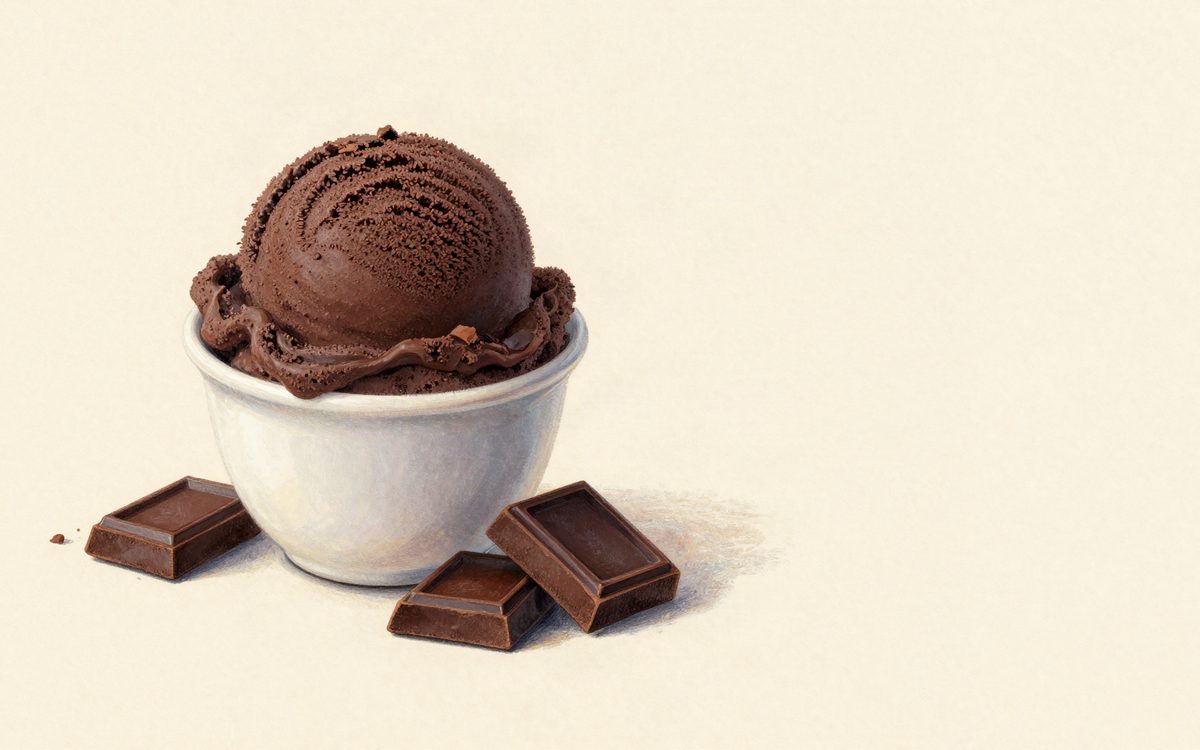
Against the sugared version of the same thing, the trade here is easy to state. The bitterness comes through harder and cleaner, without the sweet cushion that normally softens cocoa, and the finish is shorter and far less cloying. What it gives up is exactly that cushion, since sucrose builds body as well as sweetness. So the sheet leans on maltitol for the sweet mass, a little erythritol for fine tuning, and 150 g of plain water per kilo simply to dilute a cocoa that is 97 percent solids. The bar has to be a 90 percent, the only one carrying little enough sugar of its own, and 50 g of it earns its place in cocoa butter, gloss and fatty body.
What makes this recipe tight is the cocoa pushing two ceilings at once. It is roughly 20 percent protein, so protein climbs to 4.89 percent against a 5 percent ceiling, and it is about 97 percent solids, so total solids reach 40.1 percent against a 42 percent ceiling. That is why water appears as a free lever at 150 g per kilo, which is unusual in a dairy base: it is the only ingredient that dilutes without dragging protein or lactose along with it. The whole milk line drops to 482 g, the lowest of this keto batch.
The sweetening follows the same logic. Maltitol carries the load at 158 g because its PAC is the closest to sucrose among the polyols, and 17 g of erythritol does the fine tuning. Sugars land at 17.94 percent inside 16 to 22, and PAC at 258.81 inside 220 to 300.
Ingredients
Makes 1000 g of finished base.
| Ingredient | Grams | Home measure |
|---|---|---|
| Whole Milk | 482 | 2 cups |
| Maltitol | 158 | |
| Water | 150 | 1/2 cup plus 2 tablespoons |
| Cocoa Powder 22-24% | 60 | |
| Dark Chocolate 90% | 50 | |
| Heavy Cream 35% | 40 | 2 1/2 tablespoons |
| Non-Fat Dry Milk | 38 | 1/3 cup plus 1 tablespoon |
| Erythritol | 17 | |
| Stabilizer (Neutral) | 4 | |
| Salt | 1 |
Loads these exact grams into the free balancer, ready to edit.
Method
Cocoa dry blended, constant stir to 85 C, 12 hour age
- 1Whisk every dry ingredient together first: sugars, milk powder, stabiliser and salt. Dry-blending them stops the stabiliser clumping when it meets liquid.
- 2Warm the liquids to 40 C (104 F), then rain the dry mix in while whisking hard.
- 3Heat to 82 C (180 F) and hold for 2 minutes so the stabiliser hydrates.
- 4Melt the chocolate to 45 C (113 F) and stir it into the hot base off the heat, then blend 60 seconds until glossy.
- 5Chill in an ice bath to under 5 C (41 F) within 2 hours. Slow cooling is where bacteria and coarse crystals both start.
- 6Age 6 to 12 hours in the fridge under 5 C (41 F). This is when the stabiliser and the milk protein take up water.
- 7Freeze in a shallow metal pan 2 to 3 cm deep, breaking the crystals with a fork every 30 to 40 minutes, 4 to 6 times.
- 8Freeze firm, then temper 10 to 15 minutes in the fridge before scooping.
The balance
All six against the professional range for Milk Gelato.
Solids at 40.1 percent and protein at 4.89 percent are the two numbers that wrote this ingredient list. Both are close to their ceilings, 42 and 5, and both are pushed there by the cocoa powder alone, which is why 150 g of water had to be in the mix and why the milk powder stops at 38 g. The knock on effects are visible elsewhere: fat reads 7.16 percent, the leanest of this batch, MSNF 8.21 percent just above its 8 floor, and water 59.9 percent low in its 58 to 64 band, so there is genuinely nowhere left to move. Sugars close at 17.94 against 16 to 22, POD at 157.6 against 140 to 200, PAC at 258.81 against 220 to 300. Lactose reads 4.47 percent of the mix and 7.47 percent of the water, low, because most of the dairy was traded for water.
Estimated nutrition: ~196 kcal · Fat 7.2 g · Sugars 17.9 g · Protein 4.9 g (per 100 g of mix, from the balanced composition).
Without sucrose the hot mix is noticeably thinner, and cocoa powder settles and scorches on the bottom far more easily than it would in a normal base. Use a heavy pan and keep it moving all the way to 85 C. Hydrate the cocoa properly first: dry blend it with the polyols, disperse that into part of the milk at 45 C, and only then start heating. Melt the 90 percent chocolate separately at 45 C and emulsify it into the hot base. The third issue is bitterness, exposed here because there is no sucrose to mask the cocoa and the 90 percent bar: the 1 g of salt is not seasoning, it is bitterness suppression. Age 12 hours at 4 C so the cocoa butter crystallises before churning.
If it goes wrong
The cocoa settled. A sucrose free mix has low hot viscosity and will not hold 60 g of cocoa powder in suspension on its own.
Dry blend the cocoa with the polyols, disperse it in milk at 45 C, then heat in a heavy pan with continuous agitation to 85 C.
Nothing is masking it. With 60 g of cocoa and 50 g of a 90 percent bar and no sucrose in the sheet, bitterness has a clear path.
Do not cut the 1 g of salt, which is there to suppress bitterness, and use the specified 22 to 24 percent fat cocoa rather than a low fat one.
The cocoa butter from the 50 g of chocolate never crystallised, because ageing was cut short.
Give it the full 12 hours at 4 C after cooling. This is the step that turns the melted chocolate into structure instead of grease.
Suitable for: Vegetarian, Egg-free
Allergens: milk
- Goff & Hartel, Ice Cream, 7th ed., Springer 2013, caps. 3 e 5, gelato ao chocolate e ajuste de solidos: https://link.springer.com/book/10.1007/978-1-4614-6096-1
- University of Guelph, Dairy Science and Technology, Ice Cream Manufacture (limites de solidos totais e defeitos por excesso): https://www.uoguelph.ca/foodscience/book-page/ice-cream-manufacture
- EFSA Journal, poliois e uso como substitutos de acucar em alimentos: https://www.efsa.europa.eu/en/efsajournal/pub/2076
- The science behind it: Keto Gelato
- Ingredient sheet: Cocoa Powder 22/24
Want to change an ingredient and watch the numbers move? Open the free balancer