Keto Cheesecake Gelato
Sour arrives before sweet, over a dense, cool body that coats the tongue, and the salted edge at the end fades clean instead of clinging.
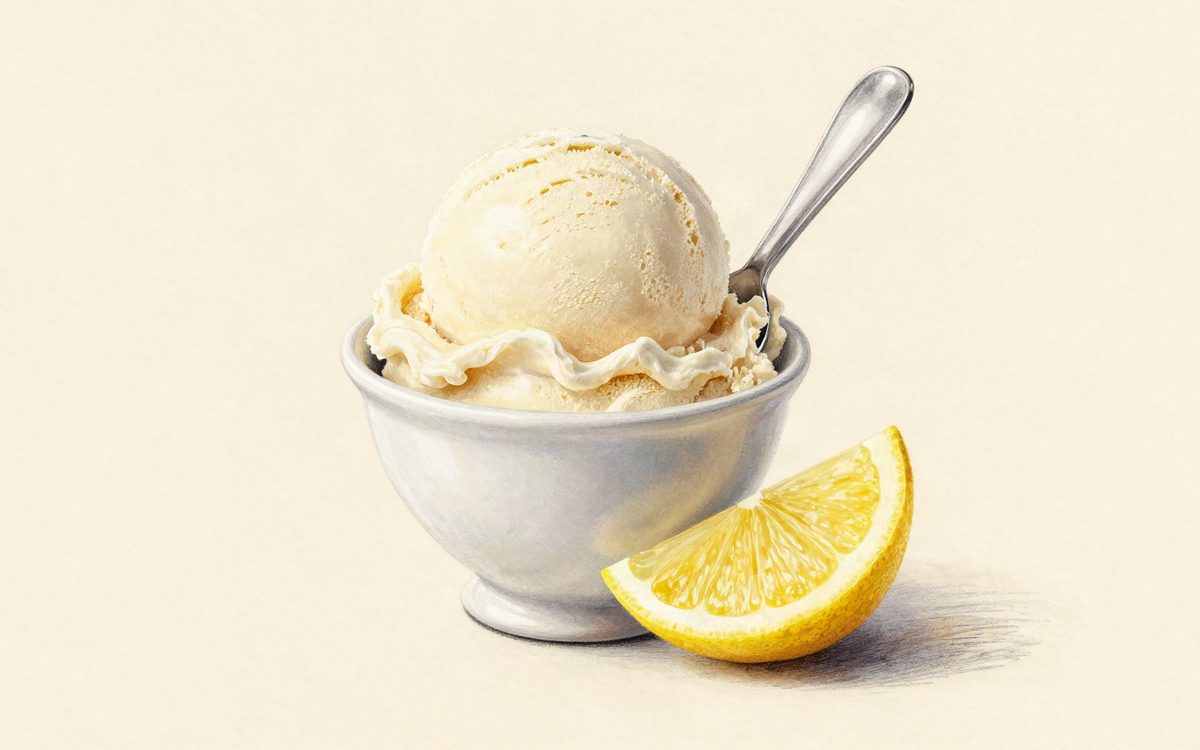
What lands first is not sweetness. Lemon juice at 12 g per kilo and the lactic tang of 180 g of cream cheese arrive together, and the sweetness follows a beat behind them, cooler and cleaner than sugar because maltitol and a little erythritol are carrying it. The body is thick without being greasy: fat closes at 8.52 percent and almost all of it comes from the cheese rather than from cream, which is why the cream line reads 10 g. It coats the palate, holds the sour note for a few seconds after the cold has gone and finishes dry. Nothing crunches, because the almond crust belongs on top of the scoop and not inside the mix.
Lemon juice at 12 g is not garnish. It is the lactic acidity that makes the flavour read as cheesecake instead of cold cream cheese, and it has to land in a narrow window. The target pH is 4.8 to 5.2, acid enough to taste and still above 4.6, the isoelectric point of casein, where the base would simply curdle in the pot.
There is no sucrose in the sheet. The sugar slot is filled by 177 g of maltitol plus 10 g of erythritol, and the solver still reads 18.73 percent sugars against a 16 to 22 band with PAC at 259.91 inside 220 to 300. The biscuit part is deliberately absent from the mix, because flour and biscuit sugar would undo the whole point. Almond flour baked with butter and erythritol goes on top at serving and never enters the balance.
Ingredients
Makes 1000 g of finished base.
| Ingredient | Grams | Home measure |
|---|---|---|
| Whole Milk | 577 | 2 1/3 cups |
| Cream Cheese | 180 | |
| Maltitol | 177 | |
| Non-Fat Dry Milk | 29 | 1/4 cup plus 1 tablespoon |
| Lemon Juice | 12 | |
| Erythritol | 10 | |
| Heavy Cream 35% | 10 | 2 teaspoons |
| Stabilizer (Neutral) | 4 | |
| Salt | 1 |
Loads these exact grams into the free balancer, ready to edit.
Method
Cheese emulsified cold, lemon in last, 12 hour age
- 1Whisk every dry ingredient together first: sugars, milk powder, stabiliser and salt. Dry-blending them stops the stabiliser clumping when it meets liquid.
- 2Warm the liquids to 40 C (104 F), then rain the dry mix in while whisking hard.
- 3Heat to 82 C (180 F) and hold for 2 minutes so the stabiliser hydrates.
- 4Chill in an ice bath to under 5 C (41 F) within 2 hours. Slow cooling is where bacteria and coarse crystals both start.
- 5Age 6 to 12 hours in the fridge under 5 C (41 F). This is when the stabiliser and the milk protein take up water.
- 6Fold the fruit in cold, after ageing. Heating it costs you the fresh aroma and nothing is gained.
- 7Freeze in a shallow metal pan 2 to 3 cm deep, breaking the crystals with a fork every 30 to 40 minutes, 4 to 6 times.
- 8Freeze firm, then temper 10 to 15 minutes in the fridge before scooping.
The balance
All six against the professional range for Milk Gelato.
Two indicators explain the ingredient list. MSNF at 10.01 percent sits mid band in 8 to 11.5 and comes almost entirely from the cream cheese plus 29 g of milk powder, which is why the milk line can stay high at 577 g without the base going thin. Protein at 4.05 percent is the ceiling watcher, since cream cheese is about 6 percent protein and the band closes at 5. Around those two, fat reads 8.52 percent against 6 to 12, solids 38.0 against 36 to 42, sugars 18.73 against 16 to 22, POD 164.68 against 140 to 200, PAC 259.91 against 220 to 300, water 62.0 against 58 to 64. Lactose comes to 5.46 percent of the mix and 8.8 percent of the water, the highest reading in this keto batch, and the sheet still passes the sandiness check.
Estimated nutrition: ~195 kcal · Fat 8.5 g · Sugars 18.7 g · Protein 4.1 g (per 100 g of mix, from the balanced composition).
Cream cheese thrown into a hot pot coagulates and goes grainy, and no amount of blending brings it back. Soften it to 30 C and emulsify it with part of the cold milk in a stick blender before any heat goes in. Pasteurise at a maximum of 82 C, not the usual 85 C: above that the cheese proteins undergo syneresis and you will see whey separating out during ageing. The lemon goes in cold, at the end, once the base is under 20 C, because added hot it curdles on contact. Age 12 hours at 4 C.
If it goes wrong
The 180 g of cream cheese met direct heat before it was emulsified, or the mix went past 82 C.
Soften the cheese to 30 C, blend it into part of the cold milk first, and cap pasteurisation at 82 C.
Syneresis of the cheese protein, from overheating past 82 C, or from lemon juice added while the base was still hot.
Hold the 82 C ceiling and add the 12 g of lemon only after the base is below 20 C, stirring as it goes in.
Not enough acid in the finished base. The 12 g of lemon was cut, or it went in hot and cooked off.
Keep the full 12 g and add it cold. The base should land at pH 4.8 to 5.2, which is where the cheesecake note appears.
Suitable for: Vegetarian, Egg-free, No added sugar
Allergens: milk
- Goff & Hartel, Ice Cream, 7th ed., Springer 2013, cap. 4, uso de queijos frescos e desnaturacao proteica na pasteurizacao: https://link.springer.com/book/10.1007/978-1-4614-6096-1
- University of Guelph, Ice Cream Structure (estabilidade de caseina em funcao do pH e sinerese): https://www.uoguelph.ca/foodscience/book-page/ice-cream-structure
- USDA FoodData Central, composicao de cream cheese (gordura, proteina, solidos): https://fdc.nal.usda.gov/
- The science behind it: Keto Gelato
- Ingredient sheet: Cream Cheese
Want to change an ingredient and watch the numbers move? Open the free balancer