Italian Custard Gelato
Spoons like cold custard, vanilla out in front, egg richness underneath, and a lemon zest lift at the end that keeps it from eating heavy.
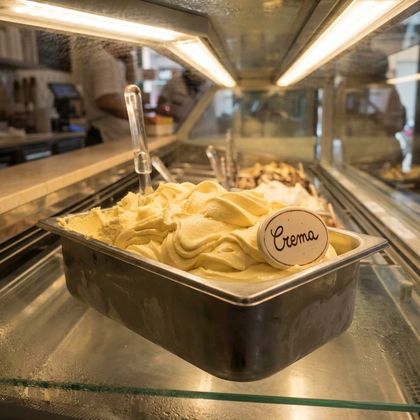
There is a narrow window on the yolk here, and the recipe sits in the middle of it. Under roughly 50 g per kilo there is not enough lecithin to emulsify properly and the texture eats icy; over roughly 90 g the egg starts talking over the vanilla and the protein climbs towards its 5% ceiling. At 70 g, three to four yolks per litre, the egg alone contributes 22.4 g of fat and 11.2 g of protein per kilo, which is why the cream line stays at 120 g and fat closes at 8.53%. In the mouth that reads as cold custard with vanilla still in front, and the 4 g of lemon zest cuts the fat so the finish stays clean.
That ceiling is the binding constraint here, not fat. 70 g of yolk delivers 22.4 g of fat and 11.2 g of protein per kilo, and the finished mix reads 8.53% fat against a 12% limit but 4.71% protein against a 5% one. Cream was left free with no minimum for exactly that reason, so dairy fat could be traded against yolk fat, and it settled at 120 g per kilo.
Stabilizer drops to 2 g per kilo, lower than an egg free milk gelato would use, because yolk lecithin already does part of that work. Keep it at 3 g alongside 70 g of yolk and the result is gummy rather than silky. The 4 g of lemon zest is the detail that separates an Italian crema from a French custard: volatile limonene cuts the fatty perception of the yolk and makes the vanilla read cleaner, without anyone identifying lemon.
Ingredients
Makes 1000 g of finished base.
| Ingredient | Grams | Home measure |
|---|---|---|
| Whole Milk | 581 | 2 1/2 cups |
| Sugar (Sucrose) | 125 | 1/2 cup plus 2 tablespoons |
| Heavy Cream 35% | 120 | 1/2 cup |
| Egg Yolk | 70 | |
| Non-Fat Dry Milk | 39 | 1/3 cup plus 1 tablespoon |
| Dextrose (Glucose) | 30 | 2 1/2 tablespoons |
| Glucose Powder | 25 | 2 tablespoons |
| Lemon Zest | 4 | |
| Vanilla Bean | 3 | |
| Stabilizer (Neutral) | 2 | |
| Salt | 1 |
Loads these exact grams into the free balancer, ready to edit.
Method
Tempered custard cooked to nappe, 12 hour rest, still-freeze
- 1Whisk every dry ingredient together first: sugars, milk powder, stabiliser and salt. Dry-blending them stops the stabiliser clumping when it meets liquid.
- 2Warm the liquids to 40 C (104 F), then rain the dry mix in while whisking hard.
- 3Beat the yolks with part of the sugar, then temper: pour the warm base over the yolks in a thin stream, never the other way round.
- 4Bring to 82 to 85 C (180 to 185 F) and stop. Past 87 C the yolk coagulates and no amount of blending brings the flavour back.
- 5Chill in an ice bath to under 5 C (41 F) within 2 hours. Slow cooling is where bacteria and coarse crystals both start.
- 6Age 6 to 12 hours in the fridge under 5 C (41 F). This is when the stabiliser and the milk protein take up water.
- 7Fold the fruit in cold, after ageing. Heating it costs you the fresh aroma and nothing is gained.
- 8Freeze in a shallow metal pan 2 to 3 cm deep, breaking the crystals with a fork every 30 to 40 minutes, 4 to 6 times.
- 9Freeze firm, then temper 10 to 15 minutes in the fridge before scooping.
The balance
All six against the professional range for Milk Gelato.
POD finishes at 164.13 in a 140 to 200 range, low for a custard, and that is the choice that sets this apart: 25 g of glucose powder per kilo add solids and freezing point control while sweetening far less than sucrose would. Sugars are 17.66% and total solids 37.6%, both comfortably inside their windows, and PAC 253.97 is mid-range so the tub firms up properly. Protein at 4.71% is the tightest number in the formula, sitting just under the 5% cap, because the 70 g of yolk contribute about 11.2 g of protein per kilo and the 39 g of non-fat dry milk is sized around whatever is left. Fat at 8.53% still has room in a 6 to 12 window, which is the opposite of what most people assume about an egg base. Lactose lands at 8.41% of the water phase, inside the sandiness limit.
Estimated nutrition: ~193 kcal · Fat 8.5 g · Sugars 17.7 g · Protein 4.7 g (per 100 g of mix, from the balanced composition).
The specific risk is scrambling. Yolk starts coagulating around 65 C and on its own would seize well before the 82 to 85 C the pasteurization needs. Two locks handle it. First, whisk the yolk with part of the sugar before it meets hot milk, since sugar lifts the coagulation temperature by roughly 5 to 10 C. Second, temper by pouring the hot milk onto the yolk in a thin stream, never the other way round. Take it to nappe between 82 and 85 C and stop. Past 87 C it has coagulated, and a stick blender will bring the texture back but not the cooked egg flavour. The lemon zest infuses in the hot milk and is strained out before the rest, otherwise the pith turns the base bitter. Rest 8 to 12 hours at 4 C, which matters more here than in any other base, because that is how long the yolk lecithin takes to reach the fat and water interface.
If it goes wrong
The yolk met the hot milk directly, or the base went past 87 C.
Whisk the yolk with part of the sugar first, pour the hot milk in a thin stream, and pull the pan at nappe between 82 and 85 C.
Stabilizer at the usual 3 g per kilo on top of 70 g of yolk. The lecithin was already doing part of that job.
Use the 2 g per kilo this formula specifies and nothing more.
Either the yolk dose was cut or the rest was skipped. Lecithin only works at the interface once it has had time to get there.
Keep 70 g of yolk per kilo and give the base its 8 to 12 hours at 4 C before freezing.
Suitable for: Vegetarian
Allergens: egg, milk
- https://www.greatitalianchefs.com/recipes/crema-gelato-recipe
- https://www.icecreamnation.org/2021/03/gelato-di-crema-and-on-gelato-in-general/
- https://www.recipesfromitaly.com/authentic-italian-gelato-recipe/
- The science behind it: Custard Gelato Balance Guide
- Ingredient sheet: Egg Yolk
Want to change an ingredient and watch the numbers move? Open the free balancer