Italian Crema Gelato
There is a warm, eggy weight to it that the zest cuts just as it settles, and vanilla carries what is left of the flavour well past the cold.
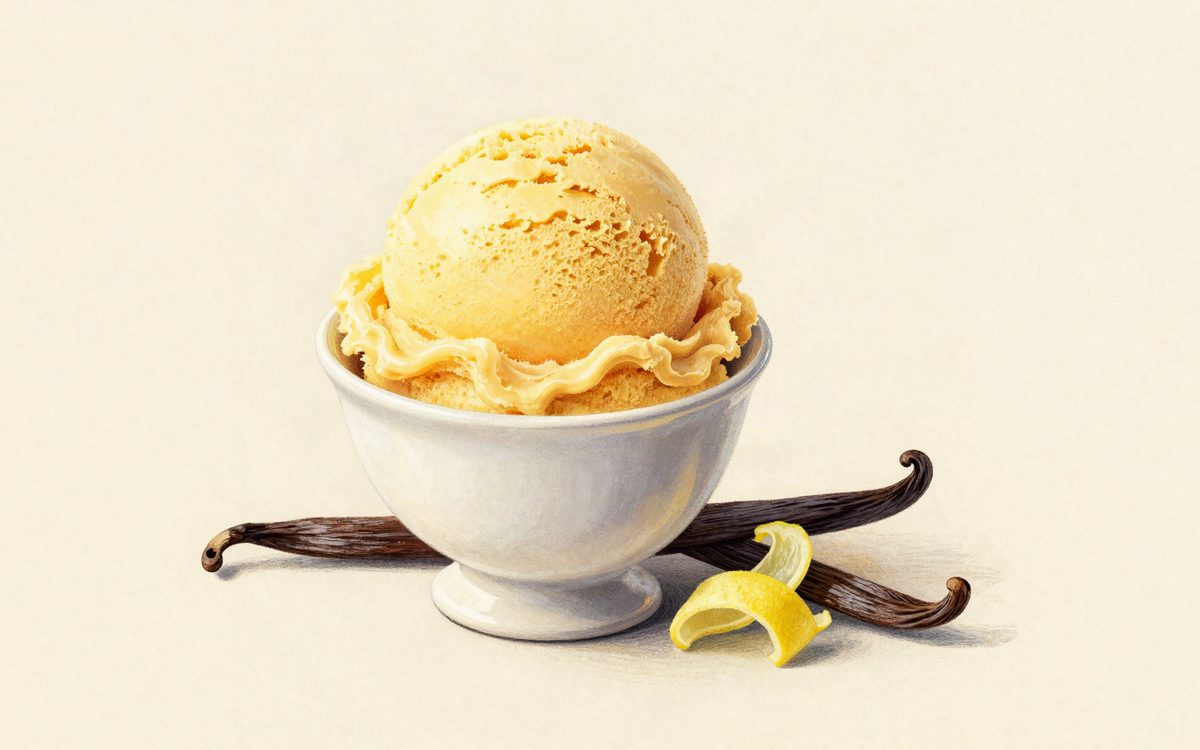
Every item on this shopping list has a cheaper twin, and each twin shows up in the spoon. Pasteurised yolk should list yolk and nothing else, since plenty of tubs carry added sugar or salt and either one moves the balance before you have weighed a thing. The lemons have to be unwaxed, because the 3 g of zest is doing real work and wax brings a bitter, cosmetic note with it. Vanilla should be a pod, not vanillin. At 90 g per kilo the yolk turns up with roughly 27 percent fat and 16 percent protein of its own, which is why the milk powder falls to 30 g and the cream to 120 g: most of the richness has already walked in.
Pasteurized yolk is 27% fat and 16% protein, and those two figures drive everything else. 90 g per kilo brings in roughly 24 g of fat and 14 g of protein on its own, so the skim milk powder has to come down to 30 g per kilo, against the 45 g a plain milk gelato would take, or protein blows past its 5% cap. Cream comes down for the same reason, to 120 g.
3 g of lemon zest per kilo is the regional marker that separates an Italian crema from a French custard. Technically the citrus terpenes cut the fatty perception of that much yolk, and they do it without acidifying anything, because this is zest and not juice. Vanilla is at 3 g of bean, less than a vanilla gelato takes, because here it accompanies rather than leads.
Ingredients
Makes 1000 g of finished base.
| Ingredient | Grams | Home measure |
|---|---|---|
| Whole Milk | 565 | 2 1/3 cups |
| Sugar (Sucrose) | 150 | 3/4 cup |
| Heavy Cream 35% | 120 | 1/2 cup |
| Pasteurized Egg Yolk | 90 | |
| Dextrose (Glucose) | 35 | 3 tablespoons |
| Skim Milk Powder | 30 | 1/4 cup plus 1 tablespoon |
| Vanilla Bean | 3 | |
| Lemon Zest | 3 | |
| Carob Seed Flour | 3 | |
| Salt | 1 |
Loads these exact grams into the free balancer, ready to edit.
Method
Infused custard cooked to nappe, shock chilled, 12 hour rest
- 1Whisk every dry ingredient together first: sugars, milk powder, stabiliser and salt. Dry-blending them stops the stabiliser clumping when it meets liquid.
- 2Warm the liquids to 40 C (104 F), then rain the dry mix in while whisking hard.
- 3Beat the yolks with part of the sugar, then temper: pour the warm base over the yolks in a thin stream, never the other way round.
- 4Bring to 82 to 85 C (180 to 185 F) and stop. Past 87 C the yolk coagulates and no amount of blending brings the flavour back.
- 5Off the heat, whisk in the paste, then blend 60 seconds so the fat emulsifies instead of separating.
- 6Chill in an ice bath to under 5 C (41 F) within 2 hours. Slow cooling is where bacteria and coarse crystals both start.
- 7Age 6 to 12 hours in the fridge under 5 C (41 F). This is when the stabiliser and the milk protein take up water.
- 8Fold the fruit in cold, after ageing. Heating it costs you the fresh aroma and nothing is gained.
- 9Freeze in a shallow metal pan 2 to 3 cm deep, breaking the crystals with a fork every 30 to 40 minutes, 4 to 6 times.
- 10Freeze firm, then temper 10 to 15 minutes in the fridge before scooping.
The balance
All six against the professional range for Milk Gelato.
Fat finishes at 8.66% and protein at 4.64%, and both are mostly the yolk talking, since about 24 g of fat and 14 g of protein per kilo arrive with it. That is why MSNF ends at 8.6%, low in its 8 to 11.5 window, which looks wrong for a rich gelato until you notice it is the only way to hold protein under the 5% ceiling. Sugars at 18.33% sit mid-range in the 16 to 22 band, and POD reaches 180.53 against a 200 limit, high in its range on purpose, because yolk fat needs sweetness to read as custard rather than as sauce. PAC 264.99 is mid-window, so the tub sets firm enough to hold the shape of a scoop instead of slumping. Lactose comes out at 7.52% of the water phase, comfortably clear of the sandiness threshold, precisely because the milk powder had to be cut.
Estimated nutrition: ~194 kcal · Fat 8.7 g · Sugars 18.3 g · Protein 4.6 g (per 100 g of mix, from the balanced composition).
Yolk on its own coagulates between 65 and 70 C, and sugar raises that threshold, which is why a crema base is taken to 82 to 85 C with constant agitation and never left sitting on a hot pan bottom. The sequence is: whisk yolk with sugar, temper with hot milk poured in a thin stream, return to the heat and cook to nappe, then shock chill to 4 C within two hours, since yolk is an ideal substrate for Salmonella between 20 and 50 C. The lemon zest infuses in the hot milk alongside the pod and comes out through a sieve before the rest. Use only the yellow layer, the white pith brings bitterness. Give it the full 12 hours: yolk lecithin needs time to migrate to the fat and water interface, and that migration is what makes crema feel silky rather than merely rich.
If it goes wrong
It went past 87 C, or it sat still on a hot pan bottom while the yolk was in it.
Whisk the yolk with the sugar first, temper with hot milk in a thin stream, and stop at nappe between 82 and 85 C. A stick blender rescues the texture but not the cooked egg flavour.
White pith went in with the lemon zest.
Take only the yellow layer for the 3 g of zest, and strain everything out before the base rests.
The rest was cut short. Lecithin migration is a time process, not a temperature one.
Give it the full 12 hours at 4 C before freezing, and keep the 3 g of carob seed flour per kilo.
Suitable for: Vegetarian
Allergens: egg, milk
No ingredient in this recipe contains gluten.
- https://www.giallozafferano.com/recipes/Cream-Ice-Cream.html
- https://italianchef.com/custard-gelato/
- https://asktheicecreamqueen.com/recipes/italian-crema-ice-cream-recipe/
- https://foodnouveau.com/how-to-make-gelato/
- The science behind it: Custard Gelato Balance Guide
- Ingredient sheet: Pasteurized Egg Yolk
- The story of this recipe: Crema all'Uovo Gelato Recipe
Want to change an ingredient and watch the numbers move? Open the free balancer