Honey Gelato
The spoon goes in without resistance, floral sweetness spreading ahead of the cream, and a warm blossom note is the last thing to leave the palate.
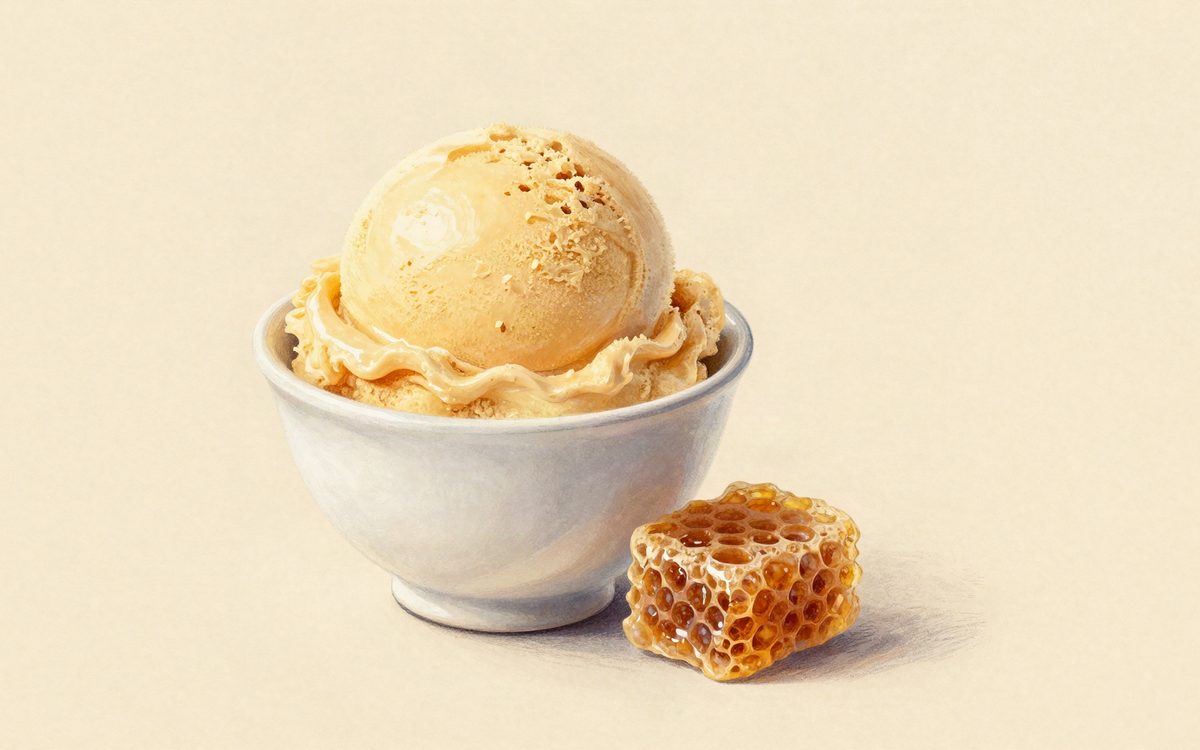
Softness in the cabinet is the first thing the spoon reports, and it comes straight out of the numbers: with PAC at 296 less of the water is frozen at serving temperature, so nothing has to be chipped free. Sweetness arrives ahead of everything else, floral and a shade sharper than plain sugar, then the cream fills in underneath and rounds the edges off. The aromatics travel on fat rather than on water, which is why they sit on the palate well after the cold has faded. At 85 g/kg the honey reads clean and unmistakable, and with free sucrose held down to 100 g the whole thing lands sweet without ever turning cloying.
That is why the sucrose here is only 100 g per kilo. With 85 g of honey already in the mix, more sugar would push sweetening power past the 200 limit for a milk gelato. POD finishes at 198.45, right up against the line and still under it.
85 g per kilo is the dose at which honey reads clearly without pushing PAC past the ceiling. Italian practice runs 60 to 70 g per kilo for acacia honey and climbs to 80 to 100 g for the more neutral flower honeys that this ingredient matches. In the app's ingredient table acacia is actually the lighter of the two, PAC 143 and POD 97 per 100 g against 156 and 105.
Ingredients
Makes 1000 g of finished base.
| Ingredient | Grams | Home measure |
|---|---|---|
| Whole Milk | 585 | 2 1/2 cups |
| Heavy Cream 35% | 180 | 3/4 cup |
| Sugar (Sucrose) | 100 | 1/2 cup |
| Honey | 85 | |
| Skim Milk Powder | 45 | 1/3 cup plus 2 tablespoons |
| Carob Seed Flour | 4 | |
| Salt | 1 |
Loads these exact grams into the free balancer, ready to edit.
Method
White base pasteurized alone, honey stirred in below 40 C
- 1Whisk every dry ingredient together first: sugars, milk powder, stabiliser and salt. Dry-blending them stops the stabiliser clumping when it meets liquid.
- 2Warm the liquids to 40 C (104 F), then rain the dry mix in while whisking hard.
- 3Heat to 82 C (180 F) and hold for 2 minutes so the stabiliser hydrates.
- 4Chill in an ice bath to under 5 C (41 F) within 2 hours. Slow cooling is where bacteria and coarse crystals both start.
- 5Age 6 to 12 hours in the fridge under 5 C (41 F). This is when the stabiliser and the milk protein take up water.
- 6Freeze in a shallow metal pan 2 to 3 cm deep, breaking the crystals with a fork every 30 to 40 minutes, 4 to 6 times.
- 7Freeze firm, then temper 10 to 15 minutes in the fridge before scooping.
The balance
All six against the professional range for Milk Gelato.
PAC lands at 295.74 in a 220 to 300 window, near the top, and the honey is the largest single share of it. The practical consequence is a tub that stays soft, so this one wants the colder end of the cabinet, around -14 to -15 C, where a plainer base would already be hard. Because the honey ate most of the sugar budget, the solids had to come from elsewhere: MSNF sits at 10.53%, in the upper half of its 8 to 11.5 range, and fat at 8.40%, carried by 180 g of cream and 45 g of skim milk powder per kilo instead of by more sweetener. Total solids reach 36.34%, just over the 36 floor, and sugars finish at 16.89% in a 16 to 22 range. Lactose finishes at 9.02% of the water phase, just inside the sandiness limit, which is exactly why the milk powder stops at 45 g. The 4 g of carob seed flour holds the free water that a PAC this high leaves unfrozen, and that is the difference between creamy and icy.
Estimated nutrition: ~187 kcal · Fat 8.4 g · Sugars 16.9 g · Protein 3.9 g (per 100 g of mix, from the balanced composition).
Never pasteurize with the honey in the pan. Honey aromatics are volatile, and the Maillard reaction between its free fructose and milk protein at 82 to 85 C produces a burnt caramel note that flattens everything floral. Pasteurize the white base at 82 to 85 C, cool it below 40 C, then dissolve the honey in while the mixer is still running, and rest 6 to 12 hours at 4 C. The 1 g of salt is functional rather than decorative: in a honey base it cuts the cloying edge and lifts the floral note. Acacia honey is lighter in the app's table, PAC 143 and POD 97 per 100 g against 156 and 105, so at the same 85 g the mix lands at PAC 284.69 and POD 191.65, inside every range and a touch firmer in the cabinet. Orange blossom goes the other way: at 85 g it takes POD to 200.15, just past the 200 ceiling, so balance that one in the app instead of swapping it in gram for gram.
If it goes wrong
The honey was in the pan during pasteurization and reacted with the milk protein at 82 to 85 C.
Pasteurize the white base on its own and stir the 85 g of honey in once the base is below 40 C.
PAC 295.74 is high by design, so a cabinet warmer than -14 C leaves too much of the water unfrozen.
Hold the cabinet at -14 to -15 C, as the balance assumes. For a firmer tub at the same temperature, acacia honey at the same 85 g brings PAC down to 284.69; everything else stays as written.
A high PAC leaves a lot of unfrozen water, and with nothing binding it that water crystallises coarsely.
Keep the 4 g of carob seed flour per kilo and give the mix its full 6 to 12 hours at 4 C before freezing.
Suitable for: Vegetarian, Egg-free
Allergens: milk
No ingredient in this recipe contains gluten.
- https://gelatiereartigianale.forumattivo.com/t74-saccarosio-destrosio-e-zucchero-invertito-come-distribuirli
- https://www.cucina.li/gelato-al-latte-e-miele-gourmet/
- https://www.researchgate.net/publication/236255877_EFFECT_OF_HONEY_ON_FREEZING_POINT_AND_ACCEPTABILITY_OF_ICE_CREAM
- The science behind it: Honey in Gelato
- Ingredient sheet: Honey
Want to change an ingredient and watch the numbers move? Open the free balancer