High Protein Strawberry Gelato
Bright, lean and very cold on the tongue, with ripe fruit aroma arriving late and a clean finish that stops short instead of coating the mouth.
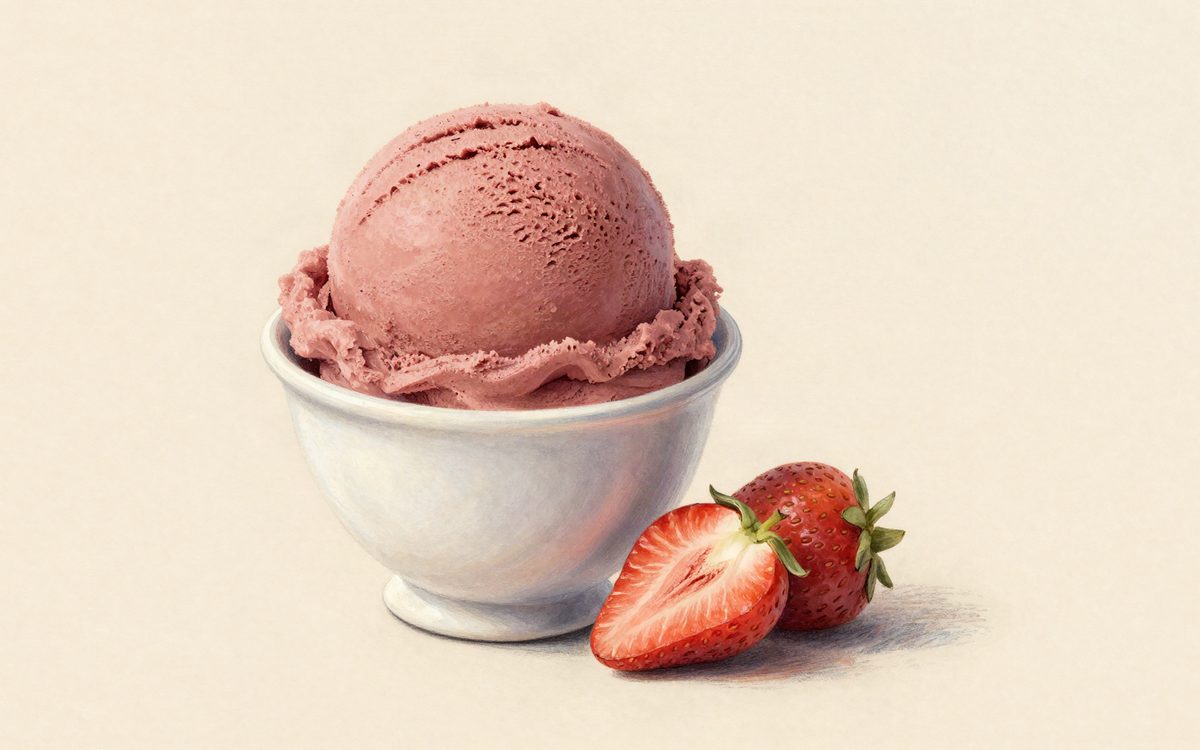
It goes in softer than a plain milk gelato and colder on the tongue, because the sugar blend runs a PAC of 286.83 and the scoop never sets hard. The fruit comes second, sharp then ripe, and it comes through whole because the acid never meets a hot base. Then there is the part people notice without naming it: the body holds its shape while still eating lean, since fat sits at 5.11 percent and the carrying is done by 15 g of whey protein and 33 g of milk powder. The finish is short and clean, cut by 8 g of lemon juice against 250 g of strawberry.
The fruit dose is 250 g per kilo, the classic figure for a milk based fruit gelato. That is enough strawberry to lead the flavour and little enough that the acid does not wreck the dairy protein around it. Strawberry sits near pH 3.3 and casein flocculates below pH 4.6, so the entire method here is organised around keeping those two apart until the base is cold.
Fat lands at 5.11% against a 3.5 to 8 window, deliberately in the lower half: less fat coating the palate means the strawberry reads sharper. The 8 g of lemon juice per kilo finishes that job, lifting an aroma that gets diluted by milk and holding the colour in place.
Ingredients
Makes 1000 g of finished base.
| Ingredient | Grams | Home measure |
|---|---|---|
| Whole Milk | 295 | 1 1/4 cups |
| Strawberry | 250 | |
| Sugar (Sucrose) | 140 | 2/3 cup plus 1 tablespoon |
| Heavy Cream 35% | 110 | 1/3 cup plus 2 tablespoons |
| Skim Milk | 100 | 1/3 cup plus 1 tablespoon |
| Dextrose (Glucose) | 45 | 1/4 cup |
| Non-Fat Dry Milk | 33 | 1/3 cup |
| Whey Protein 80% | 15 | |
| Lemon Juice | 8 | |
| Stabilizer (Neutral) | 3 | |
| Salt | 1 |
Loads these exact grams into the free balancer, ready to edit.
Method
Cold base, raw strawberry puree stirred in at the end
- 1Whisk every dry ingredient together first: sugars, milk powder, stabiliser and salt. Dry-blending them stops the stabiliser clumping when it meets liquid.
- 2Warm the liquids to 40 C (104 F), then rain the dry mix in while whisking hard.
- 3Heat to 82 C (180 F) and hold for 2 minutes so the stabiliser hydrates.
- 4Chill in an ice bath to under 5 C (41 F) within 2 hours. Slow cooling is where bacteria and coarse crystals both start.
- 5Age 6 to 12 hours in the fridge under 5 C (41 F). This is when the stabiliser and the milk protein take up water.
- 6Fold the fruit in cold, after ageing. Heating it costs you the fresh aroma and nothing is gained.
- 7Freeze in a shallow metal pan 2 to 3 cm deep, breaking the crystals with a fork every 30 to 40 minutes, 4 to 6 times.
- 8Freeze firm, then temper 10 to 15 minutes in the fridge before scooping.
The balance
All six against the professional range for Milk Gelato with Fruit.
PAC finishes at 286.83 in a 240 to 310 window, in the upper half, and that is a direct consequence of 250 g of fruit plus 45 g of dextrose per kilo, both of which depress the freezing point harder than sucrose does. More of the water stays unfrozen, so the tub scoops cleanly after a brief rest in the fridge instead of setting into a block. Total solids sit at 34.49% against a 32 to 40 range, in its lower part, because strawberry is mostly water, and that is also why water reads 65.51% against a 68 ceiling. Protein at 4.11% is the number the whole formula is built around, and 15 g of whey per kilo is simply the most that fits under the 4.5% cap once milk protein, non-fat dry milk and cream are counted. Lactose ends at 7.13% of the water phase, well clear of the sandiness threshold.
Estimated nutrition: ~164 kcal · Fat 5.1 g · Sugars 19.5 g · Protein 4.1 g (per 100 g of mix, from the balanced composition).
The dominant risk is curdling, and it is an order of operations problem, not a stabilizer problem. Pasteurize only the dairy part, at 65 C for 30 minutes, which is the ceiling the whey imposes, then cool to 4 C, mature, and fold in the raw cold strawberry puree immediately before freezing. Whey that has already been denatured is far more acid sensitive than casein, so a hot base meeting acid fruit gives you visible grain, not just a dull texture. Leave the seeds in the puree, they read as real fruit in the finished tub.
If it goes wrong
The puree met the base while it was still warm. Below pH 4.6 the milk protein flocculates, and denatured whey does it faster than casein.
Chill the dairy base to 4 C first and add the puree cold, in the last moment before freezing.
Almost always the same wrong order of addition, not a shortage of stabilizer.
Keep the 3 g of neutral stabilizer per kilo as written and fix the sequence instead of raising the dose.
PAC 286.83 sits in the upper half of the 240 to 310 window for a milk gelato with fruit, so more of the water is still liquid at freezer temperature than in a plain milk gelato.
That is the design, not a fault. Give the tub a longer final rest in the coldest part of the freezer before scooping.
Suitable for: Vegetarian, Egg-free
Allergens: milk
- Goff, H. D.; Hartel, R. W. Ice Cream, 7a ed. Springer, 2013 (estabilidade de proteinas lacteas em sistemas acidos)
- University of Guelph, Dairy Science and Technology eBook (H. D. Goff): https://www.uoguelph.ca/foodscience/book-page/ice-cream-manufacture
- Caviezel, L. Il gelato artigianale. Chiriotti Editori (gelato alla frutta com base de leite, percentuais de fruta)
- USDA FoodData Central, morango cru: https://fdc.nal.usda.gov/
- The science behind it: High-Protein Gelato Recipe
- Ingredient sheet: Strawberry
Want to change an ingredient and watch the numbers move? Open the free balancer