High-Protein Greek Yogurt Gelato
Expect sour before sweet, a thick body with no chalk in it, and a tang that stays put long after a vanilla of the same weight would have gone quiet.
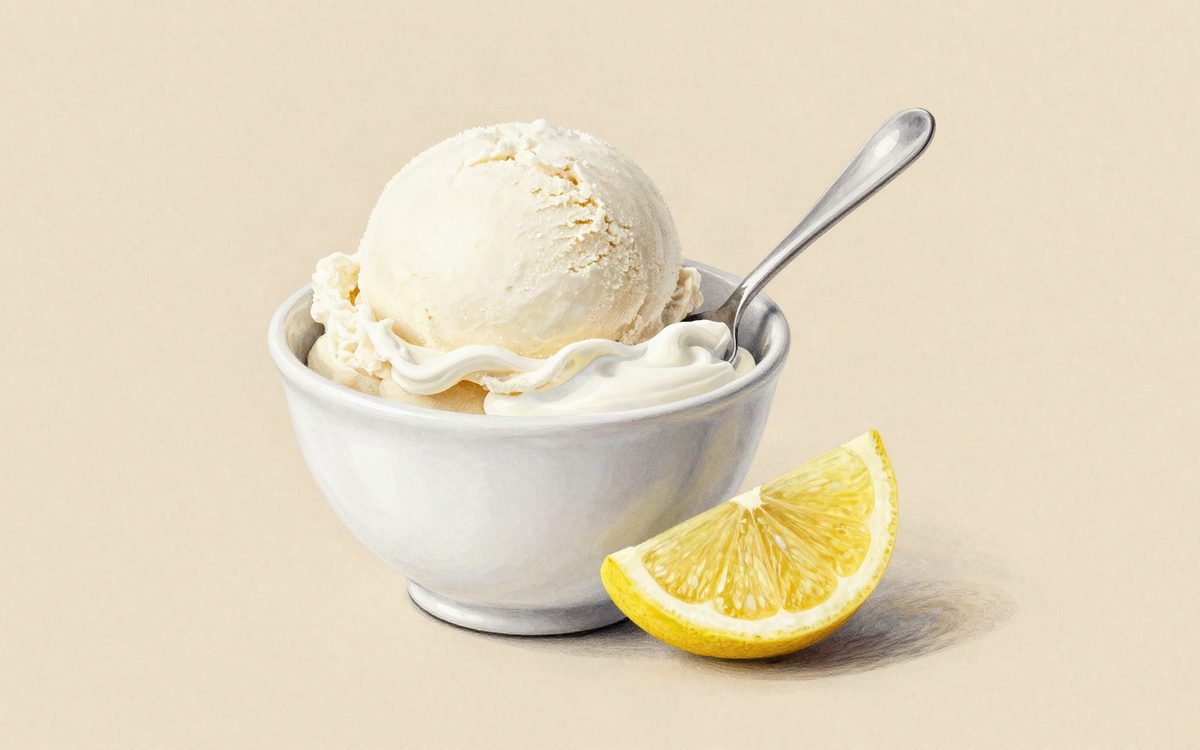
Set this against the high-protein tubs in the supermarket freezer and the difference is in what does the work. Those lean on isolate powder, and powder is what you taste: a chalky edge and a body that turns gummy as it softens. Here it is 300 g of Greek yogurt per kilo, bringing roughly 27 g of protein on its own and closing the sheet at 4.76 percent with no powder at all. The trade is neutrality. Yogurt is sour and stays sour, so this will not stand in for a plain vanilla the way a powdered base tries to. What it gives back is a clean finish and a texture that scoops cleanly once tempered in the fridge.
Acidity changes the freezing behaviour, not only the taste. PAC reads 261.09, mid range in the 230 to 300 band for frozen yogurt, but the acid depresses the freezing point on its own account, so this base behaves softer than that number alone predicts. In practice it takes longer to set firm than a neutral milk base with the same PAC.
Solids come in at 34.83 percent and water at 65.17 percent, both in the middle of the frozen yogurt bands, 32 to 38 and 62 to 68. Yogurt is mostly water and this is the recipe where you feel that: a milk gelato would want more solids than this. The 16 g of milk powder and the 120 g of cream are still not decorative. Without the powder MSNF drops to 7.17 percent, under its 8 percent floor, and without the cream solids fall to 31.47 percent, under theirs.
Ingredients
Makes 1000 g of finished base.
| Ingredient | Grams | Home measure |
|---|---|---|
| Whole Milk | 374 | 1 1/2 cups |
| Greek Yogurt | 300 | |
| Sugar (Sucrose) | 135 | 2/3 cup |
| Heavy Cream 35% | 120 | 1/2 cup |
| Dextrose (Glucose) | 45 | 1/4 cup |
| Non-Fat Dry Milk | 16 | 3 tablespoons |
| Lemon Juice | 6 | |
| Stabilizer (Neutral) | 3 | |
| Salt | 1 |
Loads these exact grams into the free balancer, ready to edit.
Method
Yogurt folded in cold, tray freeze, short fridge temper
- 1Whisk every dry ingredient together first: sugars, milk powder, stabiliser and salt. Dry-blending them stops the stabiliser clumping when it meets liquid.
- 2Warm the liquids to 40 C (104 F), then rain the dry mix in while whisking hard.
- 3Heat to 82 C (180 F) and hold for 2 minutes so the stabiliser hydrates.
- 4Chill in an ice bath to under 5 C (41 F) within 2 hours. Slow cooling is where bacteria and coarse crystals both start.
- 5Age 6 to 12 hours in the fridge under 5 C (41 F). This is when the stabiliser and the milk protein take up water.
- 6Pour the cold yogurt into the aged base in a thin stream, stirring by hand. Yogurt never goes in the pan: heat kills the live cultures and curdles the milk protein. From here the mix goes to the freezer without another rest.
- 7Fold the fruit in cold, after ageing. Heating it costs you the fresh aroma and nothing is gained.
- 8Freeze in a shallow metal pan 2 to 3 cm deep, breaking the crystals with a fork every 30 to 40 minutes, 4 to 6 times.
- 9Freeze firm, then temper 10 to 15 minutes in the fridge before scooping.
The balance
All six against the professional range for Frozen Yogurt.
Protein at 4.76 percent and MSNF at 8.56 percent are the two numbers that fix everything else. Protein is the highest reading on this sheet relative to its ceiling, 4.76 against 5, and it is reached without a gram of protein powder because the 300 g of yogurt already carry roughly 27 g. That same yogurt is why solids sit at 34.83 and water at 65.17: yogurt is a wet ingredient dressed as a rich one, which is exactly what the frozen yogurt bands allow for. So the 16 g of milk powder are there purely to lift MSNF to 8.56 percent over its 8 percent floor, and 120 g of cream close fat at 7.03 percent in a 3 to 8 band. Sugar was then placed to keep an acidic base scoopable, 135 g of sucrose with 45 g of dextrose giving sugars 18.81 percent, POD 170.58 against 150 to 210 and PAC 261.09. Lactose is 4.67 percent of the mix and 7.16 percent of the water.
Estimated nutrition: ~174 kcal · Fat 7 g · Sugars 18.8 g · Protein 4.8 g (per 100 g of mix, from the balanced composition).
Never pasteurise the yogurt. Heat the milk, cream, sugars and milk powder to 85 C, chill to 4 C, age 6 to 12 hours, then fold the cold yogurt in immediately before freezing. Heating kills the cultures, flattens the lactic aroma, and above about 70 C the acid whey separates outright. The order of mixing matters more here than on any other sheet in this family: yogurt sits near pH 4.3, below casein's isoelectric point, so add the yogurt to the base, stirring continuously, and never the base to the yogurt. Get it backwards and you form lumps that no amount of blending will undo. The 6 g of lemon juice sharpen the lactic note without moving the pH far enough to flocculate. If you are using a machine, the practical effect of the acid is that extraction wants to be at -9 to -10 C rather than the usual setting.
If it goes wrong
The base was poured into the yogurt. At pH 4.3, below the isoelectric point of casein, a sudden acid shock flocculates the protein.
Reverse it. Pour the 300 g of cold yogurt into the aged base, in a steady stream, stirring the whole time.
The yogurt was heated with the base. Cultures and lactic aroma do not survive pasteurisation.
Pasteurise the dairy alone at 85 C, chill to 4 C, age 6 to 12 hours, and add the yogurt cold just before freezing.
The acid depresses the freezing point on top of PAC 261.09, and water is at 65.17 percent, more than a milk gelato would carry. There is simply a lot of water to freeze.
Give it more time in the coldest part of the freezer, then temper it 10 to 15 minutes in the fridge before scooping.
Suitable for: Vegetarian, Egg-free
Allergens: milk
- Goff, H. D.; Hartel, R. W. Ice Cream, 7a ed. Springer, 2013 (frozen yogurt, acidez e estabilidade da caseina)
- University of Guelph, Dairy Science and Technology eBook (H. D. Goff), secoes de iogurte e sorvete: https://www.uoguelph.ca/foodscience/book-page/ice-cream-manufacture
- Tharp, B. W.; Young, L. S. Tharp & Young on Ice Cream. DEStech Publications, 2013 (frozen yogurt: pH, corpo e sobrevivencia de culturas)
- USDA FoodData Central, iogurte grego integral: https://fdc.nal.usda.gov/
- The science behind it: High-Protein Gelato Recipe
- Ingredient sheet: Greek Yogurt
Want to change an ingredient and watch the numbers move? Open the free balancer