High-Protein Cookies and Cream Gelato
Sweet dairy reaches the palate first, then dark crumbs that soften instead of crunching, and a cocoa-bitter tail that stops the whole thing reading as plainly sweet.
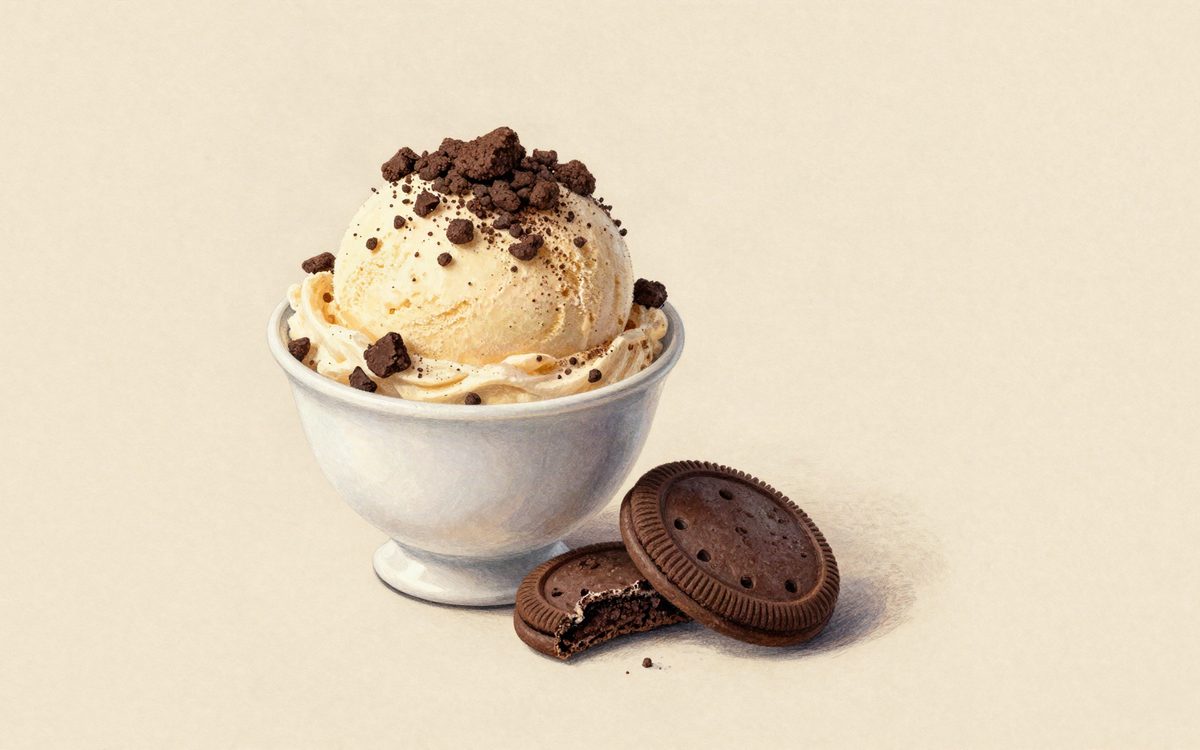
At freezer temperature this reads hard and quiet. Give it two minutes and the body turns pliable without going slack, held up by whey protein and inulin where the reduced sucrose would otherwise leave a thin, icy edge. Cream lands first on the palate, vanilla a beat behind it. The crumbs arrive second, softened by the mix rather than crisp, so they read as dark, faintly salty pockets instead of biscuit. That cocoa bitterness is what keeps the finish from flattening out, and it is also why the added sugar stops at 105 g per kilo: the biscuit brought roughly 25 g of its own.
There is a subtlety the arithmetic hides. Biscuit fat is vegetable fat, and vegetable fat does not do partial coalescence, which is the mechanism dairy fat uses to build structure while the base freezes. So total fat reads 7.24 percent, comfortably inside 6 to 12, but 110 g of cream stays in the formula anyway, because part of that 7.24 percent counts on paper and does nothing for the body.
On the protein side, 18 g of whey plus 17 g of milk powder and 150 g of skim milk put protein at 4.71 percent, in the upper part of 3 to 5, and MSNF at 9.26 percent, in the lower half of 8 to 11.5. PAC lands at 258.93, the lower half of 220 to 300, so this milk base sets firmer than a fruit gelato and wants a few minutes out of the freezer before you scoop.
Ingredients
Makes 1000 g of finished base.
| Ingredient | Grams | Home measure |
|---|---|---|
| Whole Milk | 464 | 2 cups |
| Skim Milk | 150 | 1/2 cup plus 2 tablespoons |
| Heavy Cream 35% | 110 | 1/3 cup plus 2 tablespoons |
| Sugar (Sucrose) | 105 | 1/2 cup plus 1 tablespoon |
| Chocolate Biscuit | 70 | |
| Dextrose (Glucose) | 45 | 1/4 cup |
| Whey Protein 80% | 18 | |
| Non-Fat Dry Milk | 17 | 3 tablespoons |
| Inulin HP | 9 | |
| Vanilla Extract (Pure) | 8 | |
| Stabilizer (Neutral) | 3 | |
| Salt | 1 |
Loads these exact grams into the free balancer, ready to edit.
Method
Half the biscuit in the base, half folded in last
- 1Whisk every dry ingredient together first: sugars, milk powder, stabiliser and salt. Dry-blending them stops the stabiliser clumping when it meets liquid.
- 2Warm the liquids to 40 C (104 F), then rain the dry mix in while whisking hard.
- 3Heat to 82 C (180 F) and hold for 2 minutes so the stabiliser hydrates.
- 4Melt the chocolate to 45 C (113 F) and stir it into the hot base off the heat, then blend 60 seconds until glossy.
- 5Chill in an ice bath to under 5 C (41 F) within 2 hours. Slow cooling is where bacteria and coarse crystals both start.
- 6Age 6 to 12 hours in the fridge under 5 C (41 F). This is when the stabiliser and the milk protein take up water.
- 7Freeze in a shallow metal pan 2 to 3 cm deep, breaking the crystals with a fork every 30 to 40 minutes, 4 to 6 times.
- 8Freeze firm, then temper 10 to 15 minutes in the fridge before scooping.
The balance
All six against the professional range for Milk Gelato.
The biscuit and the protein ceiling between them explain the whole sheet. Because 70 g of biscuit already deliver about 25 g of sugar, the solver could drop added sucrose to 105 g and still close sugars at 17.32 percent with PAC at 258.93. Because the same biscuit delivers about 16 g of fat that does not build structure, the 110 g of cream stayed put and fat closed at 7.24 percent rather than being trimmed toward the 6 percent floor. Protein at 4.71 percent against a 5 percent ceiling then fixed the whey at 18 g, and MSNF at 9.26 percent against 8 to 11.5 covered the rest. Solids 38.00 against 36 to 42, POD 167.30 against 140 to 200, water 62.00 against 58 to 64. Lactose is 5.05 percent of the mix and 8.14 percent of the water, well under the 7 percent line on the mix that flags a real crystallisation risk.
Estimated nutrition: ~188 kcal · Fat 7.2 g · Sugars 17.3 g · Protein 4.7 g (per 100 g of mix, from the balanced composition).
Split the biscuit, because the two halves do different jobs. Half goes in ground, before pasteurisation, to hydrate and give the base its grey cream colour and its body. The other half goes in broken, at the end of freezing, so it stays crisp. Put all 70 g through the base and you have mush within 24 hours. The biscuit starch also absorbs free water during ageing, so measure the mix after 12 hours at 4 C and never while it is hot, since a hot reading understates the solids. Pasteurise at 65 C for 30 minutes, capped by the whey. Do not drop the salt: 1 g per kilo is what separates the biscuit flavour from the dairy background, and without it the whole thing reads as one sweet block. If the gelato comes out sandy, the likely cause is whey aggregate from too much heat, not lactose, since lactose here is only 5.05 percent of the mix.
If it goes wrong
All 70 g were mixed into the base and the starch hydrated fully.
Grind 35 g into the mix before pasteurising and fold the other 35 g in broken, at the very end of freezing, just before it goes into the tub.
Whey aggregated above 72 C. Lactose is not the culprit here, since it is 5.05 percent of the mix, under the 7 percent line.
Pasteurise at 65 C for 30 minutes with the 18 g of whey dissolved cold and added at the end of the hold.
The salt was left out, or the vanilla was cut. Both are what separate the two halves of the flavour.
Keep 1 g of salt and 8 g of pure vanilla extract per kilo. At 105 g of added sucrose the sheet is already restrained on sugar, so the contrast has to come from these two.
Suitable for: Vegetarian, Egg-free
Allergens: gluten, milk
- Goff, H. D.; Hartel, R. W. Ice Cream, 7a ed. Springer, 2013 (cap. 3 e cap. 11, coalescencia parcial e papel da gordura lactea)
- University of Guelph, Dairy Science and Technology eBook (H. D. Goff): https://www.uoguelph.ca/foodscience/book-page/ice-cream-manufacture
- Tharp, B. W.; Young, L. S. Tharp & Young on Ice Cream. DEStech Publications, 2013 (inclusoes e absorcao de agua livre por amido)
- The science behind it: High-Protein Gelato Recipe
- Ingredient sheet: Chocolate Biscuit
Want to change an ingredient and watch the numbers move? Open the free balancer