High-Protein Coffee Gelato
Where the ordinary version thins out, this one holds its body: roast and bitterness up front, a chewier scoop, and a finish that dries a touch.
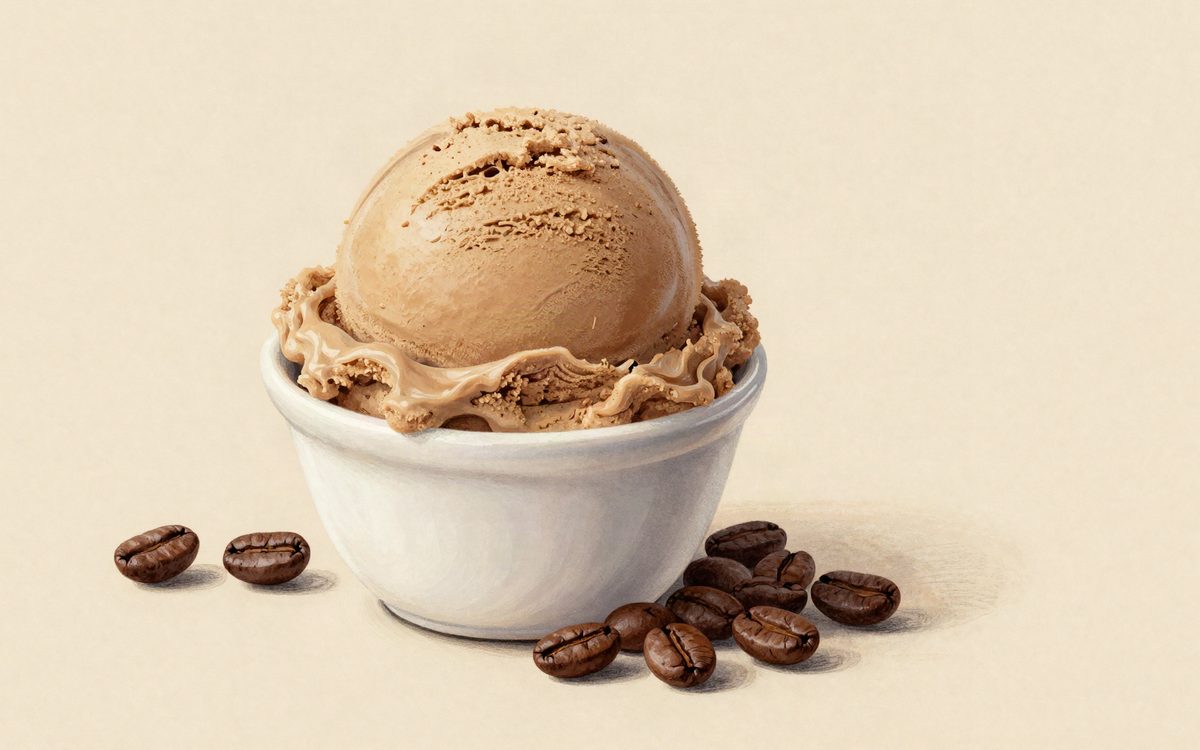
The obvious alternative is a plain coffee gelato: milk, sugar, espresso, nothing to argue with. This version makes a trade instead. What it buys is protein at 4.71 percent, from whey and dry milk, which gives a firmer, chewier scoop that holds its shape longer out of the freezer. What it pays is a drier finish, because coffee tannin binds to protein, and the 130 g of cream per kilo is the answer to exactly that, since fat coats the tannin. The coffee itself comes from two places, 80 g of espresso for the volatile top notes and 8 g of instant for the roasted spine that survives freezing.
The number that separates this sheet from a conventional coffee gelato is protein at 4.71 percent. Chlorogenic acids and polyphenols from coffee bind to protein, and in a base this protein rich that binding reads on the palate as a dry, astringent finish. The answer written into the recipe is fat: 130 g of cream take total fat to 6.24 percent, and that fat is there to coat tannin, not to make the gelato richer.
Inulin HP at 29 g per kilo does the rest of the structural work, carrying solids to 38.08 percent without touching sugars, which stay at 17.29 percent. MSNF ends at 9.91 percent in an 8 to 11.5 band, and lactose reads 5.40 percent of the mix and 8.72 percent of the water, the busiest water phase in this family of recipes and still within what the sandiness check clears.
Ingredients
Makes 1000 g of finished base.
| Ingredient | Grams | Home measure |
|---|---|---|
| Whole Milk | 425 | 1 3/4 cups |
| Sugar (Sucrose) | 135 | 2/3 cup |
| Heavy Cream 35% | 130 | 1/2 cup plus 1 tablespoon |
| Skim Milk | 100 | 1/3 cup plus 1 tablespoon |
| Espresso (Rich) | 80 | |
| Dextrose (Glucose) | 40 | 3 1/2 tablespoons |
| Non-Fat Dry Milk | 31 | 1/3 cup |
| Inulin HP | 29 | |
| Whey Protein 80% | 18 | |
| Instant Coffee | 8 | |
| Stabilizer (Neutral) | 3 | |
| Salt | 1 |
Loads these exact grams into the free balancer, ready to edit.
Method
Espresso in cold, shallow tray, three stir downs
- 1Whisk every dry ingredient together first: sugars, milk powder, stabiliser and salt. Dry-blending them stops the stabiliser clumping when it meets liquid.
- 2Warm the liquids to 40 C (104 F), then rain the dry mix in while whisking hard.
- 3Heat to 82 C (180 F) and hold for 2 minutes so the stabiliser hydrates.
- 4Chill in an ice bath to under 5 C (41 F) within 2 hours. Slow cooling is where bacteria and coarse crystals both start.
- 5Age 6 to 12 hours in the fridge under 5 C (41 F). This is when the stabiliser and the milk protein take up water.
- 6Freeze in a shallow metal pan 2 to 3 cm deep, breaking the crystals with a fork every 30 to 40 minutes, 4 to 6 times.
- 7Freeze firm, then temper 10 to 15 minutes in the fridge before scooping.
The balance
All six against the professional range for Milk Gelato.
Two indicators run this sheet in opposite directions. Protein at 4.71 percent, against a 3 to 5 band, is the point of the recipe and also the source of its main defect risk with coffee polyphenols. Fat at 6.24 percent, against 6 to 12, is the counterweight: it is just above the floor of the band, so there is no room to cut cream without leaving the tannin uncovered. MSNF at 9.91 percent is what carries the 18 g of whey and the 31 g of milk powder, and it also pushes lactose to 8.72 percent of the water phase, which is why the milk powder is not free to rise further. On the freezing side, 135 g of sucrose with 40 g of dextrose put POD at 168.79 against 140 to 200 and PAC at 260.57 against 220 to 300. Solids 38.08 against 36 to 42, water 61.92 against 58 to 64, sugars 17.29 against 16 to 22.
Estimated nutrition: ~184 kcal · Fat 6.2 g · Sugars 17.3 g · Protein 4.7 g (per 100 g of mix, from the balanced composition).
The specific issue here is tannin, and it appears only because the protein is high. Chlorogenic acids lower the pH slightly and the polyphenols bind to protein, giving a dry finish that a normal coffee gelato does not have. The 1 g per kilo of salt is part of the answer, since it lifts perceived sweetness and blunts the astringency, and the 130 g of cream is the other part. The espresso goes in only after the base has come below 30 C: warmer than that and you trade the top notes for a reheated coffee flavour. Pasteurise at 65 C for 30 minutes because of the whey. The instant coffee has to be dispersed dry with the milk powder before anything hydrates, otherwise it clumps and leaves concentrated bitter points through the finished gelato.
If it goes wrong
Coffee polyphenols binding to protein. At 4.71 percent protein this base is far more exposed to it than a conventional coffee gelato.
Keep the cream at 130 g so fat stays at 6.24 percent, and do not skip the 1 g of salt. Cutting fat to lighten the recipe makes this worse, not better.
The espresso was stirred in while the base was still warm and the top notes evaporated.
Chill the base below 30 C first, then add the 80 g of espresso. The instant coffee is what survives heat, and it is already in the mix for that reason.
The 8 g of instant coffee were tipped into liquid and clumped.
Blend the instant coffee dry with the 31 g of milk powder before either meets liquid, so the granules disperse instead of caking.
Suitable for: Vegetarian, Egg-free
Allergens: milk
- Goff, H. D.; Hartel, R. W. Ice Cream, 7a ed. Springer, 2013 (interacao proteina-polifenol e percepcao de adstringencia)
- University of Guelph, Dairy Science and Technology eBook (H. D. Goff): https://www.uoguelph.ca/foodscience/book-page/ice-cream-manufacture
- Caviezel, L. Il gelato artigianale. Chiriotti Editori (doses de cafe em gelato)
- Tharp, B. W.; Young, L. S. Tharp & Young on Ice Cream. DEStech Publications, 2013
- The science behind it: High-Protein Gelato Recipe
- Ingredient sheet: Espresso (Rich)
Want to change an ingredient and watch the numbers move? Open the free balancer