High-Protein Chocolate Gelato
Resistance under the spoon comes first, then bitter cocoa well ahead of any sweetness, and a finish that stays smooth instead of drying to chalk.
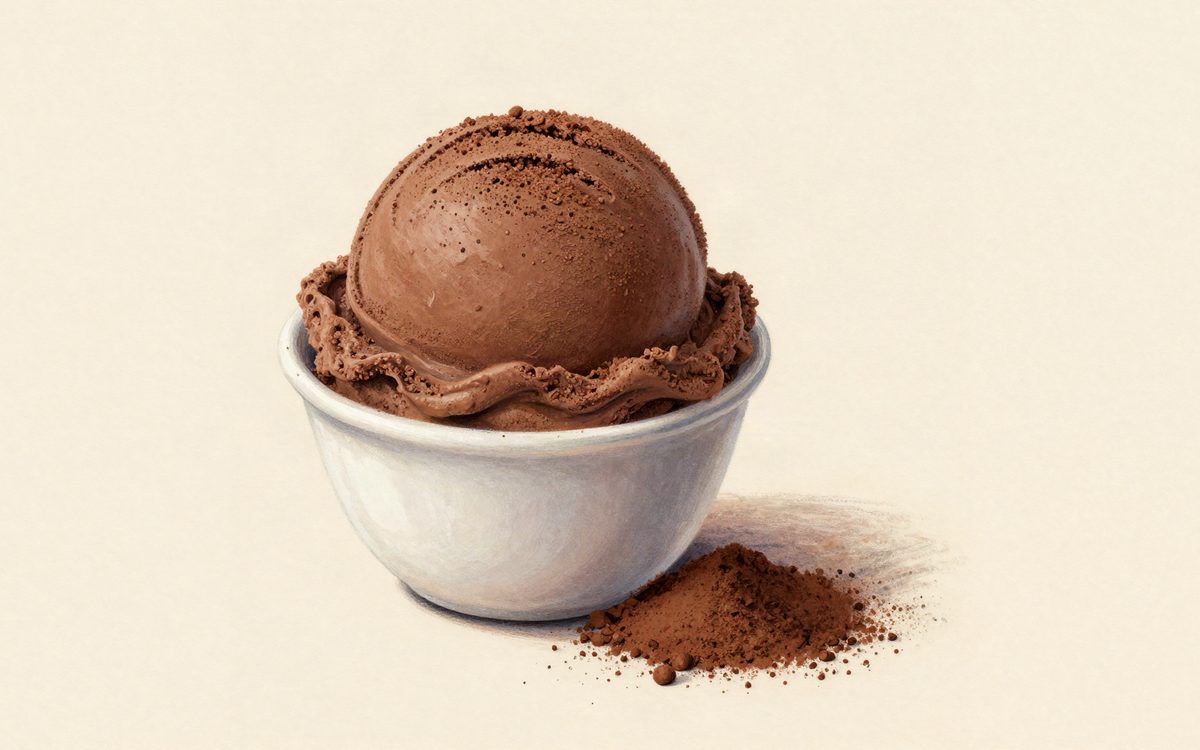
Give it a moment on the tongue before judging the sweetness. Bitterness is out in front early, cocoa well ahead of sugar, and the sweet side only catches up somewhere in the middle of the mouthful. The body behind it sets firmer than a standard chocolate gelato and takes a beat longer to give way, which is what protein at this level does to a mix. The finish is where recipes like this normally collapse, drying to chalk on the palate; here it stays smooth, because the cocoa powder alone accounts for about a fifth of the protein budget. That leaves the whey at a modest 10 g per kilo and hands the rest of the texture work to 14 g of inulin.
What makes this particular sheet interesting is that the cocoa competes for the same allowance. Cocoa powder is about 20 percent protein, so 45 g per kilo of 22 to 24 percent powder already spends around 9 g before any dairy is counted. Add the 8 percent MSNF floor, which by itself brings roughly 30 g of milk protein at 0.37 g per gram of MSNF, and the budget is nearly gone. That is why whey protein sits at just 10 g here.
Solids get filled from somewhere else. Inulin HP at 14 g per kilo is a non sugar solid, so total solids reach 37.97 percent while sugars stay at 17.22 percent, low in 16 to 22. Fat closes at 6.81 percent in a 6 to 12 band, just above the floor, which means the body of this gelato comes from protein and cocoa solids rather than from cream.
Ingredients
Makes 1000 g of finished base.
| Ingredient | Grams | Home measure |
|---|---|---|
| Whole Milk | 522 | 2 1/4 cups |
| Sugar (Sucrose) | 130 | 2/3 cup |
| Heavy Cream 35% | 110 | 1/3 cup plus 2 tablespoons |
| Skim Milk | 100 | 1/3 cup plus 1 tablespoon |
| Cocoa Powder 22-24% | 45 | |
| Dextrose (Glucose) | 45 | 1/4 cup |
| Non-Fat Dry Milk | 20 | 3 1/2 tablespoons |
| Inulin HP | 14 | |
| Whey Protein 80% | 10 | |
| Stabilizer (Neutral) | 3 | |
| Salt | 1 |
Loads these exact grams into the free balancer, ready to edit.
Method
Cold whey, shallow pan, blend twice while it sets
- 1Whisk every dry ingredient together first: sugars, milk powder, stabiliser and salt. Dry-blending them stops the stabiliser clumping when it meets liquid.
- 2Warm the liquids to 40 C (104 F), then rain the dry mix in while whisking hard.
- 3Heat to 82 C (180 F) and hold for 2 minutes so the stabiliser hydrates.
- 4Chill in an ice bath to under 5 C (41 F) within 2 hours. Slow cooling is where bacteria and coarse crystals both start.
- 5Age 6 to 12 hours in the fridge under 5 C (41 F). This is when the stabiliser and the milk protein take up water.
- 6Freeze in a shallow metal pan 2 to 3 cm deep, breaking the crystals with a fork every 30 to 40 minutes, 4 to 6 times.
- 7Freeze firm, then temper 10 to 15 minutes in the fridge before scooping.
The balance
All six against the professional range for Milk Gelato.
Protein at 4.71 percent and MSNF at 8.95 percent explain nearly every line. The 8 percent MSNF floor forces roughly 80 g of non fat milk solids, and those solids carry protein with them, so by the time the 45 g of cocoa has taken its 9 g there is only room for 10 g of whey. Sugar was then placed to hit the freezing targets without disturbing that: 130 g of sucrose with 45 g of dextrose land POD at 166.57 against 140 to 200 and PAC at 260.11 against 220 to 300, the lower middle of the band, so this one sets a little firmer than a fruit base. Solids 37.97 against 36 to 42, water 62.03 against 58 to 64, fat 6.81 against 6 to 12. Lactose is 4.88 percent of the mix and 7.87 percent of the water, comfortably clear of the sandiness threshold.
Estimated nutrition: ~186 kcal · Fat 6.8 g · Sugars 17.2 g · Protein 4.7 g (per 100 g of mix, from the balanced composition).
The heat step is where high protein chocolate bases fail. Whey protein denatures from 72 C and, above roughly 4 percent of the mix, it gels outright, which reads as a chalky, sandy gelato. Pasteurise at 65 C for 30 minutes and skip the fast 85 C cycle entirely, adding the whey already dissolved in cold milk at the end of pasteurisation and chilling straight after. The second trap is viscosity: protein and cocoa together thicken the mix a lot, so hold the stabiliser at 3 g per kilo. The usual 5 g dose turns this base rubbery. The third is air. Protein foams readily and a base like this will take 40 percent overrun without complaint, giving a light, aerated product that is the opposite of what a gelato should be. Hold overrun between 25 and 30 percent. If you want more texture without more protein, swap part of the whey for milk protein concentrate 85, since micellar casein holds water better and does not denature as early.
If it goes wrong
Whey aggregated by heat. The mix went above 72 C, most likely on a standard 85 C pasteurisation cycle.
Hold 65 C for 30 minutes and add the 10 g of whey pre dissolved in cold milk at the end of the hold, then chill immediately.
Too much stabiliser on top of a mix already thickened by 45 g of cocoa and 4.71 percent protein.
Keep the neutral stabiliser at 3 g per kilo, which is the dose on this sheet, and do not scale it up out of habit.
Overrun ran away. A high protein base whips easily and will happily take 40 percent air.
Stop at 25 to 30 percent overrun. When still freezing in a tray, blend to break crystals rather than to whip air in.
Suitable for: Vegetarian, Egg-free
Allergens: milk
- Goff, H. D.; Hartel, R. W. Ice Cream, 7a ed. Springer, 2013 (cap. 3, papel do MSNF e limites de proteina)
- University of Guelph, Dairy Science and Technology eBook (H. D. Goff), secao Ice Cream Mix Processing: https://www.uoguelph.ca/foodscience/book-page/ice-cream-manufacture
- Tharp, B. W.; Young, L. S. Tharp & Young on Ice Cream. DEStech Publications, 2013 (defeitos de corpo e textura associados a excesso de solidos nao gordos)
- Beckett, S. T. Industrial Chocolate Manufacture and Use, 5a ed. Wiley, 2017
- The science behind it: High-Protein Gelato Recipe
- Ingredient sheet: Cocoa Powder 22/24
Want to change an ingredient and watch the numbers move? Open the free balancer