High-Protein Banana Gelato
It eats thicker and colder than the blender version, sweet without tasting sugared, and the fruit turns almost caramelised as it warms on the spoon.
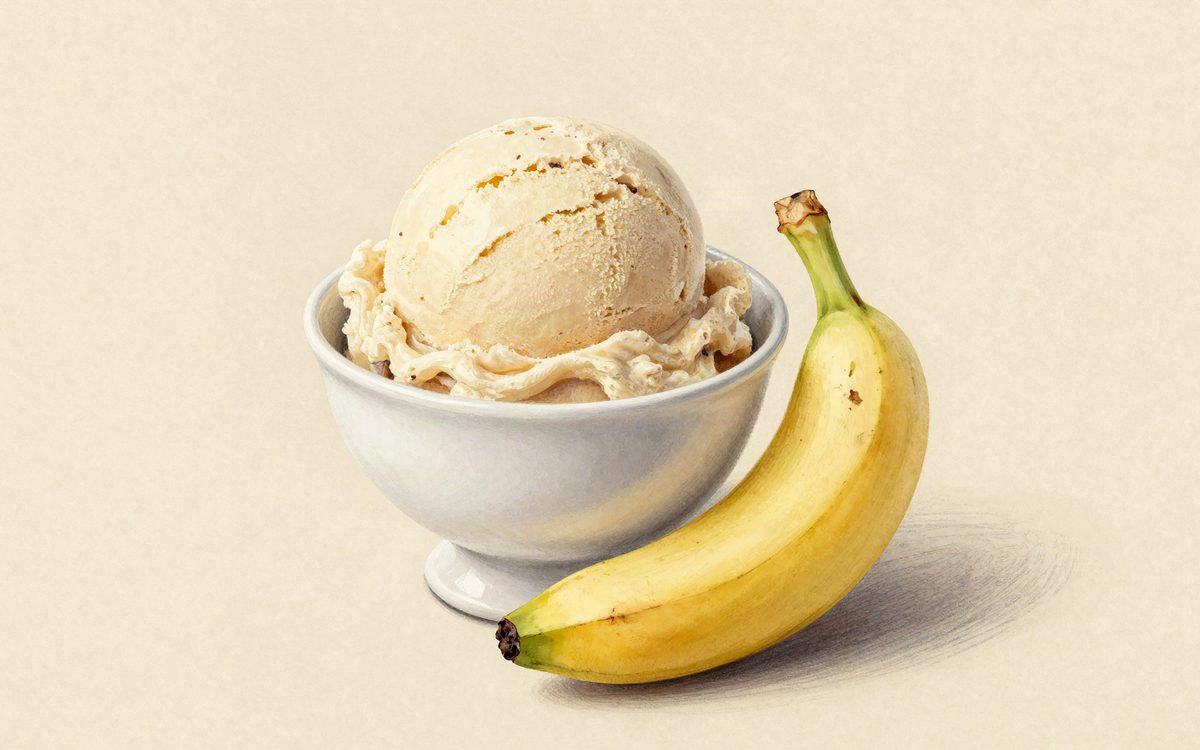
Most people meet this flavour as frozen chunks thrashed in a blender, which is excellent for as long as it takes to eat and a brick the moment it goes back in the freezer. What the blender wins is purity, fruit and nothing else. What it loses is every hour after the first, since nothing in it holds the water still. This sheet trades a little of that purity for keeping quality and picks up protein on the way, 3.94 per cent with whey carrying part of the load. The fruit still does much of the sweetening: 220 g per kilo brings around 35 g of its own sugar, which is why added sucrose stops at 125 g.
The label says high protein, and the honest number is 3.94 percent. This is a milk gelato with fruit, and that base type caps protein at 4.5 percent, not at the 5 percent a dairy only gelato gets. So 15 g of whey per kilo is not a timid dose, it is the dose that fits: about 39 g of protein per kilo with the milk, the skim milk and the 21 g of milk powder already accounted for. Comparing this sheet against a dairy only high protein gelato is comparing two different rulebooks.
On the freezing side, PAC 279.92 sits in the upper half of 240 to 310 and water reads 65.22 percent against a 60 to 68 range. Both point the same way: this is a soft scooper. That is convenient in a cabinet at -14 C and inconvenient on a warm plate, where it will slump faster than a chocolate base would.
Ingredients
Makes 1000 g of finished base.
| Ingredient | Grams | Home measure |
|---|---|---|
| Whole Milk | 360 | 1 1/2 cups |
| Banana | 220 | |
| Sugar (Sucrose) | 125 | 1/2 cup plus 2 tablespoons |
| Heavy Cream 35% | 110 | 1/3 cup plus 2 tablespoons |
| Skim Milk | 100 | 1/3 cup plus 1 tablespoon |
| Dextrose (Glucose) | 35 | 3 tablespoons |
| Non-Fat Dry Milk | 21 | 3 1/2 tablespoons |
| Whey Protein 80% | 15 | |
| Lemon Juice | 10 | |
| Stabilizer (Neutral) | 3 | |
| Salt | 1 |
Loads these exact grams into the free balancer, ready to edit.
Method
Banana blended in raw, tray freeze with forks
- 1Whisk every dry ingredient together first: sugars, milk powder, stabiliser and salt. Dry-blending them stops the stabiliser clumping when it meets liquid.
- 2Warm the liquids to 40 C (104 F), then rain the dry mix in while whisking hard.
- 3Heat to 82 C (180 F) and hold for 2 minutes so the stabiliser hydrates.
- 4Chill in an ice bath to under 5 C (41 F) within 2 hours. Slow cooling is where bacteria and coarse crystals both start.
- 5Age 6 to 12 hours in the fridge under 5 C (41 F). This is when the stabiliser and the milk protein take up water.
- 6Fold the fruit in cold, after ageing. Heating it costs you the fresh aroma and nothing is gained.
- 7Freeze in a shallow metal pan 2 to 3 cm deep, breaking the crystals with a fork every 30 to 40 minutes, 4 to 6 times.
- 8Freeze firm, then temper 10 to 15 minutes in the fridge before scooping.
The balance
All six against the professional range for Milk Gelato with Fruit.
The two indicators that dictate this sheet are protein and PAC. Protein at 3.94 percent against the 2 to 4.5 band for a milk gelato with fruit is what limits the whey to 15 g: the banana and the dairy already spend most of the allowance, and this base type has a lower ceiling than a plain milk gelato. PAC at 279.92, in the upper half of 240 to 310, is the direct consequence of using fruit sugar plus 35 g of dextrose, and it is why the finished tub stays soft. Around them, fat lands at 5.25 percent in a 3.5 to 8 band, in its lower half because the fruit displaces dairy; MSNF 8.01 against 5 to 9.5; solids 34.78 against 32 to 40, in the lower half because banana carries water with its solids; POD 193.25 against 150 to 230, mid band, with sweetness headroom left. Lactose is 4.36 percent of the mix and 6.69 percent of the water, the least crowded water phase you will find in a milk gelato of this style.
Estimated nutrition: ~165 kcal · Fat 5.3 g · Sugars 19.3 g · Protein 3.9 g (per 100 g of mix, from the balanced composition).
Banana browns in minutes, so the fruit step is a single move. Blend the 220 g of banana together with the 10 g of lemon juice in one pass, and take it straight into the cold, already aged base. Any gap between blending and incorporating shows up as grey in the finished product, and the lemon here is functional before it is flavour: it blocks polyphenol oxidase. Do not heat the fruit. Cooked banana reads as baby food and its starch gelatinises, leaving the gelato gummy and heavy. Use fruit at ripeness stage 6, full yellow with the first brown flecks: greener bananas carry resistant starch that never dissolves and feels chalky, blacker ones push sugars toward the 25 percent ceiling. The dairy portion pasteurises at 65 C for 30 minutes, capped by the whey, then chills and ages before the fruit goes in.
If it goes wrong
Time passed between blending the banana and folding it into the base. Polyphenol oxidase works in minutes.
Blend the 220 g of banana with the 10 g of lemon juice in the same jar, in one pass, and go straight into the cold base.
The banana was heated with the base and its starch gelatinised.
Pasteurise only the dairy at 65 C for 30 minutes, chill, age, then fold the raw fruit in. The fruit never sees the pot.
Underripe banana. Resistant starch does not dissolve and does not read as sweetness either.
Use stage 6 fruit, full yellow with the first brown flecks. Ripeness also matters to the balance, since sugars are already at 19.31 percent.
Suitable for: Vegetarian, Egg-free
Allergens: milk
- Goff, H. D.; Hartel, R. W. Ice Cream, 7a ed. Springer, 2013 (cap. 3, contribuicao de solidos de fruta ao balanco)
- USDA FoodData Central, banana crua: https://fdc.nal.usda.gov/
- Caviezel, L. Il gelato artigianale. Chiriotti Editori (gelato alla banana, dose de fruta e escurecimento enzimatico)
- University of Guelph, Dairy Science and Technology eBook (H. D. Goff): https://www.uoguelph.ca/foodscience/book-page/ice-cream-manufacture
- The science behind it: High-Protein Gelato Recipe
- Ingredient sheet: Banana
Want to change an ingredient and watch the numbers move? Open the free balancer