Hazelnut Praline Gelato
Roast arrives before sweetness, then a warm dark caramel note settles in and lingers well past the spoon, with salt keeping the finish clean instead of cloying.
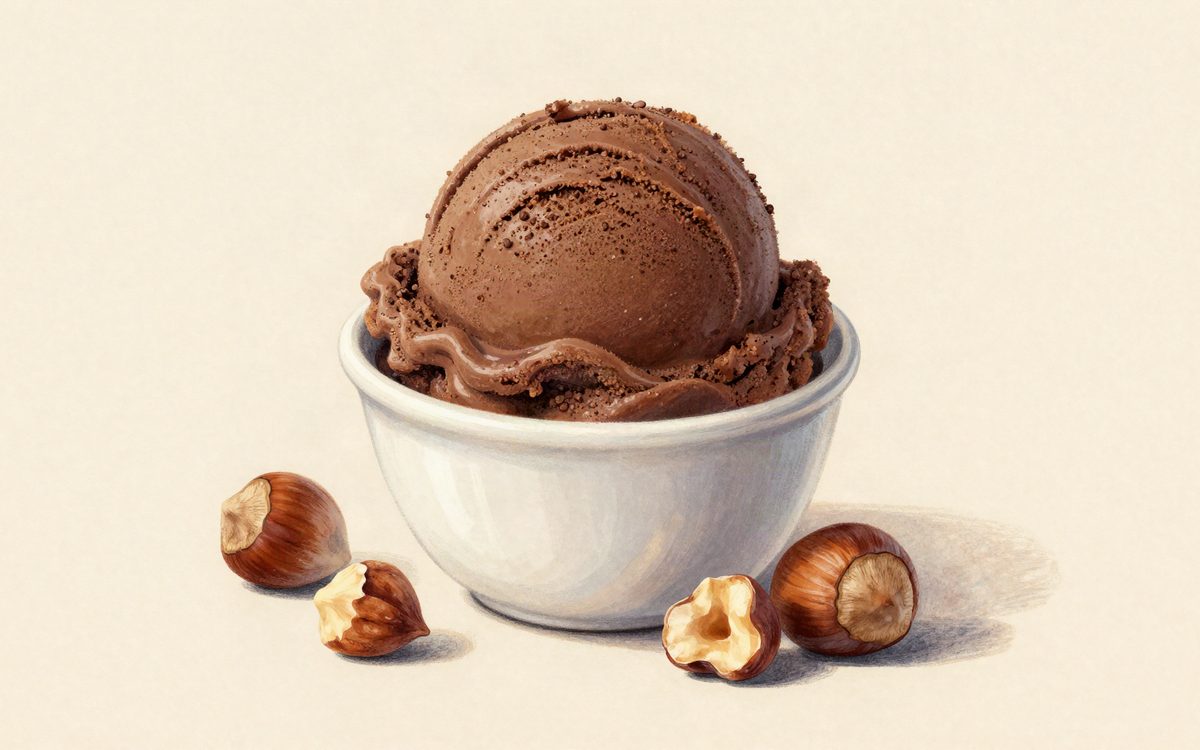
Two labels decide this one. The nut paste should list hazelnut and nothing else, with no added sugar and no added oil, because a paste cut with either arrives at the scale pretending to be nut and lands as filler; Piedmont IGP tells you which nut you are getting, and at 64 percent fat it is already putting 4.8 percent fat into the mix at 75 g per kilo. The second label is the sugar: real muscovado is unrefined and damp, not white sugar with molasses stirred back in, and that molasses residue is the whole reason 25 g of it sits here. Between them the praline gets rebuilt inside the mix instead of bought in a tub.
Weighing a 50/50 praline at 150 g would deliver the same 75 g of hazelnut, but it would also lock 75 g of sucrose in place, and sucrose is the main lever for PAC. Anchoring only 25 g in muscovado keeps the aroma signature and leaves the rest of the sugar free to be positioned: 115 g of sucrose plus 35 g of dextrose land PAC at 267.54, mid range in the 220 to 300 window, which is what makes this base scoopable at around -13.4 C in the cabinet.
The fat tells the other half of the story. IGP hazelnut paste runs about 64 percent fat, so 75 g puts roughly 4.8 percent fat into the mix before a drop of dairy is counted. That is why cream stops at 35 g against 671 g of whole milk, and total fat still reads 8.41 percent, sitting mid range in 6 to 12. Most gelato sheets use cream to reach that number. This one uses the nut.
Ingredients
Makes 1000 g of finished base.
| Ingredient | Grams | Home measure |
|---|---|---|
| Whole Milk | 671 | 2 3/4 cups |
| Sugar (Sucrose) | 115 | 1/2 cup plus 1 tablespoon |
| Hazelnut Paste (Piedmont IGP) | 75 | |
| Dextrose (Glucose) | 35 | 3 tablespoons |
| Non-Fat Dry Milk | 35 | 1/3 cup plus 1 tablespoon |
| Heavy Cream 35% | 35 | 2 1/2 tablespoons |
| Muscovado Sugar | 25 | |
| Carob Seed Flour | 4 | |
| Vanilla Extract | 3 | |
| Salt | 2 |
Loads these exact grams into the free balancer, ready to edit.
Method
Aged 8 hours, then shallow tray with three blends
- 1Whisk every dry ingredient together first: sugars, milk powder, stabiliser and salt. Dry-blending them stops the stabiliser clumping when it meets liquid.
- 2Warm the liquids to 40 C (104 F), then rain the dry mix in while whisking hard.
- 3Heat to 82 C (180 F) and hold for 2 minutes so the stabiliser hydrates.
- 4Off the heat, whisk in the paste, then blend 60 seconds so the fat emulsifies instead of separating.
- 5Chill in an ice bath to under 5 C (41 F) within 2 hours. Slow cooling is where bacteria and coarse crystals both start.
- 6Age 6 to 12 hours in the fridge under 5 C (41 F). This is when the stabiliser and the milk protein take up water.
- 7Freeze in a shallow metal pan 2 to 3 cm deep, breaking the crystals with a fork every 30 to 40 minutes, 4 to 6 times.
- 8Freeze firm, then temper 10 to 15 minutes in the fridge before scooping.
The balance
All six against the professional range for Milk Gelato.
Two numbers carry the sheet. Fat at 8.41 percent is mostly nut fat, not dairy fat, which is why the cream line is 35 g and the whole milk line is 671 g: the solver had almost no room to add cream without leaving the 6 to 12 band. PAC at 267.54 is the second, and it is the reason the sugar was split 115 g sucrose to 35 g dextrose rather than all sucrose, since the 25 g of muscovado was already fixed by the flavour. Around those two, protein reads 4.70 percent against a 5 percent ceiling, MSNF 9.59 against 8 to 11.5, solids 38.22 against 36 to 42, sugars 17.40 against 16 to 22, POD 173.06 against 140 to 200, water 61.78 against 58 to 64. Lactose comes to 5.23 percent of the mix and 8.46 percent of the water, so crystallised lactose is not the sandiness risk on this one.
Estimated nutrition: ~195 kcal · Fat 8.4 g · Sugars 17.4 g · Protein 4.7 g (per 100 g of mix, from the balanced composition).
Order and temperature are the whole game here. The 25 g of muscovado has to dissolve alongside the sucrose in cold milk before any heat goes in, because damp muscovado crystals thrown into a hot mix clump and stay clumped. Pasteurise at 85 C for 30 seconds, then bring the mix down and stick blend the hazelnut paste in at 60 to 65 C, never during the heating: above 80 C the hazelnut oil develops a stale oil note and the roast aroma disappears. Ageing is not optional on this sheet, 8 hours minimum at 4 C, because hazelnut fat crystallises slowly and an unaged batch reads greasy on the palate instead of velvety. Expect a dark beige colour, not a pale one: the muscovado darkens the mix and that is correct. If you want chopped hazelnut on top, toast it separately and add it at packing, since nuts sitting in the mix go soft within 24 hours.
If it goes wrong
The paste went in while the mix was still hot. Hazelnut oil pushed past 80 C loses the roast volatiles and picks up an old oil note.
Pasteurise the dairy base alone at 85 C for 30 seconds, let it fall to 60 to 65 C, and only then blend the 75 g of paste in.
Short or skipped ageing. With 8.41 percent fat and most of it coming from the nut, the fat has not had time to crystallise.
Hold the aged mix a full 8 hours at 4 C before freezing. This is the one step that cannot be shortened on this recipe.
Muscovado added to the hot mix. Its moisture makes it cake instead of dissolving.
Dissolve the 25 g of muscovado together with the 115 g of sucrose in the cold milk, before the pot goes on the heat.
Suitable for: Vegetarian, Egg-free
Allergens: milk, tree nuts
No ingredient in this recipe contains gluten.
- https://en.wikipedia.org/wiki/Praline_(nut_confection)
- https://www.valrhona.com/en/l-ecole-valrhona/discover-l-ecole-valrhona/chocolate-terminology/praline
- https://www.mec3.com/en/products/gelato/flavouring-pastes/premium-line/hazelnut-maxima
- https://www.ircagroup.com/en/products/praline-noisette
- The science behind it: Hazelnut Paste in Gelato
- Ingredient sheet: Hazelnut Paste (Piedmont IGP)
Want to change an ingredient and watch the numbers move? Open the free balancer