Hazelnut Gelato
Toasted aroma arrives late and stays late, the body is round and warm, and the bite finishes short instead of coating the palate.
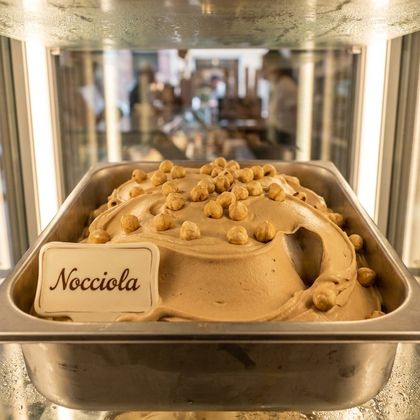
Check the ingredient list before the price: it should have one entry, and that entry should be the nut. Pastes cut with sugar, palm oil or milk powder are cheaper for a reason, and in a frozen base the substitution shows up as an oily, flat finish where the aroma was supposed to be. Roast level is the second thing worth asking about, since a dark roast turns the nut bitter and a pale one leaves it green and raw. Gelateria specifications ask for 90 g per kilo on stabilised lines and 80 to 130 g on the pure ones, and 90 g is what this sheet uses, with the dried milk pushed to 28 g so the body stays round and the bite stays short.
Piedmont hazelnut is the fattest nut in this group at 64 percent, which reshapes everything downstream. Those 90 g put 57.6 g of fat into the kilo on their own, already most of the way to the 6 percent floor before any dairy is counted. That is why cream comes in at just 10 g and 692 g of whole milk does the volume: give cream a free hand and fat breaks its ceiling long before MSNF is settled.
The compensation runs the other way on protein. Hazelnut is poor in protein for a nut, around 15 percent, so it spends only 1.35 points of the protein budget. That leaves room for 28 g of non-fat dry milk to carry MSNF to 8.97 percent, which is where hazelnut gelato picks up its round body and short bite. And 40 g of dextrose stand in for part of the sucrose, because the high fat already firms the product and PAC had to rise without POD rising with it.
Ingredients
Makes 1000 g of finished base.
| Ingredient | Grams | Home measure |
|---|---|---|
| Whole Milk | 692 | 3 cups |
| Sugar (Sucrose) | 135 | 2/3 cup |
| Hazelnut Paste (Piedmont IGP) | 90 | |
| Dextrose (Glucose) | 40 | 3 1/2 tablespoons |
| Non-Fat Dry Milk | 28 | 1/4 cup plus 1 tablespoon |
| Heavy Cream 35% | 10 | 2 teaspoons |
| Carob Seed Flour | 4 | |
| Salt | 1 |
Loads these exact grams into the free balancer, ready to edit.
Method
Blend the paste in under 40 C, then still-freeze
- 1Whisk every dry ingredient together first: sugars, milk powder, stabiliser and salt. Dry-blending them stops the stabiliser clumping when it meets liquid.
- 2Warm the liquids to 40 C (104 F), then rain the dry mix in while whisking hard.
- 3Heat to 82 C (180 F) and hold for 2 minutes so the stabiliser hydrates.
- 4Off the heat, whisk in the paste, then blend 60 seconds so the fat emulsifies instead of separating.
- 5Chill in an ice bath to under 5 C (41 F) within 2 hours. Slow cooling is where bacteria and coarse crystals both start.
- 6Age 6 to 12 hours in the fridge under 5 C (41 F). This is when the stabiliser and the milk protein take up water.
- 7Freeze in a shallow metal pan 2 to 3 cm deep, breaking the crystals with a fork every 30 to 40 minutes, 4 to 6 times.
- 8Freeze firm, then temper 10 to 15 minutes in the fridge before scooping.
The balance
All six against the professional range for Milk Gelato.
Fat at 8.56 percent inside a 6 to 12 window looks unremarkable until you notice where it came from: 57.6 g of it walked in with the hazelnut paste, which is why cream is down at 10 g. Protein at 4.69 percent against a ceiling of 5 is the tighter constraint, and the only reason it fits is that hazelnut is protein-poor for a nut, spending 1.35 points and leaving room for the 28 g of milk powder that put MSNF at 8.97 percent. PAC at 262.41 sits mid-range in 220 to 300, reached with 40 g of dextrose rather than more sucrose, which is why POD stays at 171.89 and sugars at 17.5 percent, in the lower half of 16 to 22. A gelato this fat would eat hard if PAC had been left low. Lactose finishes at 7.9 percent of the water phase, under the sandiness threshold.
Estimated nutrition: ~195 kcal · Fat 8.6 g · Sugars 17.5 g · Protein 4.7 g (per 100 g of mix, from the balanced composition).
For hazelnut the roast, not the dose, is the flavour variable. A lightly roasted paste, 145 to 150 C, gives the lactic, buttery Piedmont profile; a dark roast turns praline and starts arguing with the milk. Add the paste to the pasteurized base only once it is below 40 C, because above that the roast volatiles escape. Nut fat at 8.56 percent total needs a firm emulsion, so run an immersion blender for two minutes without whipping air into the mix. Watch oxidative stability as well: hazelnut is rich in oleic acid, and the finished base should not sit more than 24 hours at 4 C exposed to light or a rancid note appears.
If it goes wrong
The paste was made from a dark roast. Past the light range the roast notes dominate and fight the milk instead of sitting inside it.
Use paste from hazelnuts roasted at 145 to 150 C. Changing the roast changes the flavour far more than changing the 90 g dose would.
The paste met the base while it was still hot, or it was stirred in by hand rather than emulsified.
Wait until the base is under 40 C, then run an immersion blender for two full minutes, keeping the head submerged so no air goes in.
Oxidation. Hazelnut is rich in oleic acid and the prepared base was held too long, or left in the light.
Keep maturation to 24 hours at 4 C in a covered container away from light, and freeze it on schedule.
Suitable for: Vegetarian, Egg-free
Allergens: milk, tree nuts
No ingredient in this recipe contains gluten.
- https://www.mec3.com/en/products/gelato/flavouring-pastes/milk-gelato-flavours/hazelnut-stabilized
- https://www.bakersauthority.com/products/nocciola-la-la
- https://www.mec3.com/en/products/gelato/flavouring-pastes/premium-line/hazelnut-maxima
- The science behind it: Hazelnut Paste in Gelato
- Ingredient sheet: Hazelnut Paste (Piedmont IGP)
- The story of this recipe: Nocciola Piemontese Gelato
Want to change an ingredient and watch the numbers move? Open the free balancer