Guava Sorbet
Scent arrives before weight: floral and icy at the first touch, then a jammy sweetness that settles in and lingers, with lime pulling the finish tight.
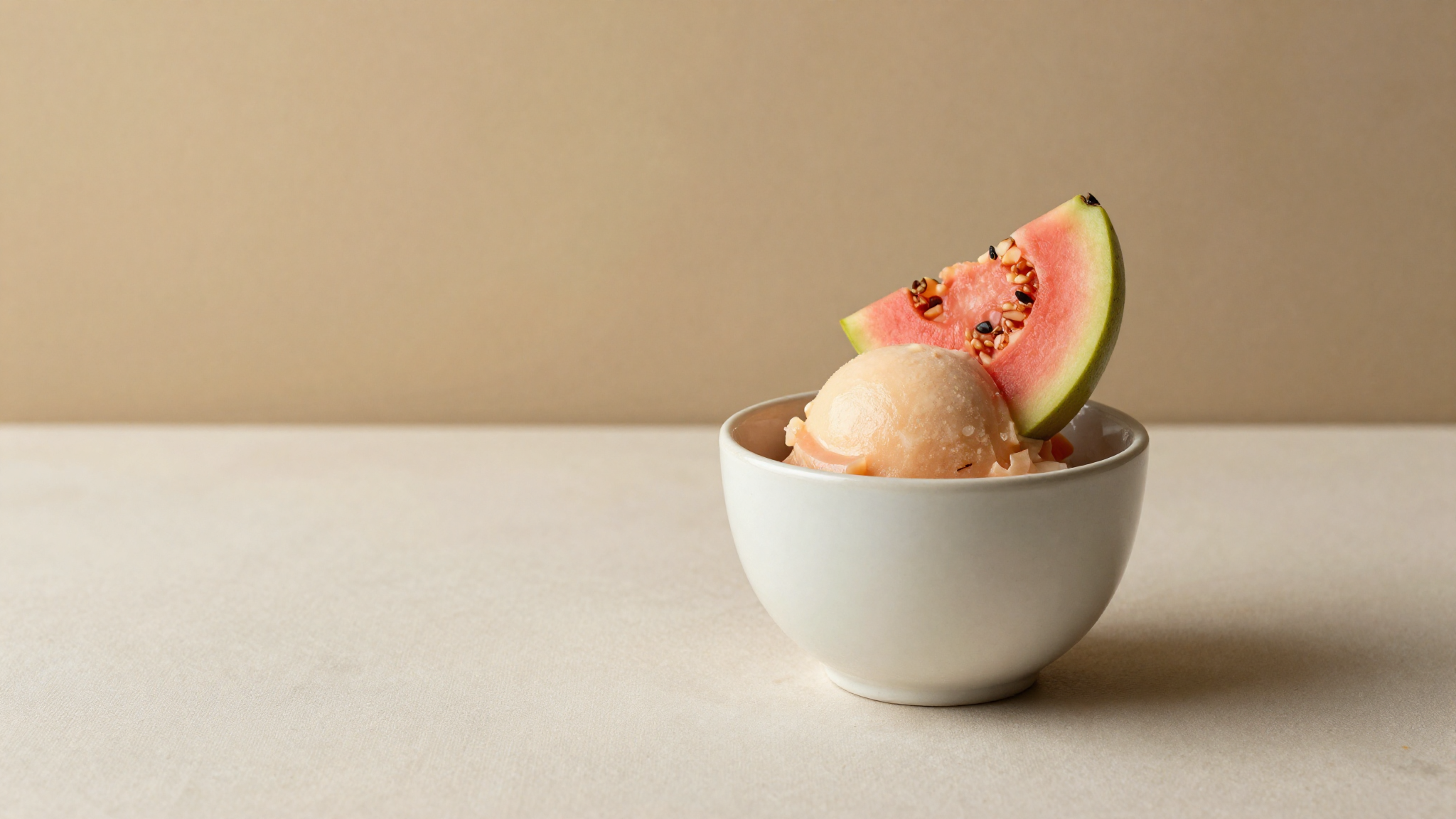
Chill first, then scent, then weight. With no fat on the sheet there is nothing to coat the tongue, so the perfume of the fresh fruit gets through early and clean. What follows is far thicker than a plain fruit water, because 90 g of paste per kilo carries 76 per cent solids into the mix and turns the middle of the mouthful dense and jammy. Tahitian lime keeps the ending from going flat, and the sweetness fades out slowly instead of snapping shut. Around 240 g of guava material in total, split between fresh fruit for the top notes and paste for weight and length.
So the load is split. 150 g of fresh guava carry the volatiles, which are fragile and live only in raw fruit, and 90 g of guava paste carry intensity and body: it is 76 percent solids and only 0.3 g of protein per 100 g, so it buys almost nothing on the protein account. Together that is around 240 g of guava material at about 4.2 g of protein, and the finished sheet reads 0.42 percent, comfortably under a ceiling of 1.
The cost lands on the sugar side. The paste alone injects roughly 63 g of sugar and 67 points of POD, and glucose powder stops at 60 g. The result leans toward the flavour of guava paste rather than raw fruit, which in Brazil is not an apology, it is the point.
Ingredients
Makes 1000 g of finished base.
| Ingredient | Grams | Home measure |
|---|---|---|
| Water | 551 | 2 1/3 cups |
| Guava | 150 | |
| Sugar (Sucrose) | 120 | 1/2 cup plus 2 tablespoons |
| Guava Paste | 90 | |
| Glucose Powder | 60 | 1/4 cup plus 1 tablespoon |
| Tahitian Lime | 15 | |
| Dextrose (Glucose) | 10 | 2 1/2 teaspoons |
| Stabilizer (Neutral) | 4 |
Loads these exact grams into the free balancer, ready to edit.
Method
Hot-melt the paste, chill, add raw pulp, still-freeze
- 1Whisk every dry ingredient together first: sugars, milk powder, stabiliser and salt. Dry-blending them stops the stabiliser clumping when it meets liquid.
- 2Warm the liquids to 40 C (104 F), then rain the dry mix in while whisking hard.
- 3Heat to 82 C (180 F) and hold for 2 minutes so the stabiliser hydrates.
- 4Off the heat, whisk in the paste, then blend 60 seconds so the fat emulsifies instead of separating.
- 5Chill in an ice bath to under 5 C (41 F) within 2 hours. Slow cooling is where bacteria and coarse crystals both start.
- 6Age 6 to 12 hours in the fridge under 5 C (41 F). This is when the stabiliser and the milk protein take up water.
- 7Freeze in a shallow metal pan 2 to 3 cm deep, breaking the crystals with a fork every 30 to 40 minutes, 4 to 6 times.
- 8Freeze firm, then temper 10 to 15 minutes in the fridge before scooping.
The balance
All six against the professional range for Sorbetto.
POD finishes at 237.09, mid band in 200 to 270, and PAC lands at 285.32 just above a floor of 280. The practical consequence is a tub that sets firm, so give it a few minutes out of the freezer before scooping. Solids at 28.83 percent sit near the 28 floor and water at 71.17 percent near the 72 ceiling, the usual shape when syrup and fruit paste do most of the work.
Estimated nutrition: ~116 kcal · Fat 0.2 g · Sugars 26.3 g · Protein 0.4 g (per 100 g of mix, from the balanced composition).
The classic defect in guava sorbet is grittiness, and it does not come from sugar. It comes from the stone cells, the lignified sclereids of about 0.1 mm scattered through the mesocarp, which industry removes with a decanter centrifuge. In a kitchen the equivalent is mandatory: blend the fruit, press it hard through a FINE sieve, and throw away what stays behind along with the seeds, which are hard enough to damage a blade and will not break down anyway. No stabilizer disguises a sclereid. The guava paste has to be dissolved hot: cube it and melt it into the syrup at 85 C, stirring until completely homogeneous, or you will be left with lumps that never hydrate in the cold. Correct order is syrup and paste pasteurized together at 85 C, chilled to 4 C, and only then the sieved raw pulp and the 15 g of Tahitian lime folded in cold so the aroma is never cooked. Mature 4 hours at 4 C.
If it goes wrong
Stone cells from the guava mesocarp, roughly 0.1 mm and lignified. This is not sugar recrystallization, so temperature will not solve it.
Press the blended fruit through a fine sieve with real force and discard everything held back, seeds included.
The guava paste was added cold, or melted only partway, and it will not hydrate once the mix is chilled.
Cube it and melt it into the syrup at 85 C, stirring until the liquid is completely uniform before anything cools.
The lime was skipped or went in hot. POD sits at 237.09, mid band, and without acidity as a counterweight that sweetness reads heavy.
Fold the 15 g of Tahitian lime into the base at 4 C, after the syrup has chilled, never during the 85 C step.
Suitable for: Vegan, Vegetarian, Lactose-free, Egg-free
- https://academic.oup.com/ijfst/article/23/5/501/7867162
- https://www.sciencedirect.com/science/article/abs/pii/000862159384186A
- https://www.feedipedia.org/node/111
- https://blog.giallozafferano.it/dolcipocodolci/sorbetteria-bilanciamento-sorbetti-con-zucchero-eritritolo/
- The science behind it: How to Balance a Sorbetto Recipe
- Ingredient sheet: Guava
- The story of this recipe: Guava Sorbetto Recipe
Want to change an ingredient and watch the numbers move? Open the free balancer