Guava Milk Gelato
Perfumed and slightly resinous, more tropical than sweet, sieved smooth so nothing grits between the teeth, with a milky roundness that carries the scent past the swallow.
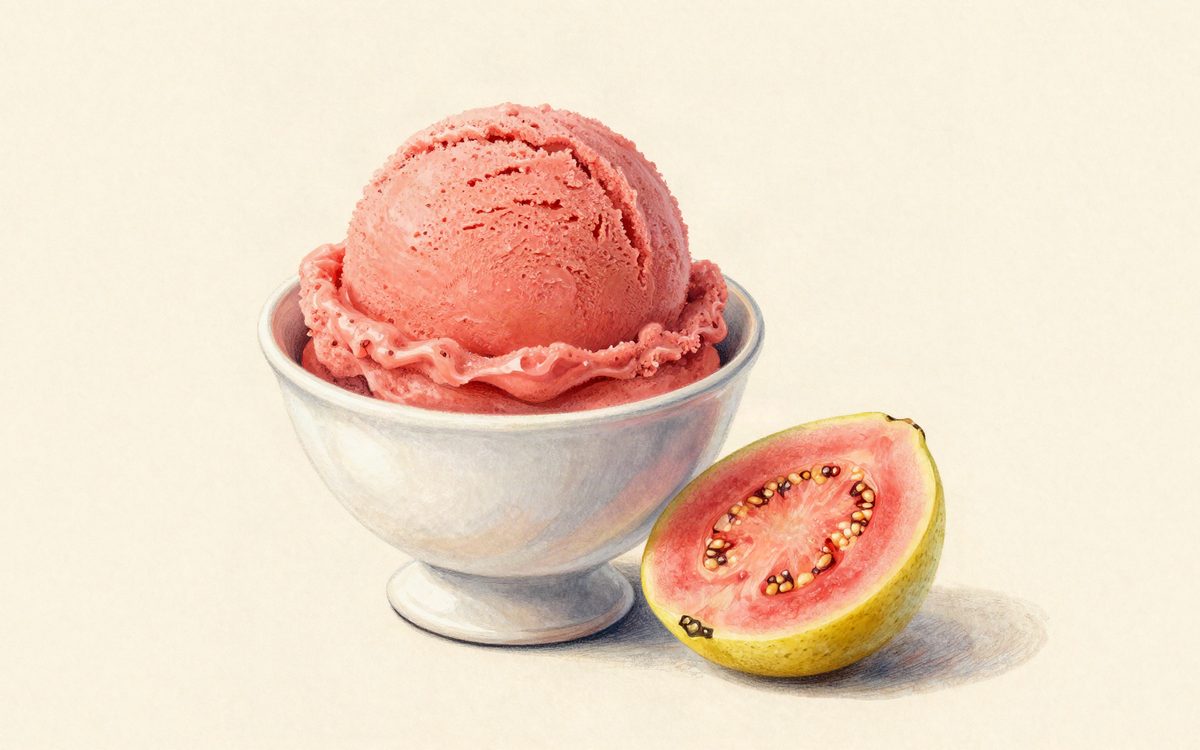
The failure mode here is ice, and it is written into the fruit: four fifths of raw guava is water, so the home instinct of adding more pulp for more flavour ends in something you chip at instead of scoop. Two things keep that away. Sixty grams of glucose powder per kilo add dry solids without adding sweetness, and the pulp is held at 250 g, which is also where the astringency stops, since skin and seed bed carry tannins that dry the mouth and fight the milk fat. Six grams of lemon juice pull the pH of ripe fruit back down, because guava that tastes flat warm tastes flatter still at freezer temperature.
The fruit also brings 19 percent solids at only 9 percent sugar, a profile that gives body without pushing sweetness, which is rarer than it sounds among tropical fruit.
The dose stops at 250 g and not higher for a reason that has nothing to do with the balance sheet. Condensed tannins concentrate in the skin and in the flesh nearest the seeds, and past about 26 percent of the mix a drying, puckering sensation shows up and starts fighting the milk fat. The 6 g of lemon juice are there because ripe guava climbs above pH 4.0 and reads flat, and because guava is not acidic enough for that correction to threaten the casein.
Ingredients
Makes 1000 g of finished base.
| Ingredient | Grams | Home measure |
|---|---|---|
| Whole Milk | 391 | 1 2/3 cups |
| Guava | 250 | |
| Heavy Cream 35% | 130 | 1/2 cup plus 1 tablespoon |
| Sugar (Sucrose) | 100 | 1/2 cup |
| Glucose Powder | 60 | 1/4 cup plus 1 tablespoon |
| Non-Fat Dry Milk | 39 | 1/3 cup plus 1 tablespoon |
| Dextrose (Glucose) | 20 | 1 1/2 tablespoons |
| Lemon Juice | 6 | |
| Stabilizer (Neutral) | 3 | |
| Salt | 1 |
Loads these exact grams into the free balancer, ready to edit.
Method
Chill the base first, fold in raw pulp, still-freeze
- 1Whisk every dry ingredient together first: sugars, milk powder, stabiliser and salt. Dry-blending them stops the stabiliser clumping when it meets liquid.
- 2Warm the liquids to 40 C (104 F), then rain the dry mix in while whisking hard.
- 3Heat to 82 C (180 F) and hold for 2 minutes so the stabiliser hydrates.
- 4Chill in an ice bath to under 5 C (41 F) within 2 hours. Slow cooling is where bacteria and coarse crystals both start.
- 5Age 6 to 12 hours in the fridge under 5 C (41 F). This is when the stabiliser and the milk protein take up water.
- 6Fold the fruit in cold, after ageing. Heating it costs you the fresh aroma and nothing is gained.
- 7Freeze in a shallow metal pan 2 to 3 cm deep, breaking the crystals with a fork every 30 to 40 minutes, 4 to 6 times.
- 8Freeze firm, then temper 10 to 15 minutes in the fridge before scooping.
The balance
All six against the professional range for Milk Gelato with Fruit.
Protein at 3.62 percent inside a 2 to 4.5 window is the number worth reading first, because roughly 6.5 g of it came from the fruit rather than from powder. That is what let non-fat dry milk stay at 39 g and MSNF settle at 7.98 percent, in the upper half of its 5 to 9.5 range instead of pressed against the top. Fat at 6.21 percent sits mid-window in 3.5 to 8, enough to carry the aroma without smothering it, and PAC at 264.62 lands in the lower half of 240 to 310 for a clean scoop in a -11 to -14 C cabinet. Sugars finish at 19.79 percent within 17 to 25, most of it added rather than from the fruit, since guava only carries 9 percent sugar. Lactose ends at 6.86 percent of the water phase, well clear of sandiness.
Estimated nutrition: ~178 kcal · Fat 6.2 g · Sugars 19.8 g · Protein 3.6 g (per 100 g of mix, from the balanced composition).
Sieve without compromise. Guava seeds are hard, they do not soften in the freezer, and they are defect number one in this flavour. Use a fine sieve or a food mill, never the blender alone, because a blender cracks the seeds and releases tannin, which increases astringency instead of reducing it. Discard the outer skin for the same reason. The pulp goes in raw, into the already chilled and matured base, never into the hot pot: cooked guava loses its fresh esters and turns into the taste of guava paste. If you are using red guava, expect the pink to fade against the milk, and know that more fruit will not bring it back, only acidity will. Draw at -8 C and hold at -14 C.
If it goes wrong
Guava seeds. They do not soften at freezing temperature and a blender alone will not remove them.
Push the pulp through a fine sieve or a food mill and discard everything held back, seeds and skin together.
Astringency from condensed tannins, either because the skin went in or because the fruit dose climbed past about 26 percent of the mix.
Peel first, and stay at the 250 g per kilo in the sheet. That is the ceiling where the tannins stop competing with the milk fat.
The pulp was cooked, or the colour simply diluted against the dairy, which is normal for red guava in a milk base.
Add the pulp raw to the cold base after maturation. If the colour still reads flat, sharpen it with the 6 g of lemon juice rather than with more fruit.
Suitable for: Vegetarian, Egg-free
Allergens: milk
- USDA FoodData Central - composicao da goiaba crua (https://fdc.nal.usda.gov)
- Embrapa - caracterizacao fisico-quimica de goiaba (Psidium guajava): solidos soluveis, acidez e pectina
- Belitz, H.-D.; Grosch, W.; Schieberle, P. - Food Chemistry, 4a ed., Springer, 2009 (taninos condensados e adstringencia)
- Goff, H.D.; Hartel, R.W. - Ice Cream, 7a ed., Springer, 2013 (proteina do mix e estrutura do gelato)
- The science behind it: Fruit Purée Selection for Sorbetto
- Ingredient sheet: Guava
Want to change an ingredient and watch the numbers move? Open the free balancer