Grape Sorbet
Juicy on contact, rounder in the body than its pale colour suggests, finishing with a flick of lemon that stops the sweetness settling in.
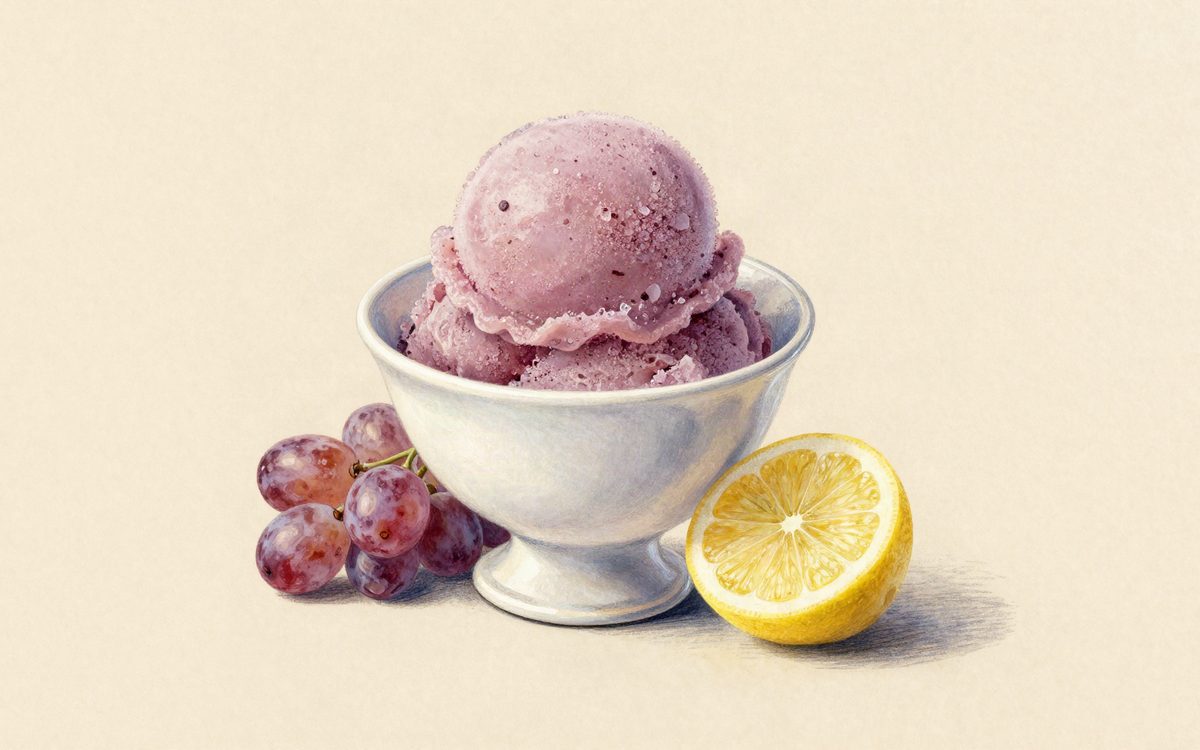
What arrives first is the cold, and then a body fuller than the colour leads you to expect. Fruit sits at 580 g per kilo, among the heaviest loads a balanced sorbet will carry, and that weight is what gives the middle of the spoon something to hold rather than a wash of syrup. The flavour opens slowly as the mix warms on the palate, stays sweet without going flat, and the 20 g of lemon juice turns up late to tighten the finish. Maltodextrin at 90 g does the quiet work underneath, filling out the solids so the sugars can stay low and nothing eats cloying.
That generosity creates the central tension of the recipe. Grape is also the sugariest fruit in this group, around 16 percent sugar with POD 20 and PAC 30, so those 580 g deposit about 9.3 points of sugar, 116 points of POD and 174 points of PAC before anything else goes on the scale. With the POD ceiling at 270, every added sweetener has to fit into what the fruit left over, and the sugar floor of 25 percent still has to be reached.
That is why sucrose stops at 50 g while maltodextrin runs to 90 g, the largest addition after the fruit and the water. Maltodextrin contributes solids almost without contributing sweetening power, which is the only way to close solids and sugars at once without blowing through the POD ceiling. The 20 g of lemon juice fix the other problem: table grape sits at pH 3.5 to 4.0 but its titratable acidity barely registers against that much sugar.
Ingredients
Makes 1000 g of finished base.
| Ingredient | Grams | Home measure |
|---|---|---|
| Grape | 580 | |
| Water | 196 | 3/4 cup plus 1 tablespoon |
| Maltodextrin | 90 | |
| Sugar (Sucrose) | 50 | 1/4 cup |
| Dextrose (Glucose) | 40 | 3 1/2 tablespoons |
| Lemon Juice | 20 | |
| Glucose Powder | 20 | 1 1/2 tablespoons |
| Carob Seed Flour | 3 | |
| Guar Gum | 1 |
Loads these exact grams into the free balancer, ready to edit.
Method
Strain twice, freeze flat, blitz at the halfway point
- 1Whisk every dry ingredient together first: sugars, milk powder, stabiliser and salt. Dry-blending them stops the stabiliser clumping when it meets liquid.
- 2Warm the liquids to 40 C (104 F), then rain the dry mix in while whisking hard.
- 3Heat to 82 C (180 F) and hold for 2 minutes so the stabiliser hydrates.
- 4Chill in an ice bath to under 5 C (41 F) within 2 hours. Slow cooling is where bacteria and coarse crystals both start.
- 5Age 6 to 12 hours in the fridge under 5 C (41 F). This is when the stabiliser and the milk protein take up water.
- 6Fold the fruit in cold, after ageing. Heating it costs you the fresh aroma and nothing is gained.
- 7Freeze in a shallow metal pan 2 to 3 cm deep, breaking the crystals with a fork every 30 to 40 minutes, 4 to 6 times.
- 8Freeze firm, then temper 10 to 15 minutes in the fridge before scooping.
The balance
All six against the professional range for Sorbetto.
POD finishes at 209.55, near the floor of a 200 to 270 band, and the fruit alone accounts for 116 of those points. PAC ends at 327.38 inside a 280 to 340 window, sitting in the upper half, which means it wants a colder cabinet, at -13.1 C, again a consequence of the fruit rather than the sweeteners: grape brought 174 points of PAC with it. Sugars finish at 28.42 percent within 25 to 31, solids at 31.2 percent within 28 to 34, and water at 68.8 percent within 66 to 72.
Estimated nutrition: ~125 kcal · Fat 0 g · Sugars 28.4 g · Protein 0.4 g (per 100 g of mix, from the balanced composition).
Use seedless grapes, or sieve without mercy, because a ground seed releases tannin and bitter oil straight into the mix. If you are working with dark-skinned grapes such as Bordo, Isabel or Concord, warm the fruit to 60 C for ten minutes purely to pull the anthocyanin out of the skins and then sieve, because the colour of a dark grape lives in the skin and not in the pulp. For green grapes there is no reason to heat at all. Never take the fruit past 65 C: above that the methoxypyrazine note that makes grape taste like grape is lost and you are left with sweet without identity. One step is specific to this fruit and appears in none of the others: potassium bitartrate from the grape can precipitate as gritty crystals during cold maturation, so rest the mix 12 hours at 4 C and strain it a second time before freezing.
If it goes wrong
Potassium bitartrate precipitating out of the grape during the cold rest. It is tartrate, not sugar, so it will not redissolve on the counter.
Let the mix sit 12 hours at 4 C so the tartrate drops out, then strain a second time before it goes into the freezer.
Ground seeds. Blending seeded grapes releases tannin and bitter seed oil into the mix.
Use seedless grapes, or press the puree through a fine sieve and discard everything that stays behind.
The colour was never extracted. Anthocyanin sits in the skin, not the pulp, so cold blending leaves it behind.
Warm the whole fruit to 60 C for ten minutes, then sieve. Do not pass 65 C or you trade the aroma for the colour.
Suitable for: Vegan, Vegetarian, Lactose-free, Egg-free
No ingredient in this recipe contains gluten.
- Angelo Corvitto, Los secretos del helado (Vilbo), tabelas de poder anticongelante e criterio de dose por intensidade de fruta
- USDA FoodData Central, Grapes, red or green (european type), raw (acucares totais cerca de 15,5 g/100 g)
- Pastry Arts Magazine, Simple Sorbet Science (https://pastryartsmag.com/sponsored/simple-sorbet-science/)
- Underbelly, Sample Sorbet Recipe (https://under-belly.org/sample-sorbet-recipe/)
- The science behind it: Anthocyanin Color Stability in Sorbet
- Ingredient sheet: Grape
Want to change an ingredient and watch the numbers move? Open the free balancer