Fig Sorbet
Denser on the spoon than a sorbet usually is, jammy rather than sharp, with a honeyed sweetness that fades out slowly instead of snapping shut.
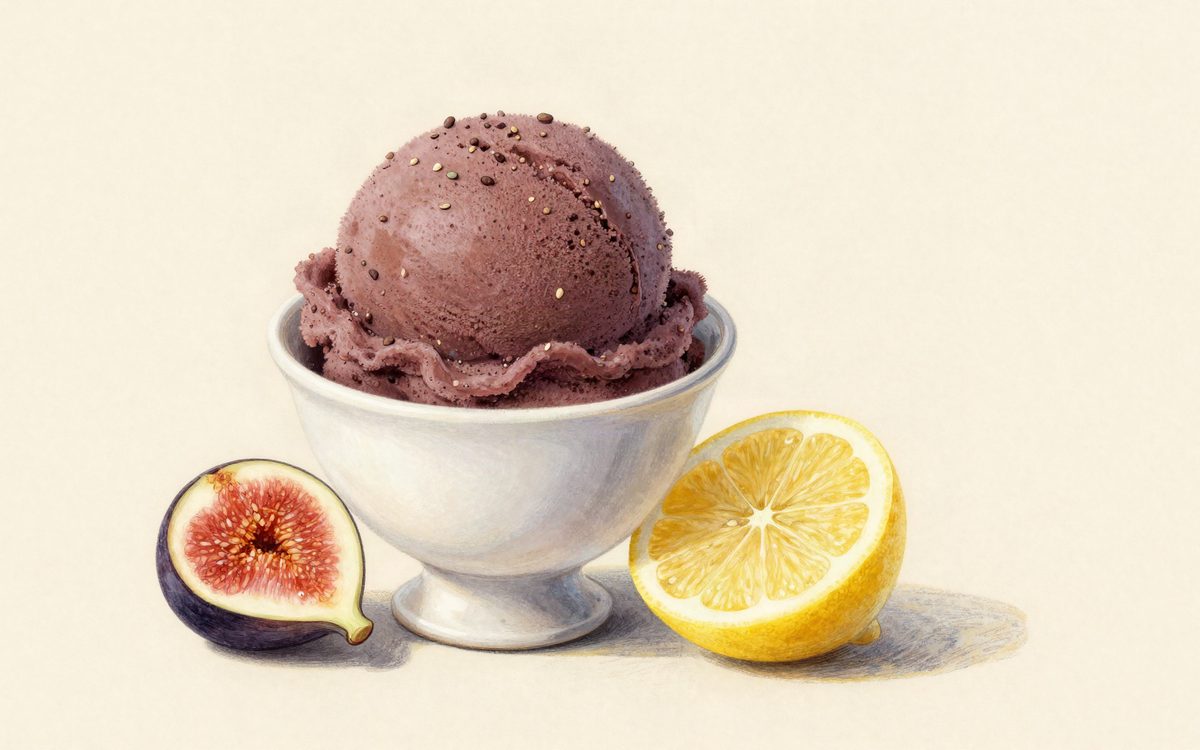
The first spoonful lands heavier than the word sorbet leads you to expect. It sits on the tongue instead of sliding off it, and the sweetness arrives round and slow, nearer to jam than to fruit juice, with the seeds giving a fine grain under the teeth. Acidity cuts across the middle of the mouthful and stops the whole thing going flat, and the finish is long, warm and honeyed rather than clean. That body is bought with maltodextrin at 81 g/kg, which adds solids without adding sweetness, and with carob and guar holding the water so the texture stays smooth down to the last spoon.
That fact rewrites the sugar plan. Sucrose retreats, here to 85 g/kg, while the missing solids come from a carbohydrate that does not taste sweet. Maltodextrin does that at 81 g/kg: dry extract and body without spending POD budget and without the freezing point depression that more dextrose would bring. POD finishes at 206.34 and total sugars at 27.85%.
Dextrose is capped at 60 g/kg precisely because its PAC is 173, roughly double sucrose, and the fig is already pushing PAC upward. The mix lands at PAC 325.27, high in the 280 to 340 band, with solids at 30.92% and water at 69.08%.
Lemon juice at 15 g/kg is pH work, not flavor. Ripe fig sits at pH 4.6 to 5.0, which is high for a sorbetto, and low acidity reads as flat and takes the freshness away. Carob seed flour at 3 g/kg plus 1 g/kg of guar gum is the standard sorbetto pair, with documented synergy for ice crystal control in a system that has no fat and no milk protein to help. Protein finishes at 0.47%, in the middle of the 0 to 1 band.
Ingredients
Makes 1000 g of finished base.
| Ingredient | Grams | Home measure |
|---|---|---|
| Fig | 440 | |
| Water | 315 | 1 1/3 cups |
| Sugar (Sucrose) | 85 | 1/3 cup plus 2 tablespoons |
| Maltodextrin | 81 | |
| Dextrose (Glucose) | 60 | 1/4 cup plus 1 tablespoon |
| Lemon Juice | 15 | |
| Carob Seed Flour | 3 | |
| Guar Gum | 1 |
Loads these exact grams into the free balancer, ready to edit.
Method
Freeze solid, then food processor blitz
- 1Whisk every dry ingredient together first: sugars, milk powder, stabiliser and salt. Dry-blending them stops the stabiliser clumping when it meets liquid.
- 2Warm the liquids to 40 C (104 F), then rain the dry mix in while whisking hard.
- 3Heat to 82 C (180 F) and hold for 2 minutes so the stabiliser hydrates.
- 4Chill in an ice bath to under 5 C (41 F) within 2 hours. Slow cooling is where bacteria and coarse crystals both start.
- 5Age 6 to 12 hours in the fridge under 5 C (41 F). This is when the stabiliser and the milk protein take up water.
- 6Fold the fruit in cold, after ageing. Heating it costs you the fresh aroma and nothing is gained.
- 7Freeze in a shallow metal pan 2 to 3 cm deep, breaking the crystals with a fork every 30 to 40 minutes, 4 to 6 times.
- 8Freeze firm, then temper 10 to 15 minutes in the fridge before scooping.
The balance
All six against the professional range for Sorbetto.
The number that drives everything is the 75 points of POD the fig contributes on its own. Sucrose sits at 85 g/kg while total sugars still reach 27.85%, well inside the 25 to 31 band. The gap is filled by 81 g/kg of maltodextrin, which raises solids to 30.92% without sweetening and without moving the freezing point much. PAC is the second constraint: at 325.27 the mix is already high in 280 to 340, so dextrose stops at 60 g/kg rather than being used to build solids. Protein at 0.47% comes entirely from the fruit.
Estimated nutrition: ~124 kcal · Fat 0 g · Sugars 27.9 g · Protein 0.5 g (per 100 g of mix, from the balanced composition).
Fig carries a lot of ficin, a protease. It does not matter in a sorbetto, since there is no milk protein to attack, but it destroys gelatin, so never use gelatin as the stabilizer here. Do not cook the fig. Heat the water and sugars to 85 C for 2 minutes to hydrate the carob seed flour and guar, chill to 4 C, and only then fold in raw fig pulp, blended and passed through a sieve to hold back the fibrous skin. Cooking the fruit darkens the sorbet through Maillard browning with the fruit's own reducing sugars and turns a fresh aroma into a jam aroma. Mature 6 to 12 hours at 4 C. The lemon juice goes in after maturation, at churning, so the citrus volatiles survive.
If it goes wrong
The fruit was cooked with the syrup, and its reducing sugars browned.
Cook only the water and sugars, chill the syrup to 4 C, and fold the raw sieved fig in cold.
Extra dextrose or extra fruit. PAC is already at 325.27 and dextrose reads PAC 173, so small additions move the freezing point a long way.
Keep dextrose at 60 g/kg and fig at 440 g/kg, and build body with the 81 g/kg of maltodextrin instead.
Ficin, the protease in raw fig, breaks the gelatin down.
Use the carob seed flour and guar pair in the formula, 3 g/kg and 1 g/kg, and leave gelatin out entirely.
Suitable for: Vegan, Vegetarian, Lactose-free, Egg-free
No ingredient in this recipe contains gluten.
- So Good Magazine, Fruit sorbets from a syrup base: a practical resource (https://www.sogoodmagazine.com/pastry-blog/pastry-chef-articles/fruit-sorbets-from-a-syrup-base-a-practical-resource/)
- Angelo Corvitto, Los secretos del helado: el helado sin secretos (Vilbo), tabelas de PAC e POD e proporcao fruta/xarope em sorbetes
- USDA FoodData Central, Figs, raw (composicao: umidade, acucares totais, proteina)
- Pastry Arts Magazine, Simple Sorbet Science (https://pastryartsmag.com/sponsored/simple-sorbet-science/)
- The science behind it: How to Balance a Sorbetto Recipe
- Ingredient sheet: Fig
Want to change an ingredient and watch the numbers move? Open the free balancer