Espresso Coffee Gelato
Roast bitterness comes through first, warm and dry, then the milk rounds it off, and what lingers is the finish an espresso leaves without the heat.
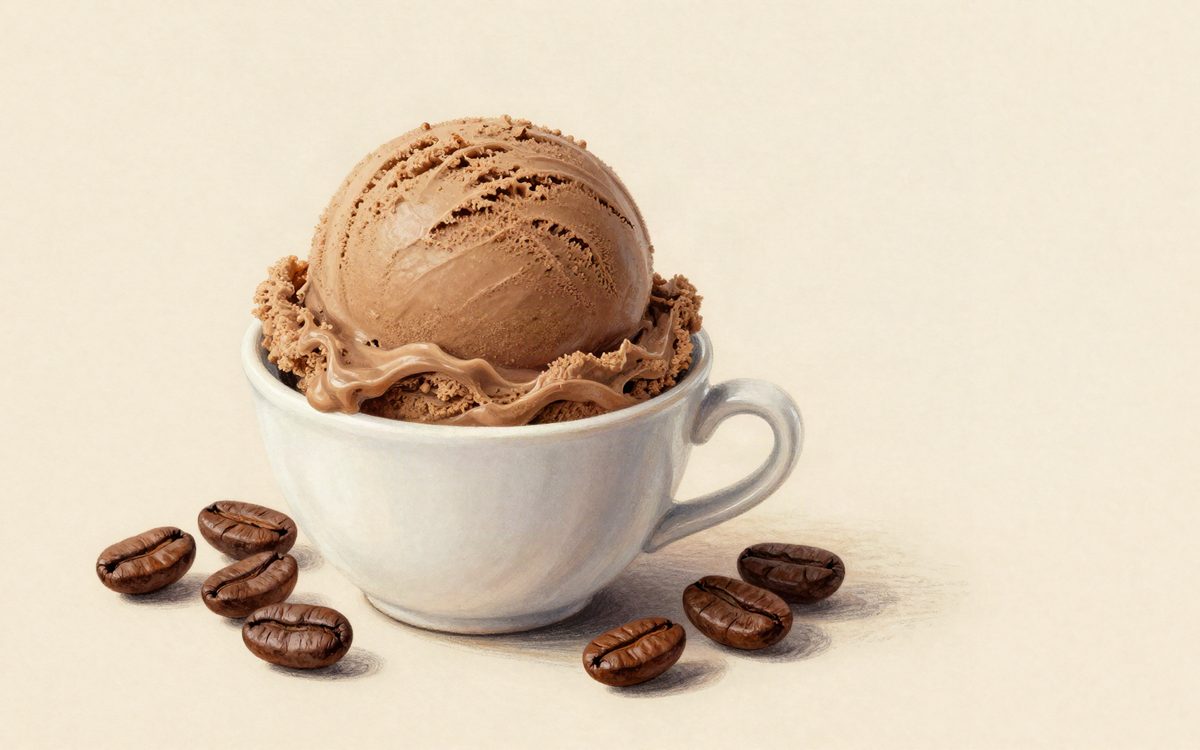
Long before anyone worried about the arithmetic, Italy had already moved its coffee into the gelato case, and the arithmetic is unkind. The flavour arrives dissolved in water, so every gram of brew that goes in is a gram of milk that comes out, and solids, MSNF and protein fall together. Italian professional formulas run between 100 and 250 g of espresso per kilo; this one holds at 120 g and puts 6 g of instant behind it to give back the solids the brew took away. Brewed coffee alone smells right and tastes thin, and the second coffee exists to stop exactly that.
The fix is to use two coffees. The 120 g/kg of espresso brings the volatile aroma, the oils and the perceived acidity. The 6 g/kg of instant coffee brings intensity with no water at all, since instant is about 96.5% solids and carries the roast compounds, pyrazines and furans, that survive freezing. Espresso alone gives an aromatic, weak gelato. Instant alone gives a strong, flat one.
Skim milk powder is pushed to 45 g/kg for one reason: to put back the MSNF the espresso diluted, which lands at 9.39%. Cream runs high at 195 g/kg for the mirror reason. Fat at 8.5% cushions the astringency of chlorogenic acids and tannins, and a lean coffee gelato tastes aggressive on the finish.
POD ends at 180.41, in the upper part of the 140 to 200 band. That is high for a milk base and it is deliberate, because bitterness needs something to sit against. It comes from 155 g/kg of sucrose plus 25 g/kg of dextrose, with PAC settling at 257.56.
Ingredients
Makes 1000 g of finished base.
| Ingredient | Grams | Home measure |
|---|---|---|
| Whole Milk | 449 | 1 3/4 cups |
| Heavy Cream 35% | 195 | 3/4 cup plus 1 tablespoon |
| Sugar (Sucrose) | 155 | 3/4 cup plus 1 tablespoon |
| Espresso (Rich) | 120 | |
| Skim Milk Powder | 45 | 1/3 cup plus 2 tablespoons |
| Dextrose (Glucose) | 25 | 2 tablespoons |
| Instant Coffee | 6 | |
| Carob Seed Flour | 4 | |
| Salt | 1 |
Loads these exact grams into the free balancer, ready to edit.
Method
Loaf pan, stick blender every 45 minutes
- 1Whisk every dry ingredient together first: sugars, milk powder, stabiliser and salt. Dry-blending them stops the stabiliser clumping when it meets liquid.
- 2Warm the liquids to 40 C (104 F), then rain the dry mix in while whisking hard.
- 3Heat to 82 C (180 F) and hold for 2 minutes so the stabiliser hydrates.
- 4Chill in an ice bath to under 5 C (41 F) within 2 hours. Slow cooling is where bacteria and coarse crystals both start.
- 5Age 6 to 12 hours in the fridge under 5 C (41 F). This is when the stabiliser and the milk protein take up water.
- 6Freeze in a shallow metal pan 2 to 3 cm deep, breaking the crystals with a fork every 30 to 40 minutes, 4 to 6 times.
- 7Freeze firm, then temper 10 to 15 minutes in the fridge before scooping.
The balance
All six against the professional range for Milk Gelato.
The two numbers that explain this build are POD 180.41 and water 62.16%. The POD sits high in the 140 to 200 range on purpose: coffee brings bitterness and astringency, and sweetness is what keeps them from reading as harshness. Meanwhile water finishes at 62.16% inside a 58 to 64 band even though 120 g/kg of brewed espresso went in, which is only possible because skim milk powder was raised to 45 g/kg to rebuild MSNF to 9.39% and cream to 195 g/kg to bring fat to 8.5%. Dextrose stays modest at 25 g/kg since PAC only needs to reach 257.56, mid band, and lactose lands at 8.23% of the water phase, safely short of where it would crystallize in storage.
Estimated nutrition: ~194 kcal · Fat 8.5 g · Sugars 17.8 g · Protein 3.6 g (per 100 g of mix, from the balanced composition).
The espresso never sees the pasteurizer. Coffee aroma compounds are volatile, and a few minutes at 85 C evaporate exactly the fraction that makes the gelato smell of coffee while pulling more bitterness into solution. Pasteurize milk, sugars, milk powder, cream and the 6 g/kg of instant coffee, chill the mix below 8 C, then add freshly pulled espresso, already cold, at maturation. Pull the shot short, around 25 to 30 seconds, and cool it fast: standing espresso oxidizes within minutes and picks up a cardboard note. Watch pH as well. Coffee sits between 4.8 and 5.2, and 120 g/kg nudges the mix down enough that combining it with already acid milk can flocculate the casein. If the base turns grainy right after the coffee goes in, the cause is pH, not mixing. The 1 g/kg of salt is not a detail either: sodium suppresses bitterness by antagonism at the receptor and cleans up the astringency.
If it goes wrong
pH shock. Coffee sits at 4.8 to 5.2 and 120 g/kg is enough to flocculate casein if the milk is already acid or the base is warm.
Chill the pasteurized base below 8 C, cool the espresso first, and pour it in slowly at the edge of the container while stirring.
The espresso was pasteurized with the base, so the volatile aroma evaporated and the extraction of bitter compounds increased.
Keep the 6 g/kg of instant coffee in the hot phase and add the 120 g/kg of espresso cold, at maturation.
Not enough fat to cushion the chlorogenic acids and tannins, or the espresso sat and oxidized before going in.
Hold cream at 195 g/kg so fat stays near 8.5%, keep the 1 g/kg of salt, and ice-bath the shot within a minute of pulling it.
Suitable for: Vegetarian, Egg-free
Allergens: milk
- https://www.innovaitalia.com/ricetta-gelato-al-caffe/
- https://www.caffevergnano.com/blog/gelato-artigianale-al-caffe
- https://blog.giallozafferano.it/fablesucre/gelato-al-caffe/
- The science behind it: Gelato Total Solids
- Ingredient sheet: Espresso (Rich)
- The story of this recipe: Caffè Gelato
Want to change an ingredient and watch the numbers move? Open the free balancer