Eggnog Gelato
There is nutmeg on the nose and cold custard underneath, thick with yolk, and the rum only turns up at the end, warm against the chill.
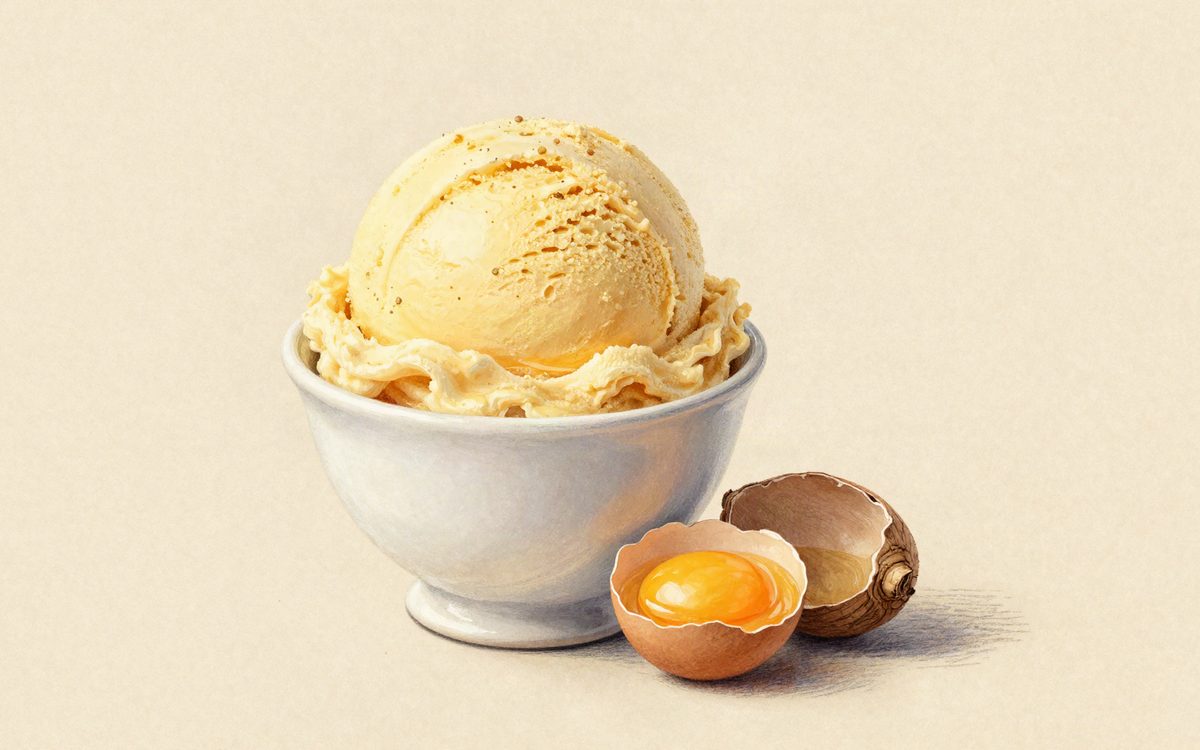
This one belongs to the end of the year, a spiked custard thick with yolk and dusted with nutmeg, and freezing it means handling the two ingredients that define it, both of which fight a clean scoop. Yolk goes in at 70 g per kilo, the five yolks a litre that eggnog bases normally call for, well inside what a custard sheet can carry; its lecithin is what gives the short, dense texture. Rum stays low and fixed at 15 g, because alcohol keeps a mix soft, and the cream line is pulled back so the yolk fat has somewhere to sit. Nutmeg at 2 g and a little vanilla close it.
The rum is the part people get wrong. Rum reads PAC 296 in the catalog, close to three times sucrose, so 15 g/kg on its own spends roughly 44 points of the PAC budget. That is the arithmetic behind the usual warning not to go past two tablespoons per batch. It was never about flavor, it was about the mix never hardening.
Because the rum is already carrying that much freezing point depression, there is no dextrose in this build at all. Sucrose at 160 g/kg does the whole sugar job by itself. Total sugars land at 16.06%, just above the floor of the 16 to 22 band, POD at 169.07, and PAC finishes at 263.28, right in the middle of 220 to 300.
Everything else is small and deliberate: 4 g/kg of vanilla extract, 2 g/kg of nutmeg, 1 g/kg of salt, and only 4 g/kg of carob seed flour. The stabilizer stays low on purpose. Yolk lecithin is already destabilizing the fat globule and giving the short, dense body, and gum piled on top of a yolk-rich base turns the texture elastic.
Ingredients
Makes 1000 g of finished base.
| Ingredient | Grams | Home measure |
|---|---|---|
| Whole Milk | 533 | 2 1/4 cups |
| Heavy Cream 35% | 170 | 2/3 cup plus 1 tablespoon |
| Sugar (Sucrose) | 160 | 3/4 cup plus 1 tablespoon |
| Egg Yolk | 70 | |
| Skim Milk Powder | 41 | 1/3 cup plus 2 tablespoons |
| Rum | 15 | |
| Vanilla Extract | 4 | |
| Carob Seed Flour | 4 | |
| Nutmeg Powder | 2 | |
| Salt | 1 |
Loads these exact grams into the free balancer, ready to edit.
Method
Cold metal tray, three whisk breaks
- 1Whisk every dry ingredient together first: sugars, milk powder, stabiliser and salt. Dry-blending them stops the stabiliser clumping when it meets liquid.
- 2Warm the liquids to 40 C (104 F), then rain the dry mix in while whisking hard.
- 3Beat the yolks with part of the sugar, then temper: pour the warm base over the yolks in a thin stream, never the other way round.
- 4Bring to 82 to 85 C (180 to 185 F) and stop. Past 87 C the yolk coagulates and no amount of blending brings the flavour back.
- 5Chill in an ice bath to under 5 C (41 F) within 2 hours. Slow cooling is where bacteria and coarse crystals both start.
- 6Age 6 to 12 hours in the fridge under 5 C (41 F). This is when the stabiliser and the milk protein take up water.
- 7Freeze in a shallow metal pan 2 to 3 cm deep, breaking the crystals with a fork every 30 to 40 minutes, 4 to 6 times.
- 8Freeze firm, then temper 10 to 15 minutes in the fridge before scooping.
The balance
All six against the professional range for Milk Gelato.
Two numbers set this formula. Fat lands at 10.17%, high in the 6 to 12 band, because 70 g/kg of yolk brings 22.4 g of fat per kilo before a drop of cream is counted, which is why cream stops at 170 g/kg instead of climbing. Protein at 4.71% against a 5.00 ceiling is the tighter constraint: the same yolk carries 11.2 g of protein per kilo, so skim milk powder had to stop at 41 g/kg and MSNF settles at 9.63%. With rum already spending about 44 PAC points, sucrose alone brings the mix to PAC 263.28 while keeping POD at 169.07, so it reads as a custard rather than as candy, and lactose stays at 8.5% of the water phase.
Estimated nutrition: ~202 kcal · Fat 10.2 g · Sugars 16.1 g · Protein 4.7 g (per 100 g of mix, from the balanced composition).
Two hazards here, both on a clock. Yolk livetins and albumin start to coagulate around 85 C, so pasteurize at 82 to 85 C with continuous stirring and shock chill straight after. Past that point the mix is scrambled egg and no blender recovers it. The rum goes in last, with the base already below 25 C, because ethanol is volatile and heat drives off exactly what you paid for while precipitating protein locally. Grate the 2 g/kg of nutmeg fresh and add it during the chill, not in the pot. With PAC at 263.28 against a 300 ceiling and no dextrose in the formula to trade away, there is no cheap room to add more rum. If you are serving people at risk, use pasteurized yolk.
If it goes wrong
The custard passed roughly 85 C, where yolk albumin and livetins coagulate.
Hold 82 to 85 C with continuous stirring, then chill in an ice bath immediately. Once it has scrambled, strain and start over rather than blending.
Extra rum, or rum added while the base was still warm so the alcohol stayed and the aroma left. At PAC 296, rum moves the freezing point fast.
Keep rum at the 15 g/kg in the formula and stir it in below 25 C. PAC is already 263.28 against a 300 ceiling, so there is little headroom.
Too much carob seed flour on a base that already has 70 g/kg of yolk providing body.
Stay at 4 g/kg of carob seed flour. The lecithin from the yolk is doing most of the structural work here.
Suitable for: Vegetarian
Contains alcohol.
Allergens: egg, milk
No ingredient in this recipe contains gluten.
- https://www.proportionalplate.com/eggnog-gelato/
- https://andreasrecipes.com/eggnog-gelato/
- https://thewanderlustkitchen.com/eggnog-ice-cream/
- https://www.thepetitecook.com/zabaglione/
- The science behind it: Alcohol in Gelato
- Ingredient sheet: Egg Yolk
Want to change an ingredient and watch the numbers move? Open the free balancer