Earl Grey Gelato
The perfume lands before the taste does: bergamot over cold cream first, then tea tannin closing in behind it and leaving the finish dry rather than sweet.
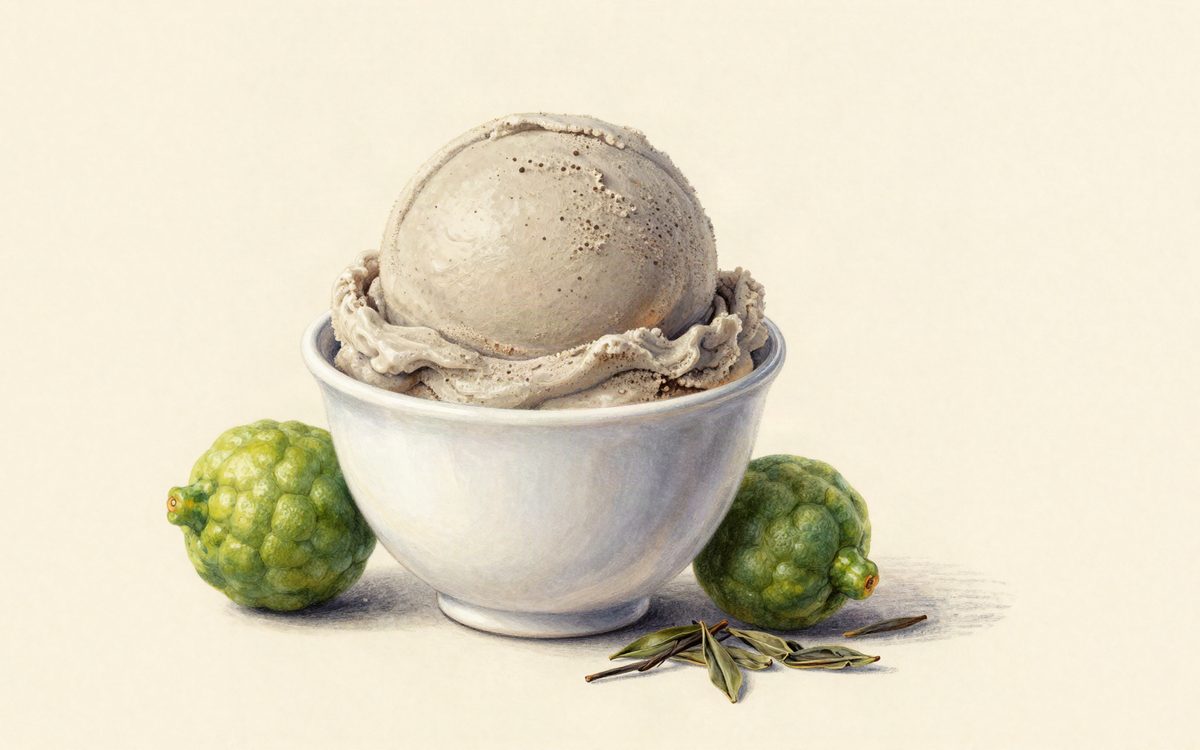
Because the leaf is strained out again after infusing, half of this flavour never reaches the balance sheet at all: 8 to 12 g of tea per kilo does its work and leaves. Bergamot is the half that stays, and 12 g per kilo is as far as it can go, since its juice is sharper than lemon and any more would walk the mix towards the point where casein curdles. Fat aims at 8% instead of the 10% a cream-led base would happily take, because fat holds citrus terpenes down. What all of that buys is the smell of the cup: perfume first, tannin second, and a finish that dries out rather than turning into sweetened cream.
Twelve grams is a small dose on purpose. Bergamot juice is more acidic than lemon, around pH 2.4, and at 12 g in a kilo the mix stays clear of the isoelectric point of casein. Double it and you are in curdling territory in a base made of 573 g whole milk and 170 g cream.
Fat is aimed at 8.01 percent rather than the 10 you might reach for in a cream forward gelato, because fat sequesters citrus terpenes and this recipe is spending its 12 g of bergamot precisely to get them. The counterweight is 45 g of skim milk powder, which takes MSNF to 10.37 percent, the top third of the 8 to 11.5 window. That also makes lactose the tightest reading on the sheet at 5.65 percent of the mix, still under the 7 percent line but with less margin than a plain white base.
Ingredients
Makes 1000 g of finished base.
| Ingredient | Grams | Home measure |
|---|---|---|
| Whole Milk | 573 | 2 1/3 cups |
| Heavy Cream 35% | 170 | 2/3 cup plus 1 tablespoon |
| Sugar (Sucrose) | 120 | 1/2 cup plus 2 tablespoons |
| Glucose Powder | 50 | 1/4 cup |
| Skim Milk Powder | 45 | 1/3 cup plus 2 tablespoons |
| Dextrose (Glucose) | 25 | 2 tablespoons |
| Bergamot | 12 | |
| Carob Seed Flour | 4 | |
| Salt | 1 |
Loads these exact grams into the free balancer, ready to edit.
Method
Cold overnight leaf infusion, then tray freeze
- 1Whisk every dry ingredient together first: sugars, milk powder, stabiliser and salt. Dry-blending them stops the stabiliser clumping when it meets liquid.
- 2Warm the liquids to 40 C (104 F), then rain the dry mix in while whisking hard.
- 3Heat to 82 C (180 F) and hold for 2 minutes so the stabiliser hydrates.
- 4Chill in an ice bath to under 5 C (41 F) within 2 hours. Slow cooling is where bacteria and coarse crystals both start.
- 5Age 6 to 12 hours in the fridge under 5 C (41 F). This is when the stabiliser and the milk protein take up water.
- 6Freeze in a shallow metal pan 2 to 3 cm deep, breaking the crystals with a fork every 30 to 40 minutes, 4 to 6 times.
- 7Freeze firm, then temper 10 to 15 minutes in the fridge before scooping.
The balance
All six against the professional range for Milk Gelato.
MSNF at 10.37 percent is the number that defines this base. It comes from 45 g of skim milk powder and sits in the top third of the 8 to 11.5 range, giving the tea and bergamot a dense milky body to sit in rather than a thin one. The cost is lactose, 5.65 percent of the mix, under the 7 percent line but without much slack, so this is not a sheet to push the milk powder any further on. Fat at 8.01 percent in a 6 to 12 range is the deliberate restraint, since citrus terpenes bind into fat and go quiet there. Around those two the rest is unremarkable, which is the point: solids 37.95 in 36 to 42, sugars 19.06 in 16 to 22, POD 167.38 in 140 to 200, PAC 261.9 in 220 to 300, water 62.05 in 58 to 64, protein 3.85 in 3 to 5.
Estimated nutrition: ~192 kcal · Fat 8 g · Sugars 19.1 g · Protein 3.9 g (per 100 g of mix, from the balanced composition).
There are two routes for the tea and they do not give the same gelato. Hot: steep the leaf in milk at 80 to 85 C for four to six minutes and strain. It is fast, but tannins bind to casein, the gelato turns astringent and the colour drops to a greyish beige. Cold: pasteurise first, drop the leaf into the mix already at 4 C and age it overnight. That pulls the aromatics without dragging as much tannin, and it is the route the ice cream literature specifically recommends for Earl Grey. Either way, strain through fine cloth as soon as the time is up, because leaf left in during ageing keeps extracting and turns the batch bitter. The bergamot always goes in last, into a mix at 4 C, poured thin and stirred fast. Citric acid plus warmth coagulates casein on contact, and there is no rescuing a base once that happens.
If it goes wrong
Hot infusion pulled tannin out of the leaf, and tannin binds to casein.
Switch to the cold route: pasteurise, chill to 4 C, add the leaf, age overnight, then strain through fine cloth.
The mix was still warm, or the bergamot was added in one pour. Bergamot juice sits around pH 2.4.
Bring the mix to 4 C, keep it stirring fast, and add the 12 g of bergamot in a thin stream at the very end.
The milk powder was cut back, so MSNF fell below the 10.37 percent this sheet relies on to bind free water.
Keep the full 45 g of skim milk powder. Do not go above it either, lactose is already at 5.65 percent of the mix.
Suitable for: Vegetarian, Egg-free
Allergens: milk
No ingredient in this recipe contains gluten.
- https://www.icecreamscience.com/blog/homemade-earl-grey-tea-ice-cream-recipe
- https://tching.com/2021/07/tea-gelato/
- https://www.icecreamnation.org/2013/05/tea-ice-cream-earl-grey/
- The science behind it: Spice Infusion in Gelato
- Ingredient sheet: Bergamot
Want to change an ingredient and watch the numbers move? Open the free balancer