Dragon Fruit Sorbet
Magenta in the tub and gentle on the tongue: lime lands first, the fruit follows soft and faintly earthy, and a pinch of salt keeps the finish from disappearing.
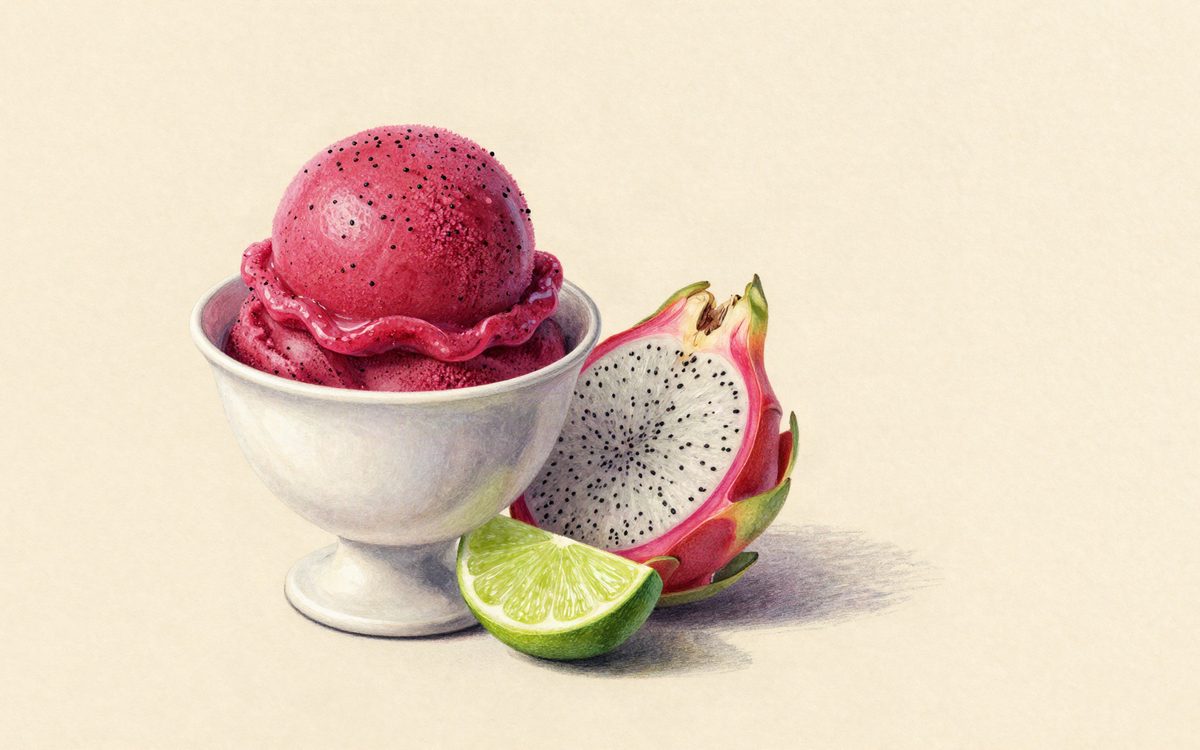
Almost every disappointing pitaya sorbet fails the same way, looking spectacular and tasting of almost nothing. The reflex is to pile in more fruit, which buys more colour and no more flavour, because the fruit is mild and barely acidic to start with. This sheet goes the other way. Fruit stops at 450 g per kilo, and the rest is built by contrast: 30 g of Tahitian lime for the acidity the fruit does not own, plus 1 g of salt, which at that dose salts nothing but pushes the background bitterness down and lets sweetness and aroma read louder.
The two correctives are 30 g of Tahitian lime and 1 g of salt. The lime installs the acidity the fruit does not have on its own. The salt at 0.1 percent does not make the sorbet salty: it suppresses background bitterness and lifts perceived sweetness and aroma, which is exactly the crutch a quiet fruit needs. Salt carries a PAC of 585 in the catalogue, but at 1 g it contributes around 6 points, which is noise inside a total of 327.49.
On the sugar side, 75 g of glucose powder alongside 135 g of sucrose and 20 g of dextrose is what lets solids reach 31.08 percent inside a 28 to 34 range. A dairy free mix has no fat and no MSNF to soften it, so softness has to come from sugars and their PAC. PAC lands at 327.49 in the upper part of a 280 to 340 window, and POD at 237.62 sits mid band in 200 to 270.
Ingredients
Makes 1000 g of finished base.
| Ingredient | Grams | Home measure |
|---|---|---|
| Dragon Fruit | 450 | |
| Water | 285 | 1 1/4 cups |
| Sugar (Sucrose) | 135 | 2/3 cup |
| Glucose Powder | 75 | 1/3 cup plus 1 tablespoon |
| Tahitian Lime | 30 | |
| Dextrose (Glucose) | 20 | 1 1/2 tablespoons |
| Stabilizer (Neutral) | 4 | |
| Salt | 1 |
Loads these exact grams into the free balancer, ready to edit.
Method
Tray freeze, whisk every 20 minutes
- 1Whisk every dry ingredient together first: sugars, milk powder, stabiliser and salt. Dry-blending them stops the stabiliser clumping when it meets liquid.
- 2Warm the liquids to 40 C (104 F), then rain the dry mix in while whisking hard.
- 3Heat to 82 C (180 F) and hold for 2 minutes so the stabiliser hydrates.
- 4Chill in an ice bath to under 5 C (41 F) within 2 hours. Slow cooling is where bacteria and coarse crystals both start.
- 5Age 6 to 12 hours in the fridge under 5 C (41 F). This is when the stabiliser and the milk protein take up water.
- 6Fold the fruit in cold, after ageing. Heating it costs you the fresh aroma and nothing is gained.
- 7Freeze in a shallow metal pan 2 to 3 cm deep, breaking the crystals with a fork every 30 to 40 minutes, 4 to 6 times.
- 8Freeze firm, then temper 10 to 15 minutes in the fridge before scooping.
The balance
All six against the professional range for Sorbetto.
PAC at 327.49 sits in the upper part of a 280 to 340 range: with fat at 0.18 percent and MSNF at zero, sugars are the only thing keeping this scoopable, and the 75 g of glucose powder is how solids reach 31.08 percent inside 28 to 34 without sugars passing their 31 percent ceiling, they read 27.67. Sweetness reads POD 237.62, mid band in 200 to 270. Water at 68.92 percent sits mid range in 66 to 72.
Estimated nutrition: ~125 kcal · Fat 0.2 g · Sugars 27.7 g · Protein 0.4 g (per 100 g of mix, from the balanced composition).
Use red fleshed pitaya, Hylocereus polyrhizus or costaricensis. The white fleshed kind gives a pale grey sorbet with neither colour nor flavour to defend it. The pigment is betacyanin and its thermal degradation in purple pitaya juice is documented, so the puree is never pasteurised: heat the syrup alone to 85 C, chill to 4 C, and fold in fruit, lime and salt cold. The black seeds are edible and give a faint nutty note, but high speed blending shatters them and clouds the magenta with dark specks, so pulse in short bursts and do not sieve. Sieving takes body out of a fruit that is already low in solids, and this sheet only reaches 31.08 percent total with help from the glucose powder. Add the lime last and cold. Besides protecting the betalain, that keeps the citrus volatiles that are carrying most of the aroma. Store away from light, betalain photodegrades.
If it goes wrong
The puree was heated, or the finished sorbet sat under light. Betacyanin degrades with both.
Pasteurise only the syrup at 85 C, add the fruit cold, and keep the tub covered and away from light.
Almost certainly white fleshed pitaya, or the 30 g of lime was cut back.
Use red fleshed fruit and keep the full 30 g of lime, added cold at the end. The lime is the acidity of this recipe, not a garnish.
The seeds were shattered by long high speed blending.
Pulse the fruit in short bursts. Do not sieve to fix it afterwards, that costs body the sorbet cannot spare at 31.08 percent solids.
Suitable for: Vegan, Vegetarian, Lactose-free, Egg-free
- https://specialtyproduce.com/produce/Red_Pitaya_Dragon_Fruit_15055.php
- https://tasterium.com/fruitsandberries/118-pitaya-dragon-fruit.html
- https://www.researchgate.net/publication/226418364_Thermal_degradation_of_betacyanins_in_juices_from_purple_pitaya_Hylocereus_polyrhizus_Weber_Britton_Rose_monitored_by_high-performance_liquid_chromatography-tandem_mass_spectometric_analyses
- https://www.sosa.cat/en/stabilize-ice-creams-sorbets/
- The science behind it: Betalain Color Stability in Gelato and Sorbetto Bases
- Ingredient sheet: Dragon Fruit
Want to change an ingredient and watch the numbers move? Open the free balancer