Dark Chocolate Gelato (70%)
Every spoon lands thick without being greasy, bitter at the edges, and slow to fade, with cocoa still sitting in the mouth well after the chill.
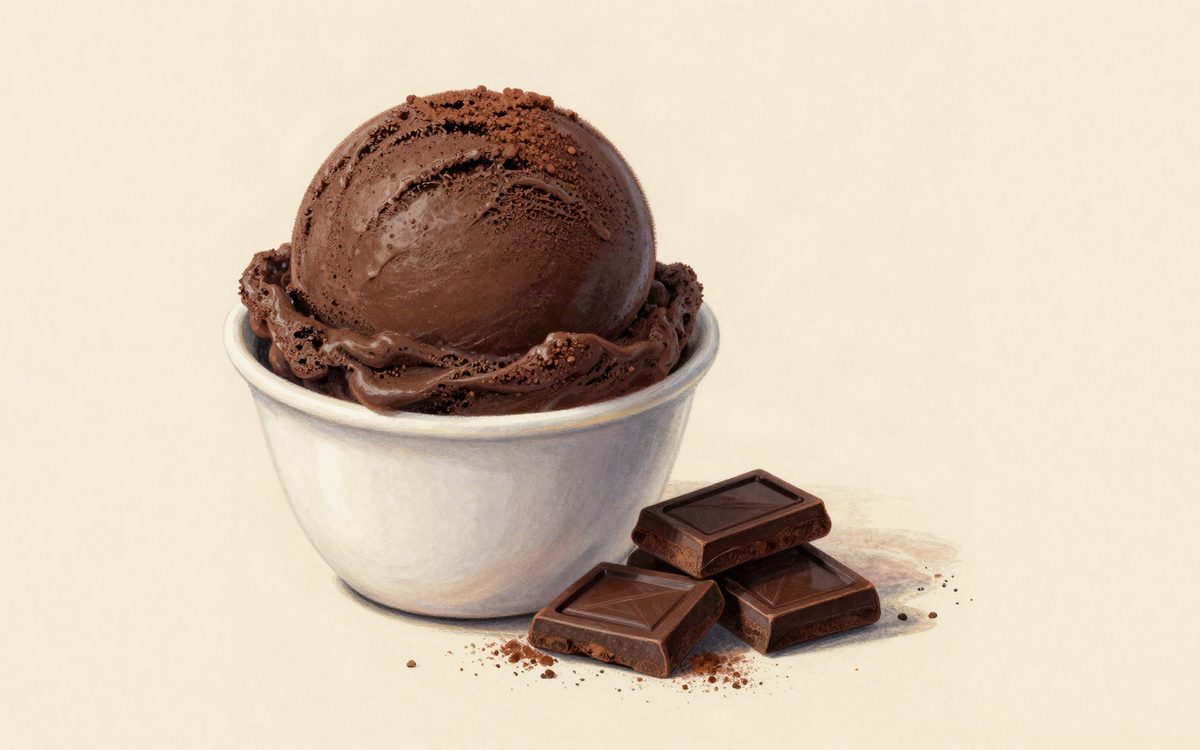
Price per kilo is the wrong comparison on the chocolate shelf. Two bags can both print 70 percent on the front while only one names cocoa butter as its fat, and that single line separates an aroma that opens and lengthens from one that coats the tongue and stops dead. Buttons or callets are worth the small premium too, since they melt evenly into a hot base instead of leaving grain behind. What the purchase buys you then shows up as a ratio: 130 g per kilo of couverture leads here and 30 g of cocoa powder sits behind it, present for bitterness and colour rather than for body, which is the flavour decision the whole sheet is built around.
What follows is arithmetic about fat. Those 130 g of couverture at 38 percent fat put around 4.9 points of fat into the kilo before any dairy is weighed, against a 12 percent ceiling. That is why 154 g of skim milk sits next to 514 g of whole milk: the recipe needs a way to add water and milk solids without dragging fat along. The finished sheet reads 7.47 percent fat, which leaves the cocoa audible rather than greasy.
This is a dry sheet by design. Solids close at 40.32 percent against a 36 to 42 range and water at 59.68 against a 58 floor, because cocoa solids are simply bulky. It also means there is little room left to add anything: another 20 g of chocolate runs solids against the 42 ceiling long before fat becomes the problem.
Ingredients
Makes 1000 g of finished base.
| Ingredient | Grams | Home measure |
|---|---|---|
| Whole Milk | 514 | 2 1/4 cups |
| Skim Milk | 154 | 1/2 cup plus 2 tablespoons |
| Dark Chocolate 70% | 130 | |
| Sugar (Sucrose) | 95 | 1/3 cup plus 2 tablespoons |
| Dextrose (Glucose) | 45 | 1/4 cup |
| Cocoa Powder 22-24% | 30 | |
| Non-Fat Dry Milk | 27 | 1/4 cup plus 1 tablespoon |
| Stabilizer (Neutral) | 4 | |
| Salt | 1 |
Loads these exact grams into the free balancer, ready to edit.
Method
Hot emulsion, then tray freeze with a blender pass
- 1Whisk every dry ingredient together first: sugars, milk powder, stabiliser and salt. Dry-blending them stops the stabiliser clumping when it meets liquid.
- 2Warm the liquids to 40 C (104 F), then rain the dry mix in while whisking hard.
- 3Heat to 82 C (180 F) and hold for 2 minutes so the stabiliser hydrates.
- 4Melt the chocolate to 45 C (113 F) and stir it into the hot base off the heat, then blend 60 seconds until glossy.
- 5Chill in an ice bath to under 5 C (41 F) within 2 hours. Slow cooling is where bacteria and coarse crystals both start.
- 6Age 6 to 12 hours in the fridge under 5 C (41 F). This is when the stabiliser and the milk protein take up water.
- 7Freeze in a shallow metal pan 2 to 3 cm deep, breaking the crystals with a fork every 30 to 40 minutes, 4 to 6 times.
- 8Freeze firm, then temper 10 to 15 minutes in the fridge before scooping.
The balance
All six against the professional range for Milk Gelato.
Solids at 40.32 percent and water at 59.68 are the pair to watch, because both sit towards the tight end of their ranges, 36 to 42 and 58 to 64. Once the couverture and cocoa powder are set at 130 and 30 g, the sheet has almost nowhere left to move. Fat is the second constraint, and it resolves lower than you might expect at 7.47 percent in a 6 to 12 window, precisely because 154 g of skim milk lets the recipe carry water and milk solids without carrying fat with them. MSNF at 8.6 percent sits just above its 8 floor on only 27 g of milk powder, since protein is already at 4.7 against a 5 ceiling and cocoa solids contribute their own. Sugars at 17.54 in 16 to 22 and PAC at 264.92 in 220 to 300 are the relaxed numbers here.
Estimated nutrition: ~199 kcal · Fat 7.5 g · Sugars 17.5 g · Protein 4.7 g (per 100 g of mix, from the balanced composition).
Seventy percent cacao means tannin, and tannin in a dairy mix binds to casein. That lowers perceived bitterness, which is welcome, but it also thickens the mix during ageing. Expect the base to firm up visibly over 12 hours at 4 C and do not thin it with water afterwards, because at 59.68 percent water this sheet has no spare room and thinning costs you the solids the flavour depends on. Order matters: cocoa powder goes in with the dry sugars into warm milk, pasteurise at 82 to 85 C, take the pot off the heat and melt the chopped couverture into the base while it is still at 70 to 75 C, then blend for one to two minutes. Emulsifying hot is what stops the cocoa butter setting into grains. Chill fast to 4 C after that. Cocoa butter stays liquid above 34 C, and a quick drop past that avoids the unstable crystal forms that later show up as a chalky grey surface.
If it goes wrong
The couverture was melted into a base that had already cooled, so the cocoa butter set before it could emulsify.
Add the chopped chocolate off the heat while the base is at 70 to 75 C and blend one to two minutes before chilling.
Tannin binding to casein. Normal for a 70 percent sheet and part of why solids sit at 40.32 percent, near the 42 ceiling.
Blend it briefly to loosen before churning. Do not add water, that costs solids this recipe is already spending carefully.
Whole milk was used in place of the 154 g of skim, so fat climbed past the 7.47 percent this sheet balances at.
Keep the split at 514 g whole milk and 154 g skim. The skim is a fat lever, not a way to save money.
Suitable for: Vegetarian, Egg-free
Allergens: milk
- https://icecreamcalc.com/2021/03/12/chocolate-gelato/
- https://foodnouveau.com/dark-chocolate-gelato/
- https://italianchef.com/chocolate-gelato/
- The science behind it: Couverture Chocolate for Gelato
- Ingredient sheet: Dark Chocolate 70%
- The story of this recipe: Cioccolato Fondente Gelato
Want to change an ingredient and watch the numbers move? Open the free balancer