Cupuacu Gelato
Sharp and tropical up front, then milk closes over it: a fruit gelato that stays bright and faintly sour under the cream, cold and long on the palate.
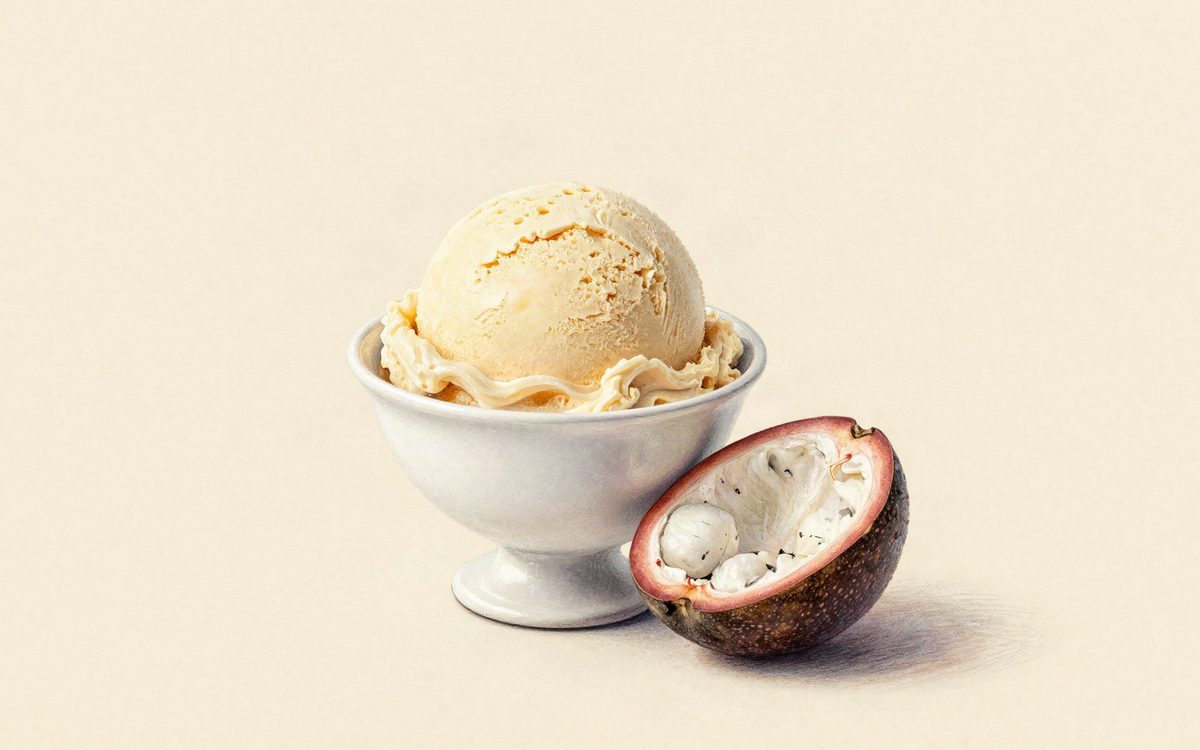
The same forests that give us cacao, the Amazon and the Atlantic forest, also grow its close relative, Theobroma grandiflorum, and that is the whole provenance of this flavour. The pulp is sharp: pH between 3.3 and 3.6, with titratable acidity in passion fruit territory. That sharpness is what holds the pulp at 230 g per kilo, because a milk base drifting towards the isoelectric point of casein is a base at risk of splitting, and it is also why no lemon juice appears anywhere on the sheet. Lean as well as sour, the pulp needs dry milk and glucose powder to rebuild the solids, while the cream stays moderate so the fruit keeps its edge.
The pulp is thin on paper: around 13 percent solids and 7 percent sugar. Left to itself it would drag the sheet under the 32 percent solids floor and under the 5 percent MSNF floor. The rebuild is done with 48 g of non fat dry milk and 60 g of glucose powder, which is how solids close at 36.51, comfortably inside range, and MSNF at 8.93, near the top of its range, while sugars stay at 19.63 percent against a 25 percent ceiling.
Fat is held at 6.3 percent in a 3.5 to 8 window, mid range for a fruit and milk gelato. The aroma of cupuacu has a strong lipophilic fraction that milk fat captures and releases well, so the 135 g of cream is doing real work. Push it higher and the fat starts flattening the acidity that is the entire signature of the fruit.
Ingredients
Makes 1000 g of finished base.
| Ingredient | Grams | Home measure |
|---|---|---|
| Whole Milk | 398 | 1 2/3 cups |
| Cupuacu Pulp | 230 | |
| Heavy Cream 35% | 135 | 1/2 cup plus 1 tablespoon |
| Sugar (Sucrose) | 105 | 1/2 cup plus 1 tablespoon |
| Glucose Powder | 60 | 1/4 cup plus 1 tablespoon |
| Non-Fat Dry Milk | 48 | 1/2 cup |
| Dextrose (Glucose) | 20 | 1 1/2 tablespoons |
| Stabilizer (Neutral) | 3 | |
| Salt | 1 |
Loads these exact grams into the free balancer, ready to edit.
Method
Tray freeze the white base, cold pulp folded in
- 1Whisk every dry ingredient together first: sugars, milk powder, stabiliser and salt. Dry-blending them stops the stabiliser clumping when it meets liquid.
- 2Warm the liquids to 40 C (104 F), then rain the dry mix in while whisking hard.
- 3Heat to 82 C (180 F) and hold for 2 minutes so the stabiliser hydrates.
- 4Chill in an ice bath to under 5 C (41 F) within 2 hours. Slow cooling is where bacteria and coarse crystals both start.
- 5Age 6 to 12 hours in the fridge under 5 C (41 F). This is when the stabiliser and the milk protein take up water.
- 6Freeze in a shallow metal pan 2 to 3 cm deep, breaking the crystals with a fork every 30 to 40 minutes, 4 to 6 times.
- 7Freeze firm, then temper 10 to 15 minutes in the fridge before scooping.
The balance
All six against the professional range for Milk Gelato with Fruit.
Two indicators carry this sheet. MSNF at 8.93 percent, in a 5 to 9.5 range for a fruit and milk gelato, is high on purpose: the pulp contributes none of it, and 230 g of watery fruit needs milk solids to bind the free water it brings in. Fat at 6.3 percent in the 3.5 to 8 range is the second decision, mid window rather than at the top, because this aroma needs fat to carry it but the acidity is muffled by too much of it. The rest is comfortable: solids 36.51 against 32 to 40, sugars 19.63 against 17 to 25, POD 169.53 against 150 to 230, PAC 260.49 against 240 to 310, water 63.49 against 60 to 68, protein 3.51 against 2 to 4.5. Lactose at 4.87 percent of the mix stays under the 7 percent line.
Estimated nutrition: ~178 kcal · Fat 6.3 g · Sugars 19.6 g · Protein 3.5 g (per 100 g of mix, from the balanced composition).
Check the pulp with a refractometer before weighing anything. Commercial frozen cupuacu runs anywhere from 9 to 13 Brix depending on brand and dilution, and this sheet was calculated on whole pulp at the top of that spread. Below 11 Brix, take milk out and lift the milk powder slightly. The pulp never goes near heat: pasteurise the white base alone at 85 C, chill to 4 C, age, then pour the cold pulp into the base while it is stirring, never the base into the pulp. Cupuacu is naturally thick from its own pectin, so the mix will already feel heavier than other fruit bases. Do not read that as licence to drop the stabiliser below 3 g per kilo, because that viscosity lives in the water phase and does nothing against recrystallisation in the freezer. Serve between -12 and -11 C. Colder than that and the acidity goes numb, which is most of what you paid 230 g of pulp for.
If it goes wrong
The pulp met the base while it was still warm, or it was poured the wrong way round so a small volume of base hit full pulp acidity.
Chill the base to 4 C first, keep it moving, and add the cold pulp into the base in a steady stream.
The pulp was more dilute than the 13 percent solids this sheet assumes. Below 11 Brix the solids no longer close at 36.51 percent.
Measure the Brix, then take milk out and add a few grams of non fat dry milk to bring solids back up. Do not fix it with sugar.
Serving too cold, or cream pushed above the 135 g this sheet balances at, which takes fat past 6.3 percent.
Temper to between -12 and -11 C before serving and leave the cream at 135 g per kilo.
Suitable for: Vegetarian, Egg-free
Allergens: milk
- Embrapa Amazonia Oriental - caracterizacao fisico-quimica da polpa de cupuacu (Theobroma grandiflorum): solidos soluveis, pH e acidez titulavel
- Goff, H.D.; Hartel, R.W. - Ice Cream, 7a ed., Springer, 2013 (estabilidade da caseina em mixes acidos e reconstrucao de solidos)
- Corvitto, A. - Los secretos del helado: el helado sin secretos, Vilbo, 2004 (limites de dose para frutas acidas em base leite)
- FAO - composicao e processamento de frutas tropicais amazonicas
- The science behind it: Fruit Purée Selection for Sorbetto
- Ingredient sheet: Cupuacu Pulp
Want to change an ingredient and watch the numbers move? Open the free balancer