Cookies and Cream Gelato
The crumb is the point here: dark, faintly bitter, softening on the tongue against a vanilla base that stays smooth from the first spoonful to the last.
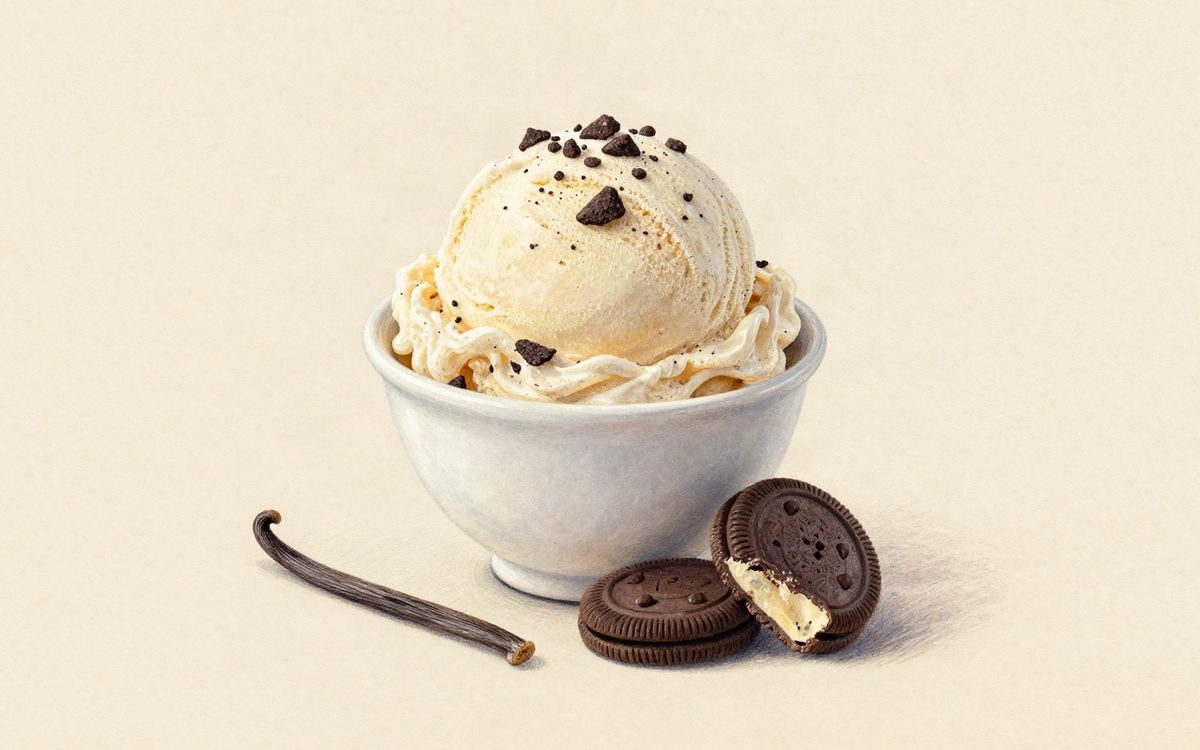
Price is the wrong first question in the biscuit aisle, and texture is the right one. What this needs is a dry, snapping, unfilled chocolate biscuit; a filled one drags its own palm fat and icing sugar into a mix whose sugar and fat are already spoken for, and a soft one turns to paste in the churn and takes the crunch with it. Check the list for cocoa rather than a cocoa-flavoured coating, then buy the plainest thing on the shelf. At 110 g per kilo the biscuit brings roughly 40 g of sugar and 25 g of fat of its own, so free sucrose lands at 95 g, cream at 60 g, and 4 g of pure vanilla extract carry the cream half of the name.
The finished sheet reads 6.95 percent fat against a 6 to 12 window, deliberately in the lower half. A cookies and cream base that runs fat rich coats the tongue and mutes the cocoa in the biscuit, and it softens the biscuit faster in storage as well. Sugars land at 17.15 percent inside 16 to 22, and PAC at 260.21 inside 220 to 300, so the base scoops cleanly after its 10 to 15 minutes in the fridge without needing extra sugar to stay soft.
MSNF at 9.2 percent, from 31 g of non fat dry milk plus the milk itself, is doing a job specific to this flavour. Biscuit starch pulls free water out of the mix and holds it badly. The milk solids bind that water first, which is what keeps the crystals fine while the biscuit sits in the base. Lactose comes to 5.01 percent of the mix, under the 7 percent line, so the milk powder can do that work without risking sandiness.
Ingredients
Makes 1000 g of finished base.
| Ingredient | Grams | Home measure |
|---|---|---|
| Whole Milk | 655 | 2 3/4 cups |
| Chocolate Biscuit | 110 | |
| Sugar (Sucrose) | 95 | 1/3 cup plus 2 tablespoons |
| Heavy Cream 35% | 60 | 1/4 cup |
| Dextrose (Glucose) | 40 | 3 1/2 tablespoons |
| Non-Fat Dry Milk | 31 | 1/3 cup |
| Vanilla Extract (Pure) | 4 | |
| Stabilizer (Neutral) | 4 | |
| Salt | 1 |
Loads these exact grams into the free balancer, ready to edit.
Method
Tray freeze the white base, biscuit folded in last
- 1Whisk every dry ingredient together first: sugars, milk powder, stabiliser and salt. Dry-blending them stops the stabiliser clumping when it meets liquid.
- 2Warm the liquids to 40 C (104 F), then rain the dry mix in while whisking hard.
- 3Heat to 82 C (180 F) and hold for 2 minutes so the stabiliser hydrates.
- 4Melt the chocolate to 45 C (113 F) and stir it into the hot base off the heat, then blend 60 seconds until glossy.
- 5Chill in an ice bath to under 5 C (41 F) within 2 hours. Slow cooling is where bacteria and coarse crystals both start.
- 6Age 6 to 12 hours in the fridge under 5 C (41 F). This is when the stabiliser and the milk protein take up water.
- 7Freeze in a shallow metal pan 2 to 3 cm deep, breaking the crystals with a fork every 30 to 40 minutes, 4 to 6 times.
- 8Freeze firm, then temper 10 to 15 minutes in the fridge before scooping.
The balance
All six against the professional range for Milk Gelato.
Two numbers explain the shape of this sheet. Fat at 6.95 percent sits in the lower half of the 6 to 12 range even though there is only 60 g of cream in the kilo, because the biscuit itself supplies around 2.5 points of fat. Take the cream to a conventional 120 g and you are near 9 percent with nothing gained in flavour. MSNF at 9.2 percent, in the lower half of 8 to 11.5, is the counterweight: the biscuit brings no milk solids at all, so the 31 g of non fat dry milk is what covers the floor and binds the water the starch will not hold. Everything else has slack: solids 38.12 against 36 to 42, sugars 17.15 against 16 to 22, POD 168.81 against 140 to 200, protein 4.01 against 3 to 5, water 61.88 against 58 to 64.
Estimated nutrition: ~187 kcal · Fat 7 g · Sugars 17.2 g · Protein 4 g (per 100 g of mix, from the balanced composition).
The biscuit never sees the pasteuriser. Heated in the mix, its starch gelatinises, the biscuit dissolves and you get a uniform brown base with no crunch anywhere. Pasteurise the white base at 82 C, age it 6 to 8 hours at 4 C, then fold in the biscuit broken coarsely, pieces of 5 to 8 mm, in the last 15 seconds of churning or at extraction. From there the crunch is on a clock: the biscuit keeps drawing moisture out of a base that is 61.88 percent water, and it stays properly crisp for 48 to 72 hours. One honest caveat about the balance, the ingredient used is a plain chocolate biscuit, without the vegetable fat and sugar filling of the classic sandwich cookie, so the free sugar and fat in this sheet approximate that filling rather than reproduce it.
If it goes wrong
The biscuit went in before or during pasteurisation. The starch gelatinised and the biscuit dissolved into the base.
Pasteurise only the white base at 82 C. Break the biscuit to 5 to 8 mm and fold it in at extraction, not before.
Expected behaviour, not a balancing error. The base is 61.88 percent water and the biscuit keeps absorbing it in storage.
Treat 48 to 72 hours as the useful window, or hold the biscuit separately and fold it in per service.
The vanilla was cut or skipped. At 4 g per kilo it is what makes the base read as vanilla cream instead of a neutral white base.
Keep the full 4 g of pure vanilla extract and add it after pasteurisation, off the heat, so it does not evaporate.
Suitable for: Vegetarian, Egg-free
Allergens: gluten, milk
- https://icecreamcalc.com/2021/03/12/chocolate-gelato/
- https://www.gavinpublishers.com/article/view/functional-gelato-how-to-reduce-the-excessive-amount-of-added-sugars-while-still-maintaining--the-perfect-taste
- https://www.recipesfromitaly.com/stracciatella-gelato/
- The science behind it: How to Balance a Gelato Recipe
- Ingredient sheet: Chocolate Biscuit
Want to change an ingredient and watch the numbers move? Open the free balancer