Coffee Sorbet
Bitter before it is sweet, with a soft melting body and a roasted, faintly salted finish that lasts longer on the palate than the chill does.
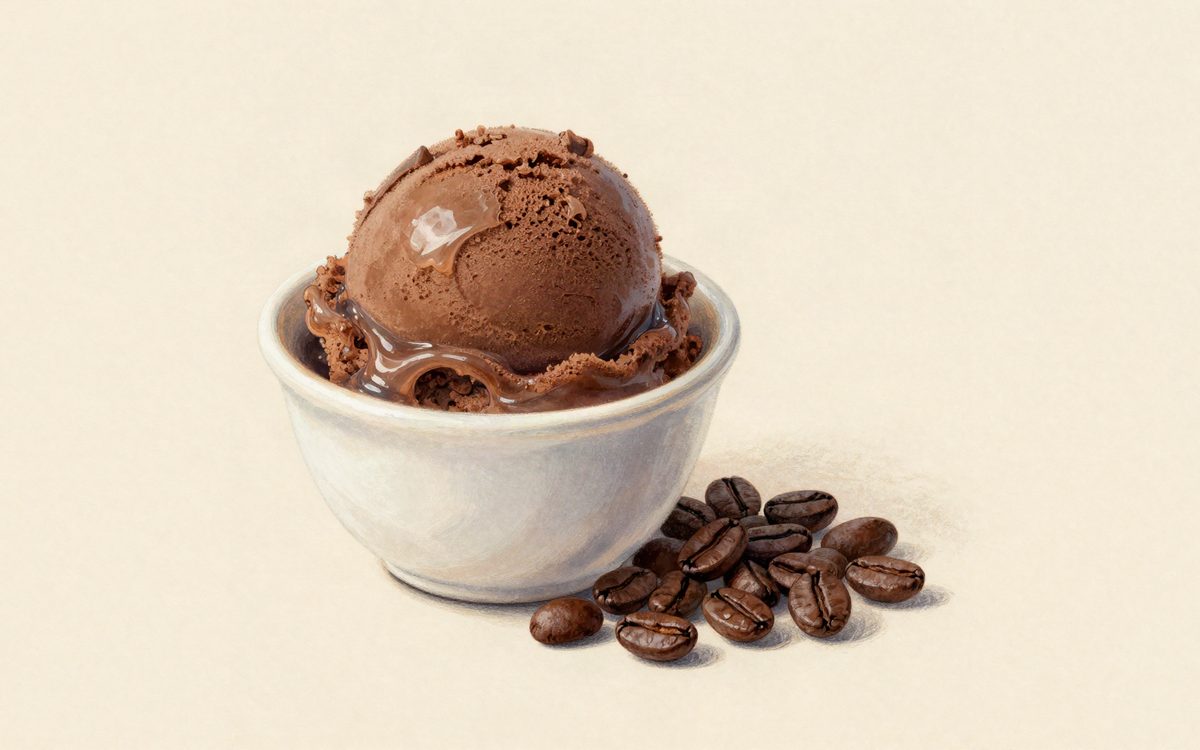
Nothing in the brew helps you structurally. It arrives at around 10% solids, with no sugar, no fat and none of the pectin or acid a fruit would hand over, so the tempting move is to use less of it and make up the difference with water. What comes out of that is thin, sweet and only faintly of coffee, and it sets hard in the tub. Here the espresso is held at 520 g per kilo and everything else is built around it: sucrose, dextrose, glucose syrup DE42 and inverted sugar split the sweetening so PAC can reach 328 without POD running away, which is what keeps it scoopable and tasting roasted rather than sugary.
Which is why four sugars appear here instead of one or two: 100 g/kg of sucrose, 70 g/kg of dextrose, 80 g/kg of glucose syrup DE42 and 30 g/kg of inverted sugar, 280 g/kg of sugar ingredients in total. Three of the four sweeten less than they freeze, which is how PAC reaches 328.45 inside a 280 to 340 band while POD stays at 209.3, near the bottom of a 200 to 270 band.
The coffee dose was fixed at 520 g/kg on purpose rather than left as a free variable. A solver optimizing for the bands would have cut it to the minimum and topped the mix up with water, and the output would have been sweetened water that smelled of coffee. Home recipes run around two parts strong coffee to one of water and one of sugar, which is the same order of magnitude.
The hard constraints of this base are worth naming. MSNF has to be exactly zero, so no dairy of any kind can enter, and protein is capped at 1%. The mix finishes at 0.36%.
Ingredients
Makes 1000 g of finished base.
| Ingredient | Grams | Home measure |
|---|---|---|
| Espresso (Rich) | 520 | |
| Water | 188 | 3/4 cup plus 1 tablespoon |
| Sugar (Sucrose) | 100 | 1/2 cup |
| Glucose Syrup DE42 | 80 | 4 tablespoons |
| Dextrose (Glucose) | 70 | 1/3 cup plus 1 tablespoon |
| Inverted Sugar | 30 | 1 1/2 tablespoons |
| Instant Coffee | 6 | |
| Carob Seed Flour | 5 | |
| Salt | 1 |
Loads these exact grams into the free balancer, ready to edit.
Method
Shallow tray, syrup chilled before the coffee, three blender passes
- 1Whisk every dry ingredient together first: sugars, milk powder, stabiliser and salt. Dry-blending them stops the stabiliser clumping when it meets liquid.
- 2Warm the liquids to 40 C (104 F), then rain the dry mix in while whisking hard.
- 3Heat to 82 C (180 F) and hold for 2 minutes so the stabiliser hydrates.
- 4Chill in an ice bath to under 5 C (41 F) within 2 hours. Slow cooling is where bacteria and coarse crystals both start.
- 5Age 6 to 12 hours in the fridge under 5 C (41 F). This is when the stabiliser and the milk protein take up water.
- 6Freeze in a shallow metal pan 2 to 3 cm deep, breaking the crystals with a fork every 30 to 40 minutes, 4 to 6 times.
- 7Freeze firm, then temper 10 to 15 minutes in the fridge before scooping.
The balance
All six against the professional range for Sorbetto.
Sorbet without fruit is sorbet without a safety net, and two numbers show where the net was rebuilt. Sugars at 25.13% sit just above the floor of the 25 to 31% band, and they are there for taste as much as for texture: with no fat and no milk protein, nothing is masking the chlorogenic acids and tannins in the coffee, and bitterness reads harder when the product is frozen. Under-sugaring a coffee sorbet does not make it more elegant, it makes it acrid. The second number is PAC 328.45, a deliberately soft setting inside 280 to 340, and it exists because total solids are only 31.19% with water at 68.81%. A mix that watery, frozen hard, scrapes rather than scoops. The 5 g/kg of carob seed flour is above the dose used in the milk bases in this collection, and that is not an accident either: with MSNF at exactly zero there is no milk protein holding free water, so the gum is the only structure in the formula.
Estimated nutrition: ~126 kcal · Fat 0.2 g · Sugars 25.1 g · Protein 0.4 g (per 100 g of mix, from the balanced composition).
Build the syrup first: heat the water, all four sugars and the carob seed flour to 85 C so the gum hydrates properly, then chill it completely. The coffee joins a cold syrup and is never boiled. Extract it cold or at moderate temperature to keep the bitterness down, because in a mix with 0.22% fat there is nothing for harshness to hide behind. Maturation here is short, 4 to 6 hours, which is the opposite of the usual advice: coffee aroma in a water phase is volatile and degrades, so a long rest costs more flavor than it buys texture. One honest caveat, since the recipe is published with its reasoning: these bands were drawn for fruit sorbets, and an infusion sorbet is a different animal, so treat this as a formula worth a bench test rather than a settled one.
If it goes wrong
The coffee was boiled, or it was combined with the syrup while the syrup was still hot.
Chill the 85 C syrup completely before the coffee goes in, and extract the coffee cold or at moderate temperature.
Sugar was cut. At 31.19% solids and 68.81% water, PAC 328.45 is the only thing keeping it workable.
Keep all four sugars at their stated weights. The 80 g/kg of glucose syrup DE42 and 30 g/kg of inverted sugar are there specifically to raise PAC more than they raise POD.
The mix sat too long. Coffee aroma in a water phase with no fat to hold it degrades quickly.
Mature 4 to 6 hours and no longer, then freeze.
Suitable for: Vegan, Vegetarian, Lactose-free, Egg-free
- https://www.giallozafferano.com/recipes/Coffee-sorbet.html
- https://www.recipesfromitaly.com/coffee-sorbet-recipe/
- https://www.gaggia.com/coffee-sorbet/
- https://www.saveur.com/article/Recipes/David-Lebovitzs-Mocha-Sherbet
- The science behind it: Brix vs Total Solids in Sorbet
- Ingredient sheet: Espresso (Rich)
Want to change an ingredient and watch the numbers move? Open the free balancer