Coffee Gelato
Roast bitterness arrives first, milk rounds it off a beat later, and what stays is the toasted, faintly smoky end of the cup instead of sweetness.
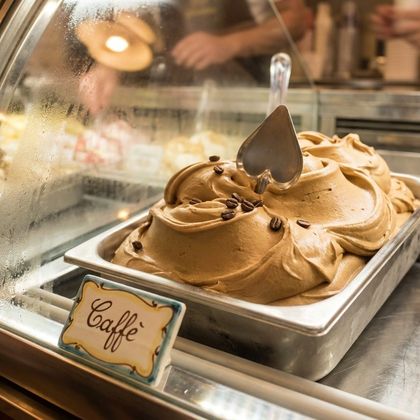
Two purchases decide this page, and the second is the one people get wrong. Beans should be bought as beans, roasted within the month and ground at the moment of brewing, because the aromatics that survive freezing are exactly the ones that fade on a shelf. The soluble is the other half: read the jar for freeze-dried rather than spray-dried, and for coffee and nothing else, no chicory, no fig, no added sugar, since whatever is in there turns up at 96.5 percent solids. That division is why the brewed dose stops at 90 g per kilo, where the water it carries still fits the sheet, and the concentration the cup cannot give arrives as 6 g of powder.
So the dose is split. 90 g/kg of espresso, roughly three ristretti per kilo, carries the brewed character, and 6 g/kg of instant coffee at 96.5% solids supplies intensity without water. Total solids finish at 37.49%, comfortably inside the band, which would not have happened at the same flavor strength using liquid coffee alone.
Rebuilding what the coffee diluted is what the rest of the formula is doing. 180 g/kg of cream puts fat at 8.12% inside a 6 to 12 band, and 45 g/kg of skim milk powder brings MSNF back up to 9.71%. The 1 g/kg of salt is not seasoning: at that level it suppresses bitterness perception and lets the roast come forward instead.
Protein lands at 3.72%, low in the 3 to 5 band, and that is a direct consequence of building body with cream rather than with more powder. Cream brings fat, not protein, which is exactly what this mix needed.
Ingredients
Makes 1000 g of finished base.
| Ingredient | Grams | Home measure |
|---|---|---|
| Whole Milk | 494 | 2 cups |
| Heavy Cream 35% | 180 | 3/4 cup |
| Sugar (Sucrose) | 155 | 3/4 cup plus 1 tablespoon |
| Espresso (Rich) | 90 | |
| Skim Milk Powder | 45 | 1/3 cup plus 2 tablespoons |
| Dextrose (Glucose) | 25 | 2 tablespoons |
| Instant Coffee | 6 | |
| Carob Seed Flour | 4 | |
| Salt | 1 |
Loads these exact grams into the free balancer, ready to edit.
Method
Shallow tray, coffee added below 45 C, two blender passes
- 1Whisk every dry ingredient together first: sugars, milk powder, stabiliser and salt. Dry-blending them stops the stabiliser clumping when it meets liquid.
- 2Warm the liquids to 40 C (104 F), then rain the dry mix in while whisking hard.
- 3Heat to 82 C (180 F) and hold for 2 minutes so the stabiliser hydrates.
- 4Chill in an ice bath to under 5 C (41 F) within 2 hours. Slow cooling is where bacteria and coarse crystals both start.
- 5Age 6 to 12 hours in the fridge under 5 C (41 F). This is when the stabiliser and the milk protein take up water.
- 6Freeze in a shallow metal pan 2 to 3 cm deep, breaking the crystals with a fork every 30 to 40 minutes, 4 to 6 times.
- 7Freeze firm, then temper 10 to 15 minutes in the fridge before scooping.
The balance
All six against the professional range for Milk Gelato.
The sugar split tells you what the recipe is compensating for. 155 g/kg of sucrose against 25 g/kg of dextrose gives POD 180.39, high in the 140 to 200 band, while PAC stops at 258.73, mid range in 220 to 300. Coffee is bitter and bitterness reads harsher at freezer temperature, so the mix is deliberately sweetness-leaning rather than texture-leaning. Dextrose depresses the freezing point about 1.9 times more than sucrose per gram while sweetening less, which is why a small dextrose share is enough to finish PAC without pushing POD past 200. On the other side, lactose sits at 8.47% of the water phase, and that is the number that stopped the milk powder at 45 g/kg. MSNF at 9.71% could legally climb toward 11.5%, but the water phase would start crystallizing lactose in storage before it got there, so the extra body came from 180 g/kg of cream instead, which is also why fat sits at 8.12% rather than somewhere leaner.
Estimated nutrition: ~191 kcal · Fat 8.1 g · Sugars 17.8 g · Protein 3.7 g (per 100 g of mix, from the balanced composition).
Coffee carries chlorogenic acids and tannins that flocculate casein, so the coffee goes in after the heat. Pasteurize milk, sugars and powders at 82 to 85 C, cool the base below 45 C, then stir in the espresso and the instant coffee. Coffee added to a boiling base curdles it: denatured protein plus a drop in pH is exactly the wrong combination. Do not bring the coffee itself to a boil either. Past 90 C it extracts a burnt bitterness that never goes away and that no amount of sugar covers. Mature 6 to 12 hours at 4 C, which hydrates the carob seed flour and rounds off the bitterness at the same time.
If it goes wrong
The mix was too hot. Chlorogenic acids drop the pH into a range where already denatured casein flocculates.
Cool the pasteurized base below 45 C before the 90 g/kg of espresso and the 6 g/kg of instant coffee go in.
The coffee was taken past 90 C at some stage, which extracts a scorched bitterness.
Add the coffee off the heat and keep the 1 g/kg of salt in the formula. It is there to suppress bitterness perception, not to season.
Liquid coffee was used to replace the instant. Espresso is 90% water, so scaling it up dilutes the solids that keep the mix smooth.
Keep the split at 90 g/kg espresso plus 6 g/kg instant. The instant is 96.5% solids and is how the flavor gets stronger while total solids stay at 37.49%.
Suitable for: Vegetarian, Egg-free
Allergens: milk
- https://carpigiani.com/en/news/coffee-gelato
- https://www.recipesfromitaly.com/coffee-gelato-recipe/
- https://foodnouveau.com/coffee-gelato/
- https://kaldi.com/blogs/post/the-ultimate-scoop-making-coffee-gelato-with-kaldis-espresso-blend
- The science behind it: Gelato Total Solids
- Ingredient sheet: Espresso (Rich)
- The story of this recipe: Coffee Gelato Without a Machine (Espresso-Strength Base)
Want to change an ingredient and watch the numbers move? Open the free balancer