Cocoa Powder Chocolate Gelato
Bitterness up front with none of the roundness a bar would bring, dry and dark through the middle, and a cocoa finish that hangs on after the cold has gone.
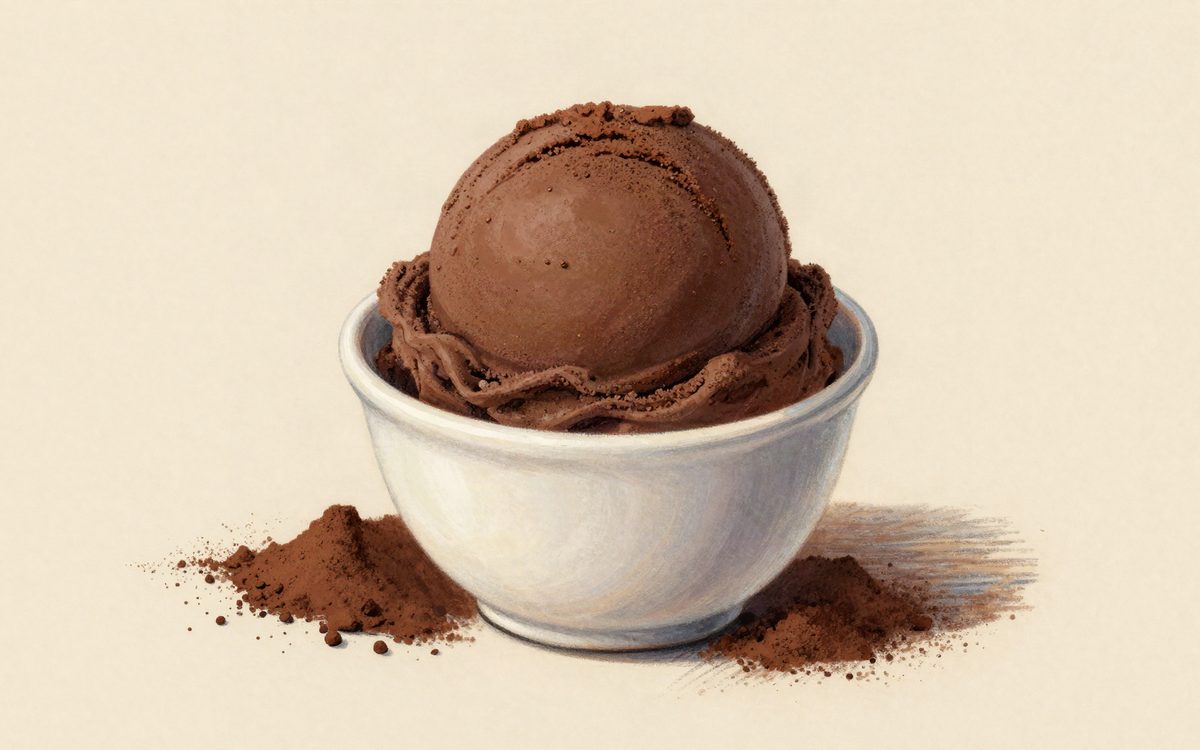
Everything rides on one purchase here, because there is no couverture in the formula to cover for a weak powder. Fat is the first thing to read: a 22 to 24 percent cocoa still has its butter, and with no bar in the mix that butter does real work on the tongue instead of sitting in the background. Alkalisation is the second, trading some of the sharp acidic edge for depth of colour and a longer, rounder finish. A cheap low-fat tin gives colour and little else, and at 75 g/kg that arrives as dust rather than chocolate. Buy properly and the same dose, with 65 g of cream behind it, comes out dark, clean and coating.
The cocoa dose is 75 g/kg, roughly double what a formula uses when a bar is carrying part of the flavor load. Cocoa is now the only source of chocolate in the mix, so it has to work alone, and this lands close to the classic cioccolato all'acqua dose transplanted onto a dairy base.
The ceiling on that dose is protein, not flavor. The mix finishes at 4.67% against a 5% limit, because three ingredients push it at once: whole milk, the 24 g/kg of skim milk powder, and the cocoa itself. That is why the milk powder line is so short. Per gram, milk powder is the heaviest protein contributor in the formula at around 36%, and there is only about a third of a percent of headroom left to spend.
Total solids land at 38.03%, the lower half of the 36 to 42 band, and sugars at 17.21%. Cocoa powder brings no sugar at all, so the entire 17.21% is added: 130 g/kg of sucrose plus 45 g/kg of dextrose, with nothing arriving for free.
Ingredients
Makes 1000 g of finished base.
| Ingredient | Grams | Home measure |
|---|---|---|
| Whole Milk | 656 | 2 3/4 cups |
| Sugar (Sucrose) | 130 | 2/3 cup |
| Cocoa Powder 22-24% | 75 | |
| Heavy Cream 35% | 65 | 1/4 cup |
| Dextrose (Glucose) | 45 | 1/4 cup |
| Non-Fat Dry Milk | 24 | 1/4 cup |
| Stabilizer (Neutral) | 4 | |
| Salt | 1 |
Loads these exact grams into the free balancer, ready to edit.
Method
Shallow tray after a full 85 C cook, two blender passes
- 1Whisk every dry ingredient together first: sugars, milk powder, stabiliser and salt. Dry-blending them stops the stabiliser clumping when it meets liquid.
- 2Warm the liquids to 40 C (104 F), then rain the dry mix in while whisking hard.
- 3Heat to 82 C (180 F) and hold for 2 minutes so the stabiliser hydrates.
- 4Chill in an ice bath to under 5 C (41 F) within 2 hours. Slow cooling is where bacteria and coarse crystals both start.
- 5Age 6 to 12 hours in the fridge under 5 C (41 F). This is when the stabiliser and the milk protein take up water.
- 6Freeze in a shallow metal pan 2 to 3 cm deep, breaking the crystals with a fork every 30 to 40 minutes, 4 to 6 times.
- 7Freeze firm, then temper 10 to 15 minutes in the fridge before scooping.
The balance
All six against the professional range for Milk Gelato.
The number that decides this recipe is not on the indicator list at all. It is the roughly 11% starch inside cocoa powder. That starch gelatinizes between 65 and 75 C, and in a mix with no cocoa butter it is what gives the gelato its body, which makes the pasteurization non negotiable: hold 85 C for 25 seconds or the starch never sets and the base stays thin and gritty no matter how good the other numbers look. The rest of the indicators back that up. Fat is only 6.32% in a band that allows up to 12%, which would be lean for a chocolate gelato if starch were not doing part of the structural work, and total solids at 38.03% are high enough to keep the mix from freezing hard at that fat level. PAC finishes at 261.33, mid range in 220 to 300, split between 130 g/kg of sucrose and 45 g/kg of dextrose. Lactose at 7.53% of the water phase leaves room that milk powder could not have used anyway, because protein reached its own limit first at 4.67%.
Estimated nutrition: ~184 kcal · Fat 6.3 g · Sugars 17.2 g · Protein 4.7 g (per 100 g of mix, from the balanced composition).
Cocoa powder is not inert and it does not behave like a pigment. Whisk the 75 g/kg of cocoa together with the sugars and the milk powder while everything is dry, then hydrate. Cocoa dropped into liquid on its own forms coated lumps that a stick blender will not open. Use alkalized (dutched) cocoa rather than natural: dutched sits around pH 7.0 to 7.5 against 5.3 to 5.8 for natural, which cuts astringency and removes any risk of the acid flocculating the milk protein. Natural cocoa in a dairy base can curdle. Take the mix to 85 C and hold there, chill fast, then mature 12 hours at 4 C so the starch finishes hydrating. A short maturation here shows up directly as thin mouthfeel.
If it goes wrong
The mix never got hot enough for long enough. The starch in the cocoa gelatinizes between 65 and 75 C and it is standing in for the cocoa butter a bar would have brought.
Hold the base at 85 C for 25 seconds, then mature a full 12 hours at 4 C before churning.
The cocoa went into liquid by itself and formed coated clumps.
Whisk the cocoa, the 130 g/kg of sucrose, the 45 g/kg of dextrose and the milk powder together dry, then hydrate the dry blend.
Natural cocoa instead of alkalized. Natural sits at pH 5.3 to 5.8 and can flocculate casein in a milk base.
Switch to dutched cocoa at pH 7.0 to 7.5. The formula was balanced against alkalized 22 to 24% fat cocoa.
Suitable for: Vegetarian, Egg-free
Allergens: milk
- https://www.keylink.org/gelato/cocoa-powder
- https://icecreamcalc.com/2021/03/12/chocolate-gelato/
- https://en.wikipedia.org/wiki/Cocoa_powder
- The science behind it: Cocoa Powder in Gelato
- Ingredient sheet: Cocoa Powder 22/24
Want to change an ingredient and watch the numbers move? Open the free balancer