Cinnamon Gelato
Warm spice blooms slowly through a rich dairy base, sweet at the front, faintly woody at the back, and it sits on the palate long after the cold has gone.
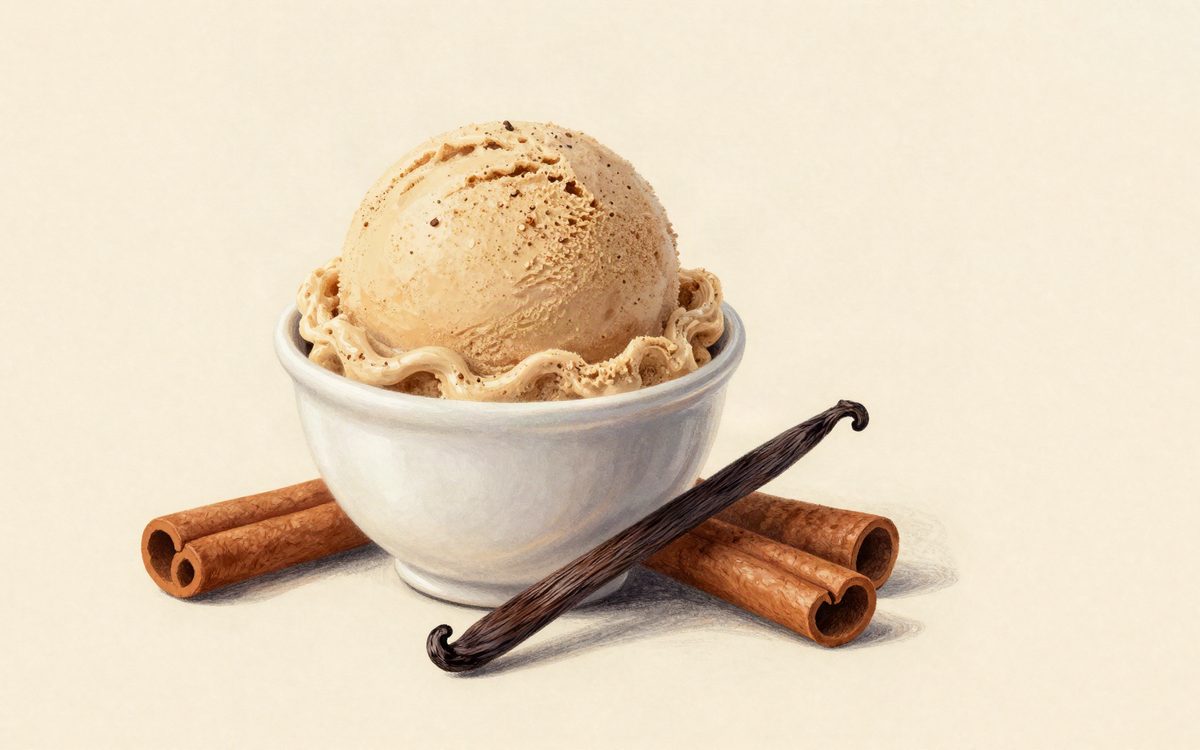
Buy this one by smell, not by price. Freshly milled powder still comes through the bag sweet and resinous, while stock that has sat open reads dusty, and no extra dose will fix that, because what went missing is volatile and does not come back. Fineness of grind matters just as much, since the spice never dissolves. It stays dispersed in the mix and will settle during maturation, which is why 4 g of carob seed flour sits in the formula holding it up, and why a coarse grind ends as grit at the bottom of the tub. At 8 g/kg the flavour dominates without tipping into the tannic, astringent bitterness that shows up past 12 g/kg.
8 g/kg is where ground cinnamon becomes the flavor of the gelato instead of a background note. Below 6 g/kg it reads as vaguely spiced cream. Above 12 g/kg the tannins take over and the finish goes dry and astringent, which cold only makes worse. The 3 g/kg of vanilla extract is not there as a flavor of its own: it rounds off the sharp top of the cinnamaldehyde so the spice arrives as warmth rather than as a spike.
Since the spice contributes nothing to the freezing curve, everything structural comes from elsewhere and the numbers show it. 160 g/kg of cream and 47 g/kg of skim milk powder put fat at 7.75% and MSNF at 10.72%, in the top third of the 8 to 11.5 band. That is a heavy dairy load, and it is deliberate: fat and milk solids are what carry a spice that brings no sugar and no water of its own.
POD lands at 182.77, high in the 140 to 200 range. Cinnamon reads as sweet without being sweet, and a base that tasted flat underneath it would make the spice feel harsh, so 160 g/kg of sucrose was chosen over a larger dextrose share.
Ingredients
Makes 1000 g of finished base.
| Ingredient | Grams | Home measure |
|---|---|---|
| Whole Milk | 597 | 2 1/2 cups |
| Heavy Cream 35% | 160 | 2/3 cup |
| Sugar (Sucrose) | 160 | 3/4 cup plus 1 tablespoon |
| Skim Milk Powder | 47 | 1/2 cup |
| Dextrose (Glucose) | 20 | 1 1/2 tablespoons |
| Cinnamon Powder | 8 | |
| Carob Seed Flour | 4 | |
| Vanilla Extract | 3 | |
| Salt | 1 |
Loads these exact grams into the free balancer, ready to edit.
Method
Shallow tray, cinnamon steeped cold, two blender passes
- 1Whisk every dry ingredient together first: sugars, milk powder, stabiliser and salt. Dry-blending them stops the stabiliser clumping when it meets liquid.
- 2Warm the liquids to 40 C (104 F), then rain the dry mix in while whisking hard.
- 3Heat to 82 C (180 F) and hold for 2 minutes so the stabiliser hydrates.
- 4Chill in an ice bath to under 5 C (41 F) within 2 hours. Slow cooling is where bacteria and coarse crystals both start.
- 5Age 6 to 12 hours in the fridge under 5 C (41 F). This is when the stabiliser and the milk protein take up water.
- 6Freeze in a shallow metal pan 2 to 3 cm deep, breaking the crystals with a fork every 30 to 40 minutes, 4 to 6 times.
- 7Freeze firm, then temper 10 to 15 minutes in the fridge before scooping.
The balance
All six against the professional range for Milk Gelato.
Look at how the sugar work is split. 160 g/kg of sucrose against only 20 g/kg of dextrose gives POD 182.77, high in the 140 to 200 band, while PAC settles at 259.39, mid range in 220 to 300. That is a sweetness-forward setting, and it is the right one for a spice with a POD of 2.0: cinnamon adds perceived warmth but no actual sweetness, and an under-sweetened cinnamon base tastes bitter rather than mild. The constraint on the other side is lactose, which sits at 9.35% of the water phase, the tightest margin in this formula. That is what caps skim milk powder at 47 g/kg even though MSNF at 10.72% still has room to 11.5%: going further would trade a marginally firmer body for sandiness in week two. The 4 g/kg of carob seed flour is doing a second job that it does not do in most recipes, which is keeping the cinnamon in suspension. The powder never dissolves, and in an unstabilized mix it sinks during maturation.
Estimated nutrition: ~189 kcal · Fat 7.8 g · Sugars 17.9 g · Protein 4 g (per 100 g of mix, from the balanced composition).
Cinnamaldehyde is volatile and leaves with the steam. Pasteurize the base at 85 C without the cinnamon, chill to 4 C, and only then stir the sieved powder in, letting it extract across a 4 to 12 hour maturation. Mix the 8 g/kg of powder dry with a handful of the sucrose before it touches liquid, otherwise it forms lumps that survive the blender. Use Ceylon cinnamon rather than cassia where you can: cassia carries more coumarin and a heavier tannin load, and tannin plus cold equals a dry mouth. The mix will look beige and the spice settles whenever agitation stops, so keep it moving right up to the moment it freezes.
If it goes wrong
The cinnamon clumped. Dropped straight into liquid it forms coated lumps that never open up.
Blend the 8 g/kg of powder with part of the 160 g/kg of sucrose while both are dry, then stir that mixture into the cold base.
The cinnamon went through the 85 C pasteurization and the cinnamaldehyde evaporated.
Pasteurize the base plain, chill to 4 C, add the cinnamon afterwards and let the 4 to 12 hour maturation do the extraction.
Either the dose went past roughly 12 g/kg, or the cinnamon is cassia rather than Ceylon and is carrying more tannin.
Stay at 8 g/kg and switch to Ceylon. Do not correct it with more sugar: POD is already set high at 182.77 for exactly this reason.
Suitable for: Vegetarian, Egg-free
Allergens: milk
No ingredient in this recipe contains gluten.
- http://acasadibb.blogspot.com/2012/06/gelato-alla-cannella.html
- https://www.buonissimo.it/lericette/5531_Gelato_alla_cannella
- https://www.ilclubdellericette.it/ricetta/gelato-alla-cannella
- The science behind it: Spice Infusion in Gelato
- Ingredient sheet: Cinnamon Powder
Want to change an ingredient and watch the numbers move? Open the free balancer