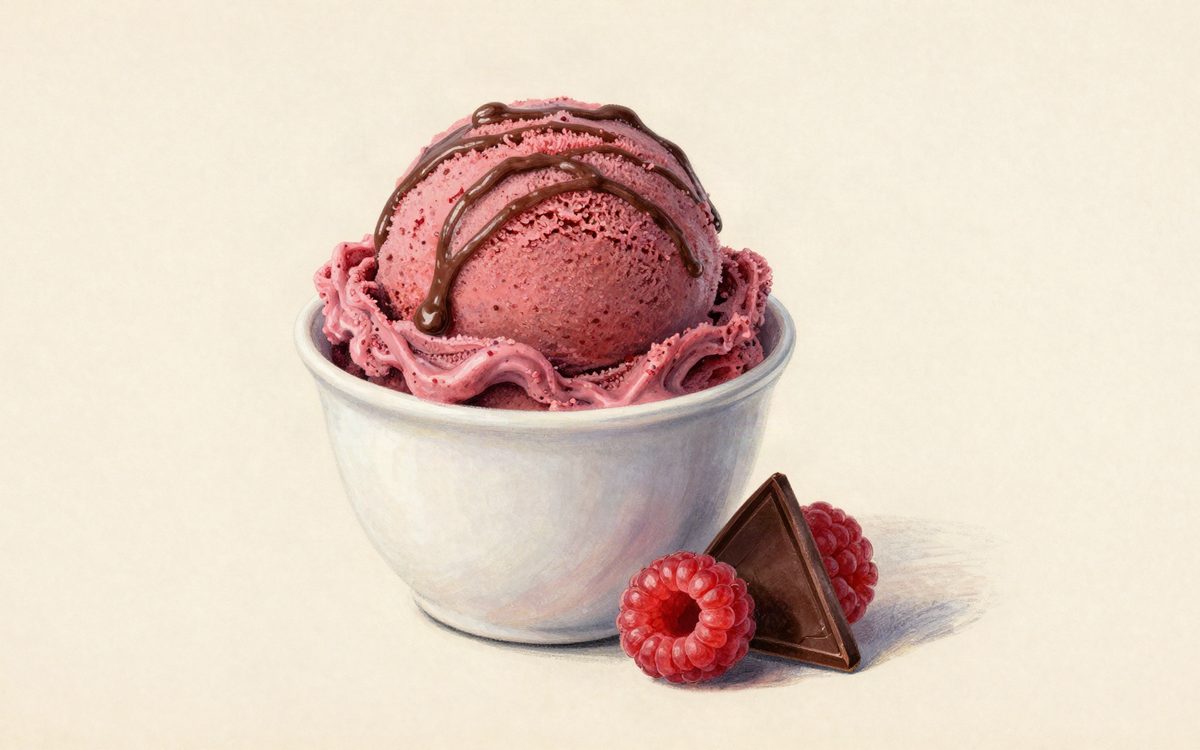
Chocolate Raspberry Gelato
Tannin sits dark and low across the tongue while a sharp fruit acid cuts over the top, and the cold keeps both of them tight instead of syrupy.
Quality here is decided in the shop, before a gram of anything is weighed. A 70 percent bar should list cocoa mass, cocoa butter and sugar, with nothing standing in for the cocoa butter, because 85 g of that bar brings roughly 32 g of cocoa fat per kilo that the balance is counting on. The powder should say alkalised at 22 to 24 percent fat, which is what carries colour and roast at only 18 g without adding sugar. Frozen fruit should be fruit and nothing else, since syrup would turn up as sweetness exactly where the sheet wants acid. Get those three right and the 140 g of raspberry does its job, holding sharpness against the tannin.
That 14% is what moves this recipe onto the fruit milk base instead of the plain milk base, and the bands change with it. Fat is allowed 3.5 to 8% for a milk gelato with fruit, against the 6 to 12% of a plain milk gelato, and the mix lands at 6.25%. Almost all of it is cocoa butter and whole milk fat, which is why the cream line reads only 15 g/kg. There is no room for more, and more would coat the tongue and mute exactly the acidity the recipe was built around.
Sugars finish at 17.92% against a floor of 17%, a tight place to sit. Raspberry brings almost no sugar of its own at this dose, so 110 g/kg of sucrose and 40 g/kg of dextrose are doing all of it. Protein lands at 4.08% with a 4.5% ceiling, because it arrives from three places at once: whole milk, 30 g/kg of skim milk powder, and the cocoa solids themselves.
Ingredients
Makes 1000 g of finished base.
| Ingredient | Grams | Home measure |
|---|---|---|
| Whole Milk | 559 | 2 1/3 cups |
| Raspberry | 140 | |
| Sugar (Sucrose) | 110 | 1/2 cup plus 1 tablespoon |
| Dark Chocolate 70% | 85 | |
| Dextrose (Glucose) | 40 | 3 1/2 tablespoons |
| Non-Fat Dry Milk | 30 | 1/4 cup plus 1 tablespoon |
| Cocoa Powder 22-24% | 18 | |
| Heavy Cream 35% | 15 | 1 tablespoon |
| Stabilizer (Neutral) | 3 |
Loads these exact grams into the free balancer, ready to edit.
Method
Shallow tray, cold fruit fold, two blender passes
- 1Whisk every dry ingredient together first: sugars, milk powder, stabiliser and salt. Dry-blending them stops the stabiliser clumping when it meets liquid.
- 2Warm the liquids to 40 C (104 F), then rain the dry mix in while whisking hard.
- 3Heat to 82 C (180 F) and hold for 2 minutes so the stabiliser hydrates.
- 4Melt the chocolate to 45 C (113 F) and stir it into the hot base off the heat, then blend 60 seconds until glossy.
- 5Chill in an ice bath to under 5 C (41 F) within 2 hours. Slow cooling is where bacteria and coarse crystals both start.
- 6Age 6 to 12 hours in the fridge under 5 C (41 F). This is when the stabiliser and the milk protein take up water.
- 7Fold the fruit in cold, after ageing. Heating it costs you the fresh aroma and nothing is gained.
- 8Freeze in a shallow metal pan 2 to 3 cm deep, breaking the crystals with a fork every 30 to 40 minutes, 4 to 6 times.
- 9Freeze firm, then temper 10 to 15 minutes in the fridge before scooping.
The balance
All six against the professional range for Milk Gelato with Fruit.
PAC lands at 261.28, low in the 240 to 310 range for a milk gelato with fruit, and that number carries more weight here than in a plain milk gelato. The water that comes with the fruit, roughly 120 g per kilo of mix at 86% water in raspberry, is free water: it has no milk solids bound to it, so it freezes first and freezes hard. The 40 g/kg of dextrose exists to hold the freezing point down without paying for it in sweetness, which is why POD stops at 176.89 instead of climbing with the sugar load. Total solids at 37.57% sit in the upper half of the 32 to 40 band and need to, given how much water the fruit contributes. Lactose is at 6.98% of the water phase, well under the point where it starts turning sandy in storage, and that headroom is what allowed 30 g/kg of milk powder to be spent rebuilding the MSNF the fruit diluted, landing it at 7.99% inside the 5 to 9.5 window.
Estimated nutrition: ~182 kcal · Fat 6.3 g · Sugars 17.9 g · Protein 4.1 g (per 100 g of mix, from the balanced composition).
Raspberry sits near pH 3.2 to 3.5 and casein precipitates around pH 4.6, so the fruit never touches the hot mix. Pasteurize milk, sugars, milk powder and cocoa powder at 82 to 85 C, take the pot off the heat, melt the chopped chocolate in and emulsify with a stick blender, then chill fast to 4 C and mature 6 to 12 hours. Disperse the 18 g/kg of cocoa powder dry with part of the sucrose before it meets any liquid, or it will clump and stay clumped. The raspberry goes in cold, blended and sieved, immediately before freezing. Serve at -12 C: colder than that and the acid goes numb while the cocoa bitterness stays, which is the worst version of this flavor.
If it goes wrong
The mix was still warm, or the raspberry was added during pasteurization. At pH 3.2 to 3.5 the fruit drags the mix through the isoelectric point of casein at 4.6.
Chill the base to 4 C and mature it first, then fold in cold sieved raspberry right before churning.
Cocoa tannin from the 70% chocolate and the 18 g/kg of cocoa powder stacking on top of fruit acid.
Raise dextrose, not sucrose. Dextrose softens the finish without lifting frontal sweetness, and PAC has room from 261.28 up toward the 310 ceiling.
Fruit water with nothing binding it. Only 3 g/kg of stabilizer is holding the water the raspberry brought in.
Keep the fruit at 140 g/kg rather than increasing it, freeze fast, and store at -14 C instead of at serving temperature.
Suitable for: Vegetarian, Egg-free
Allergens: milk
- https://www.icecreamscience.com/blog/chocolate-ice-cream-recipe
- https://www.dairyfoods.com/articles/90396-working-with-cocoa-in-ice-cream
- https://www.recipesfromitaly.com/chocolate-gelato-recipe/
- https://www.dreamscoops.com/ice-cream-science/ice-cream-calculator/
- The science behind it: Why Acidic Fruit Curdles Dairy Gelato, and How to Stop It
- Ingredient sheet: Raspberry
Want to change an ingredient and watch the numbers move? Open the free balancer