Chocolate Peanut Butter Gelato
Roast and salt land first, chocolate closes in behind, and the body is thick without being rich, holding the nut on the tongue after the cold has gone.
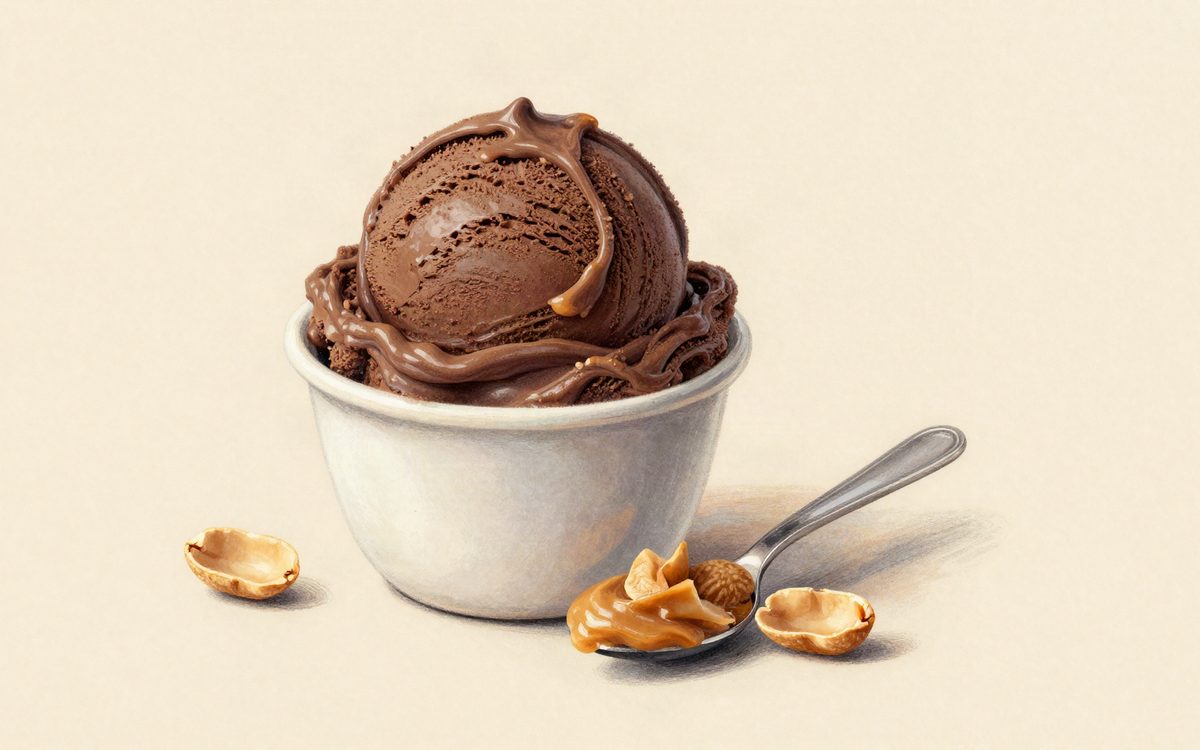
Buying decides this one long before the machine does. Two jars can both say peanut butter: one lists peanuts, salt and sugar, the other adds hardened fat and stabilisers, and the second drags a flat, waxy coating into a base already carrying cocoa. Check the protein figure too, because it sets the dose. A 100 percent paste runs about 24.4 percent protein, a sweetened butter around 16, and stacked on the dairy protein already in the mix, the higher one breaks the 5 percent ceiling at any honest quantity. The sweetened kind goes in at 75 g per kilo, enough that the nut actually shows up against 70 percent chocolate.
The 100% paste was tested at 58 g per kilo. It closed with 0.03 of a point of protein margin, which is technically approved and impossible to defend in practice, because real peanut protein swings between 16 and 25% depending on the lot and a different sack would fail the same recipe.
The fix was to switch to the sweetened paste at 16% protein instead of 24.4%, which is literally what peanut butter is. That freed the dose up to 75 g per kilo, a dose you can actually taste, with margin to spare. The 37.2% sugar it carries is deducted from the free sucrose, which is why sucrose sits at 90 g rather than higher.
Even after all that, this is the tightest recipe of the six on milk solids: MSNF finishes at 8.31% against a floor of 8, and skim milk powder is held to 21 g with cream at just 15 g, because there was no room to add milk solids without pushing protein over.
Ingredients
Makes 1000 g of finished base.
| Ingredient | Grams | Home measure |
|---|---|---|
| Whole Milk | 693 | 3 cups |
| Sugar (Sucrose) | 90 | 1/3 cup plus 2 tablespoons |
| Peanut Paste (sweetened) | 75 | |
| Dark Chocolate 70% | 50 | |
| Dextrose (Glucose) | 40 | 3 1/2 tablespoons |
| Skim Milk Powder | 21 | 3 1/2 tablespoons |
| Heavy Cream 35% | 15 | 1 tablespoon |
| Cocoa Paste | 10 | |
| Carob Seed Flour | 4 | |
| Salt | 2 |
Loads these exact grams into the free balancer, ready to edit.
Method
Stick-blend the paste in at 65 C, then still-freeze
- 1Whisk every dry ingredient together first: sugars, milk powder, stabiliser and salt. Dry-blending them stops the stabiliser clumping when it meets liquid.
- 2Warm the liquids to 40 C (104 F), then rain the dry mix in while whisking hard.
- 3Heat to 82 C (180 F) and hold for 2 minutes so the stabiliser hydrates.
- 4Melt the chocolate to 45 C (113 F) and stir it into the hot base off the heat, then blend 60 seconds until glossy.
- 5Off the heat, whisk in the paste, then blend 60 seconds so the fat emulsifies instead of separating.
- 6Chill in an ice bath to under 5 C (41 F) within 2 hours. Slow cooling is where bacteria and coarse crystals both start.
- 7Age 6 to 12 hours in the fridge under 5 C (41 F). This is when the stabiliser and the milk protein take up water.
- 8Freeze in a shallow metal pan 2 to 3 cm deep, breaking the crystals with a fork every 30 to 40 minutes, 4 to 6 times.
- 9Freeze firm, then temper 10 to 15 minutes in the fridge before scooping.
The balance
All six against the professional range for Milk Gelato.
Protein at 4.76% is the number that decided everything here. It sits just under the 5% ceiling, and it is the entire reason the sweetened peanut paste at 16% protein replaced the 100% paste at 24.4%. MSNF at 8.31% is the second tight figure, the closest to the 8% floor of any recipe in this group, which is why there are only 21 g of skim milk powder and 15 g of cream: adding milk solids would have pushed protein straight through the ceiling. Everything else was left loose on purpose. Total solids at 37.83% sit in the lower half of 36 to 42 and water at 62.17% in the upper part of 58 to 64, both with room to spare, PAC at 259.06 is the lowest of the group and POD at 165.67 sits just under the middle of 140 to 200, and fat at 7.87% comes mostly from the peanut butter and the 50 g of 70% couverture rather than from dairy.
Estimated nutrition: ~191 kcal · Fat 7.9 g · Sugars 16.9 g · Protein 4.8 g (per 100 g of mix, from the balanced composition).
Commercial peanut butter separates, and most brands stabilize it with hydrogenated fat, which has a high melting point and leaves a waxy feel in the cold. Use a paste with no added fat and blend it into the base with a stick blender at 60 to 65 C, off the heat, never during pasteurization: peanut protein denatures and forms grains above 75 C. Salt goes in at 2 g per kilo, double what the other chocolate recipes in this group use, because unsalted peanut reads flat and salt is what makes it taste like peanut butter rather than raw peanut. One serious operational note: this is a major allergen. Peanut needs its own utensils and its own line, and cross contamination in a gelateria happens at the spatula and the pan, not in the recipe. Label it every time. Mature 12 hours at 4 C so the peanut fat has time to crystallize.
If it goes wrong
The peanut butter was stabilized with hydrogenated fat, which stays solid at serving temperature.
Use a paste with no added fat, even if it separates in the jar. Stir the jar well and weigh 75 g per kilo.
The peanut butter went in during pasteurization. Peanut protein denatures above 75 C.
Add it off the heat at 60 to 65 C and homogenize with a stick blender.
The salt was cut back to the 1 g per kilo the other chocolate recipes use.
Keep the full 2 g per kilo. That is the difference between peanut and peanut butter on the palate.
Suitable for: Vegetarian, Egg-free
Allergens: milk, peanuts
- https://www.dairyscience.info/ice-cream/154-ice-cream-mix.html
- https://mygelato.eu/en/wiki/212/friend-or-foe-master-lactose-in-your-gelato/
- https://www.sciencedirect.com/science/article/pii/S0022030205727521
- https://icecreamcalc.com/knowledge-base/balancing/
- The science behind it: Starch vs Fat Nut Pastes
- Ingredient sheet: Peanut Paste (sweetened)
Want to change an ingredient and watch the numbers move? Open the free balancer